The Tsinghua team has released VeriLoop Coder-E1, an open vertical coding model based on Qwen3.6-27B. This model is designed for repository-level code repair and agent software. The model demonstrated high results across various benchmarks: SWE-bench Verified 85.20, SWE-bench Pro 62.38, Terminal-Bench 2.0 76.40, and DeepSWE 33.63.
Among all open-source models with 32 billion parameters or less, VeriLoop Coder-E1 ranks first in three benchmarks and second in DeepSWE. When compared against all open-source models, it achieved second, first, first, and fifth place, respectively.
The main advantage of this development lies in fine-tuning using the PEFT method in a narrow domain, coordinated via Self-Harness. With the base layer of Qwen3.6-27B frozen, the project enhances adherence to tool contracts, links evidence to inferences, identifies uncertainties, explains validation failures, performs local repair, and controls rollback using only a small number of trainable parameters loaded through a detachable Surface Host adapter.
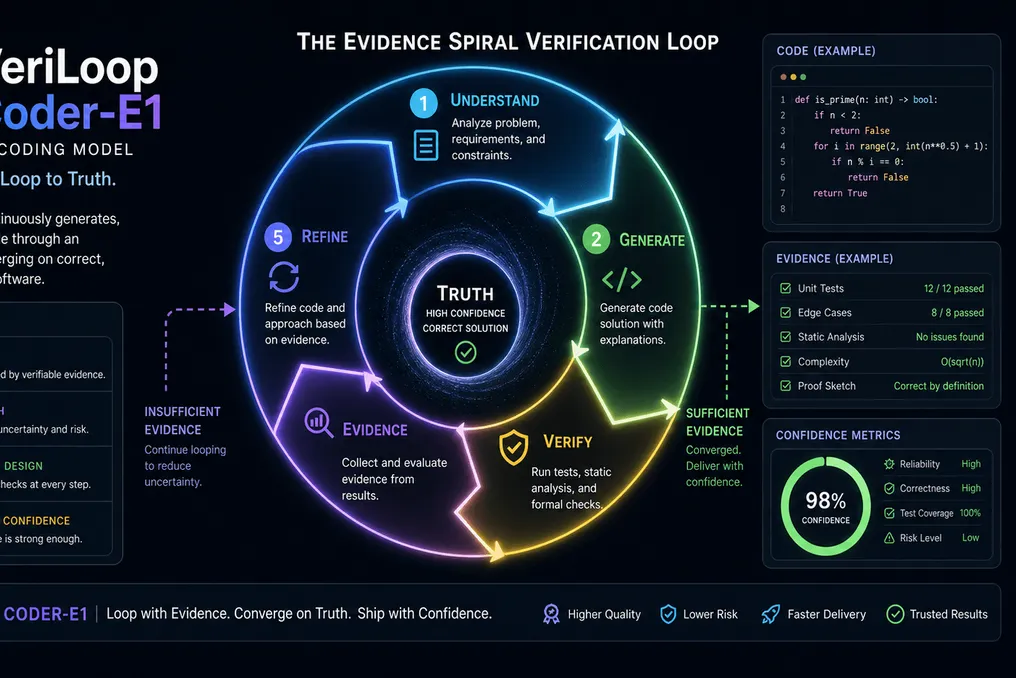
Self-Harness manages multi-round chains: the first round generates candidates based on problem descriptions, repository context, interface constraints, and acceptance criteria. Subsequent rounds recompile the generated code, check error reports, tool logs, interface conflicts, and counter-evidence, packaging them into structured Markdown work packages. This allows the model to fix locally refuted issues by relying on verified results rather than mechanical query repetition.
This cycle represents a closed, evidence-driven loop, not merely trial and error. Each generation round undergoes checking for counter-evidence, exploration, revision, and re-verification; only verified fixes proceed to the next stage. When verified fixes alter how future problems are detected, evidence is defined, and fixes are implemented, the cycle transitions into a 'Evidence-Driven Spiral' mode, following the 'refutation-exploration-repair-verification-internalization' chain.
The team redefines the concept of recursive self-improvement: it is not a system that constantly modifies itself, but methods adjusted by evidence that change the system's approach to error detection, assessment, and correction, remaining falsifiable by new evidence. Drawing on Karl Popper, unfalsifiability is considered a drawback. Passing verification does not imply recursion occurred; the recursive threshold is crossed only when a fix reveals transferable methodological flaws, enters future correction mechanisms, and changes the way unknown errors are detected and assessed. The boundary is intentionally set: the model's assets remain open, while the Self-Harness control stack remains closed.