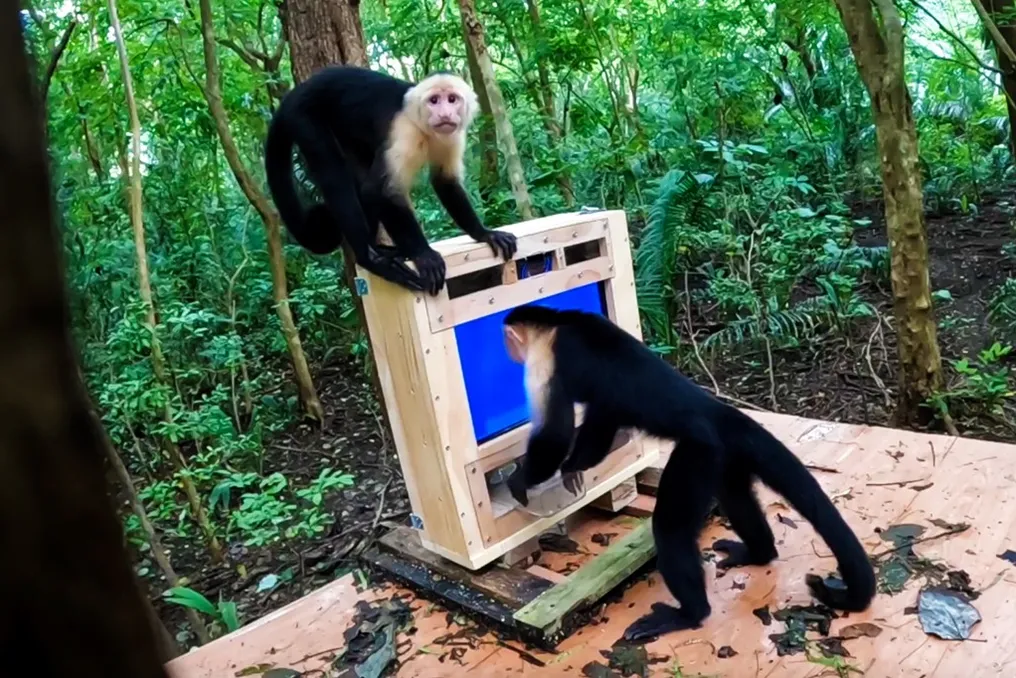
A new technological apparatus, designed to identify monkey faces and present interactive activities, promises to usher in new approaches to investigating the cognitive capacity of these animals.
In the Taboga Forest Reserve, an environmental protection area covering over 500 hectares in the province of Guanacaste, Costa Rica, there resides a notably dense population of Cebus imitator monkeys, known for being highly intelligent capuchins with a distinct pale-toned face.
Last year, in July, one of these primates found an unusual device shining amidst the vegetation. This object consisted of a 15-inch screen framed in robust wood and a transparent container.
Upon approaching, the animal began to poke the device. Touching the screen caused the automatic device to react, releasing a piece of dehydrated banana into the container. The monkey quickly understood how it worked: touching the blue screen resulted in a reward that could be consumed, repeating the cycle.
Unaware of it, the animal was participating in tests for a new artificial intelligence. This machine, named CapuchinAI, was strategically installed by its developers, scientists from Emory University and the Georgia Institute of Technology (USA), aiming to study the cognition of wild capuchins through an innovative method.
From an AI perspective, this equipment differs from platforms like ChatGPT, resembling more a Smart Sampa or the facial readers used in condominium gates. It employs an AI-based facial recognition system capable of distinguishing the face of each monkey, allowing for the individual monitoring of their responses in simple learning exercises.
The methodology was detailed in an article published in the American Journal of Primatology, providing researchers with a model for the first time to systematically analyze the cognitive abilities of monkeys in their natural habitats.
With the prototype in hand, scientists plan to test more advanced versions soon, investigating aspects of these animals' survival that would be unfeasible to address in laboratory settings.
Professor Marcela Benítez, the study's advisor, noted that 'primate brains did not evolve in a laboratory; they evolved in complex and competitive environments.' She added that despite this, primate cognition is rarely studied in nature due to the difficulty of obtaining the necessary experimental control in unpredictable scenarios.
Initially, the team used open-source AI, functional on a simple notebook and focused on object recognition. With the help of photographs of the animals, the system was trained to recognize the faces of six capuchin monkeys, achieving 97% accuracy. This training involved drawing boxes around each animal's face in all available images.
Considering there are hundreds of these animals in the forests of Costa Rica, to optimize the system, it was decided to simplify the algorithm so that it would activate the camera whenever a capuchin monkey was nearby.
In addition to facial recognition, the scientists developed a program to assess the animals' intelligence. Whenever the animal interacted with the blue square displayed on the screen, a reward was dispensed.
All components were assembled in a wooden casing and transported to the Taboga Forest Reserve. The first iteration of the device was tested between July and August 2025. On the third day, the alpha male Papi was the first to examine the object closely. Other monkeys came later, and a large monkey named Trompudo quickly deciphered the puzzle.
Federico Sánchez Vargas, the researcher responsible for the study, reported: 'He climbed onto the box and started tapping the back. Finally, he tapped the touch screen and a slice of banana fell out.' He also commented: 'It was almost as if you could see him realizing, 'Ah, so this is what needs to be done, touch the screen!'; It was incredible to observe an individual learning something so quickly.'
During this period, a total of 16 capuchin monkeys investigated the strange object left in the woods, and ten of them learned the relationship between the touch screen and the tasty reward.
The researchers have already noticed variations among the monkeys. Some understood the mechanism easily, while others needed more time to discover the need to touch the screen. There were monkeys that kissed the screen, and others who sought the reward abruptly, hitting the box or biting the banana dispensing mechanism. Furthermore, there were the more reserved ones, who chose to observe their peers before approaching the object.
Based on the footage of the 16 capuchin monkeys collected in this pilot phase, the researchers are refining the system. In the next phase of experiments, they plan to apply new tasks to explore four broad areas of cognition: learning ability, cognitive flexibility, short-term and long-term memory, and impulse control. For example, in impulse control, the animals would only be rewarded if they touched green squares and ignored the red ones.
The advantage of facial recognition is that each individual will have its own evolution in the tests—the algorithm functions as a progress marker, presenting the appropriate task for each monkey. Moreover, it restricts the amount of food each one can receive, preventing dominant individuals from monopolizing the interaction.
With CapuchinAI, scientists seek to expand research on capuchin monkeys, utilizing the entire accumulated database on these animals in the region over the past decades.
Benítez concluded: 'We can investigate fundamental questions about how environment, individual experiences, and behaviors connect with cognitive abilities.' She continued: 'Why are some individuals better than others at certain tasks? How do different individuals adapt to different situations? How do different cognitive strategies relate to fitness?'