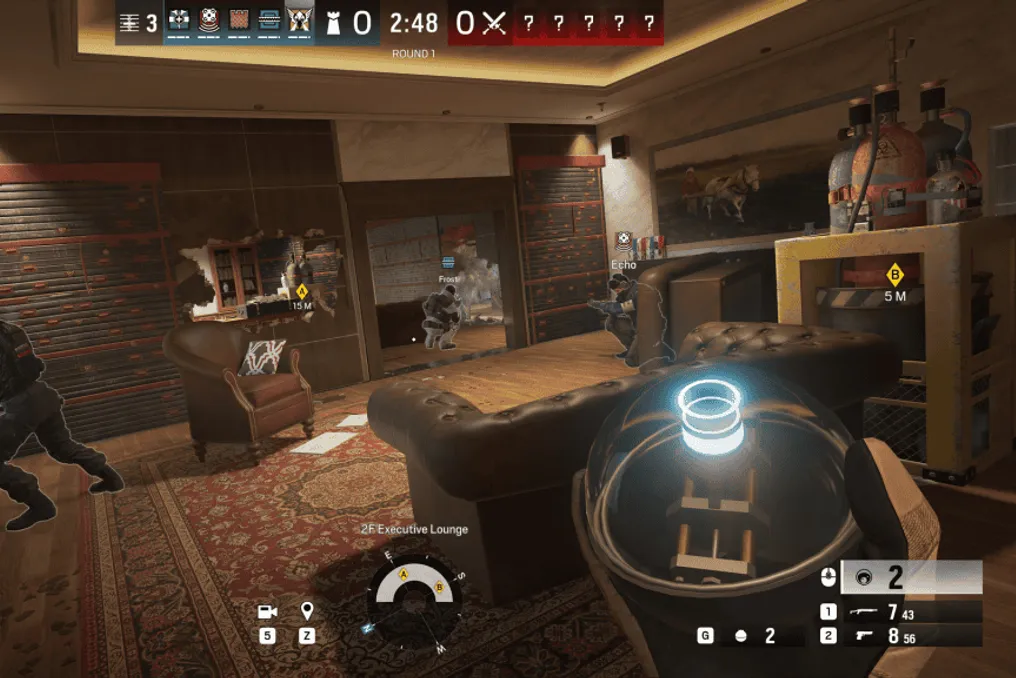
Rainbow Six Siege, developed by Ubisoft Montreal and released in 2015, remains extremely popular, especially in the competitive environment. However, its structure is not always clear to the general public, and it has undergone changes over the past year.
Tom Clancy’s Rainbow Six Siege, or R6 for short, is a competitive first-person shooter multiplayer game. Its main feature is the tactical aspect: during a match, attack and defense scenarios alternate. On the defensive side, players can reinforce walls, set up barricades, and traps. In the attack, the goal is to gather information using drones, breach, or bypass defensive structures and traps.
The game offers various Operators to choose from; there are currently about 77 characters, divided into Attackers and Defenders. Each possesses unique weapons and gadgets designed for destruction, climbing, spying, and attacking in different ways. Practically all elements—walls, floors, and even ceilings—are destructible, creating a highly competitive environment full of alternatives and capable of generating unforgettable moments.
Before the start of the game, each team sequentially bans two attacker operators and two defender operators. After the bans, vetted Operators are revealed, and each team selects their five operators. The role change between Attackers and Defenders occurs after six rounds.
In each match, the team that first reaches seven rounds wins, but a two-round advantage is required to end the game. If the score reaches six all, the team that first reaches eight rounds wins.
Professional Rainbow Six Siege championships are organized in a franchise league format. This means they are controlled and centralized by the game's publisher, Ubisoft, and have an annual competition calendar consisting of nine different stages.
1. Regional Challenger Series
This is the initial stage of the R6 competitive season, where teams can register for regional participation. League divisions are as follows: EML (Europe, Middle East, and Africa League), NAL (North America League), SAL (South America League), APL (Asia-Pacific Region), subdivided into APAC North (Japan and Korea), Asia and Oceania, and CNL (China League).
The first stage is open to all participants and is held in a simple knockout format (one match per sport). It qualifies 16 teams for the second stage, which uses a Swiss system: teams play against opponents with comparable performance levels to ensure balanced and competitive matches. The top eight teams advance to the final stage, which is held in a single-elimination playoff format. Every match is decisive until two teams reach the Grand Final, securing spots in the respective regional leagues held in the first and second half of the year.
2. Regional Season Start
This is a new starting stage for Tier 1 teams, divided by region. These teams compete for prize money, points for qualification to Six Invitational, and spots at the Major in May. This is a very dynamic tournament that determines a team's trajectory throughout the entire season.
The group stage is divided among ten teams in a round-robin format, where each plays every other team. The top eight teams advance to the Kickoff finals, which are held in a double-elimination format with three matches per sport. Thus, four teams qualify for the Major in May.
3. BLAST R6 Major May
This tournament features four teams from each region and consists of three phases. The first, Play-In, includes eight teams with the lowest qualification, competing for four spots in the second phase. Previous champions automatically advance to the second stage.
The second stage, Swiss Phase, gathers 16 qualified teams for competitions in a double-elimination format. The top eight teams advance to the third, head-to-head phase, whose location depends on the event (it will be held in Salt Lake City, USA, in 2026).
The final phase, Playoffs and Grand Final, consists of two stages. First, the Playoffs, where matches are played to three wins, qualifying two teams for the Grand Final, which is played to five wins. These matches also award prize money and points for Six Invitational qualification.
4. Regional Stage 1
Stage 1 is also divided by region and serves as the entry ticket to the EWC Rainbow Six Siege. Competitions are held in a round-robin format to one win, and the final is played to three wins. Four teams from each region qualify for the world esports championship, as well as receiving prize money and additional points for Six Invitational qualification.
5. Esports World Cup de Rainbow Six
Also known as the Esports World Championship, this is one of the largest events in the field of electronic sports, including many different disciplines. In the case of Rainbow Six Siege, the competition takes place in four phases.
Phase 1 Play-in: eight teams are divided into two equal groups, where each group competes in a double-elimination format. Initial matches are played to one win, and subsequent ones are played to three. The top two teams from each group advance to the second phase.
Phase 2 Play-in: a simple knockout between four previously qualified teams. All matches are played to three wins, and the top two teams guarantee themselves a spot in the next stage of the championship.
Group Stage: consists of 16 teams—the top two from Play-in and those who qualified directly through the global points system. They are divided into two groups that compete in a double-elimination format, with matches to one win at the beginning and to three wins in the rest. The top four teams guarantee themselves a spot in the final stage of the EWC.
Playoffs: the final stage of the championship, which is a simple knockout among eight teams, the bracket of which is determined by the results of the group stage. Matches are played to three wins, and the Grand Final is decided to five wins. The main finalist, in addition to a prize fund of up to 750 thousand US dollars, receives an automatic spot at the Six Invitational.
6. Regional Stage 2
It is very similar to Regional Stage 1, but focuses on the second Rainbow Six Siege Major. The format remains the same, but it marks the final stage of the regional season and is highly significant for those aiming to qualify for the Six Invitational.
7. BLAST R6 Major November
This is the second world tournament from Ubisoft, which almost replicates the format of the May Major. The difference is that it only considers the results of Regional Stage 2, but it still awards valuable points for Six Invitational qualification.
8. Six Invitational LCQ
LCQ stands for Last Chance Qualifiers and is the last tournament before the Six Invitational, as well as the last opportunity for teams to qualify. The top three teams from each region that have not yet qualified may participate in the LCQ in two stages.
The first stage, Open Phase, is held in two qualifiers to one win, and the semi-finals are to three wins. The finalists of each qualifier guarantee themselves a spot in the second stage.
The second stage, Playoff Phase, brings together eight qualified teams—four from the Open Phase, one from the Tier 2 international ranking, and three from Tier 1 outside the top 16 ranking—in a double-elimination format to three wins. The winner from each region qualifies for the Six Invitational.
9. Six Invitational
This is the annual world championship of Rainbow Six Siege and the final event of the game's competitive season. The tournament hosts 20 teams, 16 of which qualify via ranking, and four via LCQ. The competition takes place in three phases, with only the last one open to the public, where teams compete for a total prize pool of 3 million dollars.
Group Stage: the first phase, held in four groups of five teams formed according to the annual ranking. Teams compete for points by playing against each opponent at least once. The top four from each group advance to the next stage.
Playoffs: 16 qualified teams compete in a double-elimination format, where all matches are played to three wins. The bracket structure follows the points from the previous phase, and the top teams from the Group Stage automatically advance to the second round of the Playoffs. Losers in the first round move to the elimination bracket and are eliminated upon the second loss. Winners of the second round qualify for the final.
Grand Final: the remaining six teams compete in front of the general public at the Adidas Arena in Paris. All matches are played to three wins, except the final, which goes to five wins. The winning team, in addition to the title of world champion of the season, receives a substantial prize, which is currently 1 million US dollars.