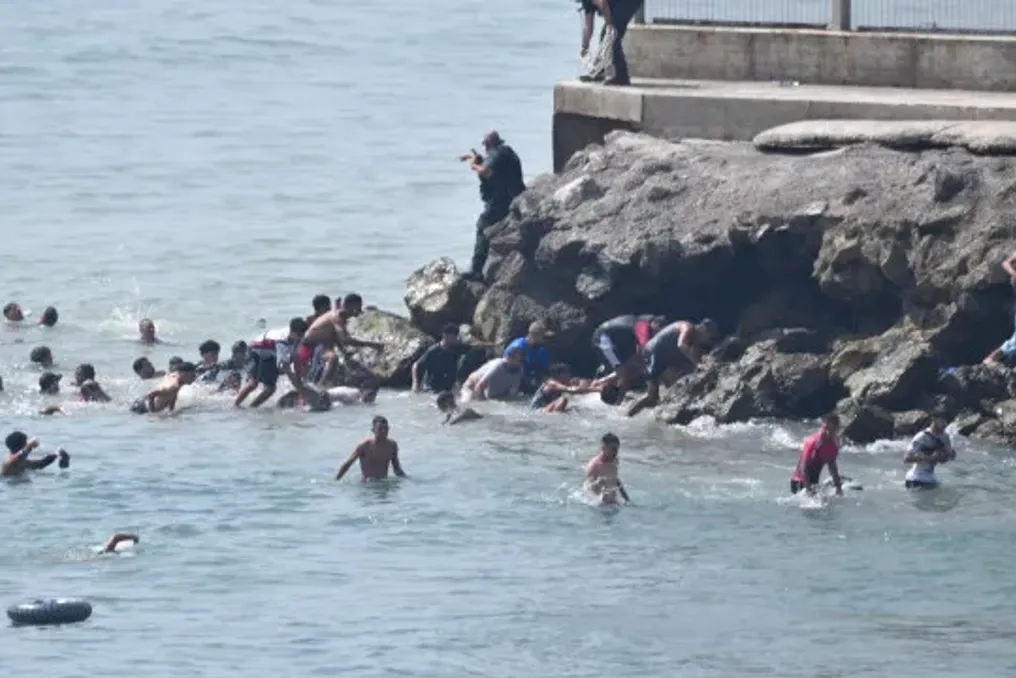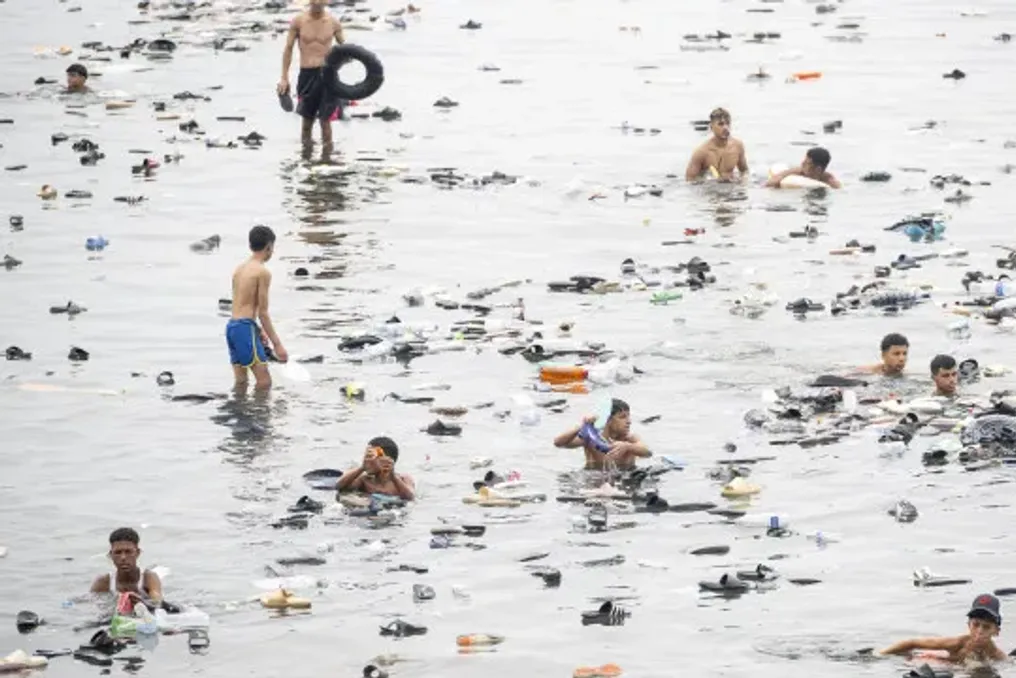
The young people aged 14 to 17, who identify as residents of 'minor centers,' revealed to Lusa that they speak Spanish or another language besides Arabic. These adolescents were attracted to the illegal border crossing from Morocco via Instagram, using posts that contained maps and detailed instructions on how to cross and what to do upon entering the Spanish city.
A 15-year-old boy from Tangier confessed to Lusa that he was deceived because the Instagram content was false. He was part of the crowd of over 50,000 people who suddenly invaded the Spanish enclave in North Africa in 24 hours, either on foot or by swimming.
In the industrial area of EL Tarajal, near the border crossing between Ceuta and the Moroccan city of Fnideq, there is a reception center managed by the Samur Foundation. This center is open but isolated by metal barriers, preventing access for journalists or the hundreds of young people wandering nearby or sitting on the sidewalks. On Sunday, the warehouses in the premises, which operate at reduced capacity, were completely closed and locked.
Ceuta authorities had repeatedly warned, before the massive arrival of tens of thousands of people on Thursday and Friday, about the overcrowding in the reception centers for unaccompanied migrant minors, requesting support from other autonomous regions of Spain.
Sources from the Ceuta executive, cited by the newspapers El Periodico and El Pais, reported that the number of minors in the centers jumped from 180 to 800 in ten days. The same sources admitted that due to the scale of the situation, it was no longer possible to count those who arrived starting on Thursday, stating that 'thousands arrived and nobody knows how many.'
In Spain, the responsibility for managing the reception of unaccompanied minors arriving in the country who cannot be subject to deportation orders falls on the regional governments, following national laws and international treaties. Regions such as the Canary Islands, Ceuta, and Melilla have requested solidarity from other autonomous governments to deal with this problem.
Following the recent events in Ceuta, the central government recognized that an 'extremely complex situation' had set in the city. Miguel Ángel Pérez, delegate of the Spanish Government in Ceuta, declared in a press conference that the state would support the autonomous city, especially in the area of minors, if there was a complex situation requiring a response.
According to the Spanish government, more than 48,000 people who entered Ceuta during 24 hours left the city on Friday. Among those who remained are the hundreds of minors who now occupy the industrial area of El Tarajal, in a scenario distinct from the normality recovered in the city center or the border area with Morocco.
Despite being tricked by Instagram, facing shortages of food and shelter, the minors informed Lusa that they will 'hold on until they can,' with returning to Morocco being the last alternative, since 'there is nothing to do' there. All interviewees guaranteed not to study; many mentioned working 'since childhood,' either in agriculture or as barbers. Some claimed their parents knew where they were, while others did not answer this question.
One group reported coming from Meknes, about 300 kilometers from Ceuta, while others claimed to be from closer cities, such as Tangier. The common goal of these young people is to 'stay in Spain' or 'have a future in Spain.'
Data from April of this year from the International Labour Organization (ILO) indicates that one in five Moroccans aged 15 to 29, totaling 2.9 million young people, is unemployed and not studying. The ILO pointed out that these figures double those recorded three years ago and that the situation of young people without education or work 'continues to be a structural challenge' in Morocco.
The Moroccan Human Rights Association stated on Saturday that 'despair has ceased to be an individual feeling to become the identity of an entire generation.' This association interprets the emigration or desire to emigrate of Moroccan youth as the realization of this despair and a condemnation of 'corruption, authoritarianism, and abuse of power.'
Discontent was also manifested in protests by the GENZ212 movement, which marched in September demanding better public services and criticizing the millionaire spending of the Moroccan Government on sports infrastructure, such as the new stadium in Casablanca planned for the 2030 World Cup. After the repression of these protests, arrests, and convictions, the GENZ212 movement is currently dispersed.