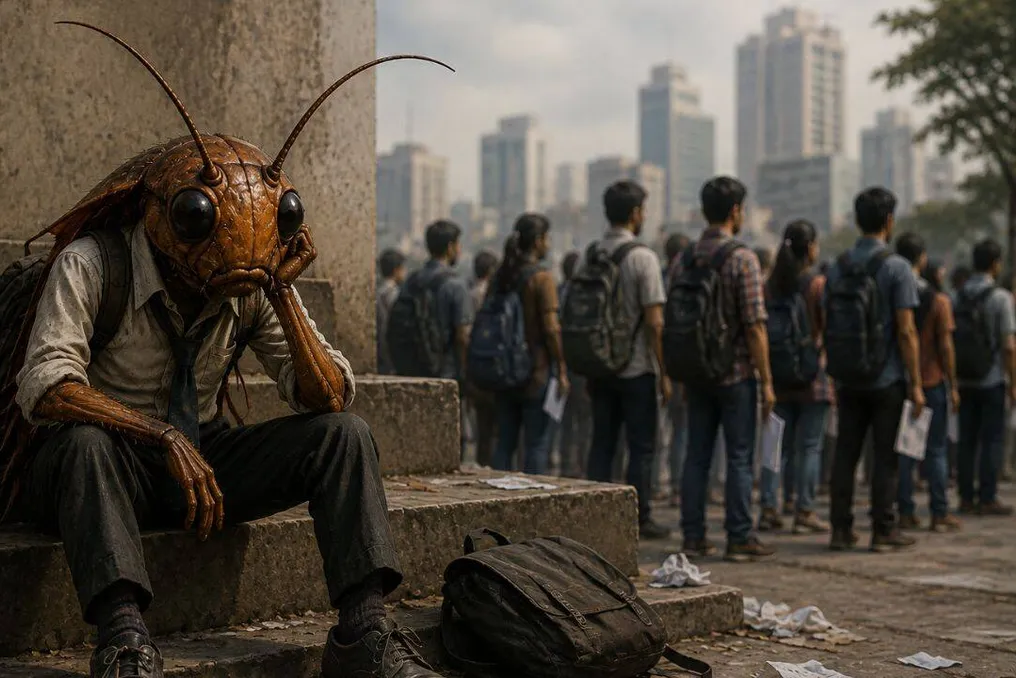
Similar to the metamorphosis of a human into an insect in Franz Kafka's work, modern India is facing a problem mocked by the CJP party, which calls itself the 'Colorado people'. This party uses a disturbing symbol to express the frustration of a generation that doubts whether years of study, expensive preparatory courses, and constant competition will lead to stable employment.
What started as a viral meme on social media with a strong satirical structure quickly turned into one of the largest youth movements in the country in recent years. The movement, calling itself the 'voice of the lazy and unemployed', grew from memes mocking unemployment, exam paper leaks, inflation, and the political elite, to street protests.
These protests could be the trigger for a generation already struggling with job cuts, rising education costs, and growing uncertainty about the future. At its core is a simple question: what happens when the economy produces millions of graduates every year but fails to create enough quality jobs?
Economist's View on the Crisis
According to experienced economist Arun Kumar, a former JNU professor, 'This unemployment crisis has created a huge gap between expectations and reality.' He notes that young people receive degrees believing they will secure good jobs, but when these vacancies do not appear, they continue preparing for competitive exams for years. Many take these exams four, five, or even six times, still hoping to get a job in the organized sector.
Parents also encourage this, knowing that such positions offer a stable salary and social security. However, according to Kumar, the growth of education privatization has intensified competition. Educational centers strive to demonstrate high success rates as this is their main asset, which generates incentives for unethical practices, including material leaks. The more privatization, the higher the pressure to resort to illegal methods to ensure student success. Fake diplomas, fraud, and test leaks are symptoms of a much deeper problem related to unemployment and the shortage of quality jobs in the organized sector.
India's Employment Challenge
For decades, India has expanded access to higher education. Universities have multiplied, student enrollment has sharply increased, and millions of families have invested heavily in obtaining degrees, viewing education as the most reliable path to social mobility. The figures show a striking picture: according to the Azim Premji University report 'State of Working India 2026', the number of young graduates in India has increased nearly 13 times—from approximately 5 million in 1983 to 63 million in 2023.
However, while the supply of graduates is growing rapidly, employment opportunities are not keeping pace with this growth. The report estimates that the unemployment rate among graduates under 25 approaches 40%, and in 2023, graduates constituted almost two-thirds of India's unemployed population. Even more alarming is the rise in the number of unemployed graduates, which has increased from less than one million in 1983 to approximately 11 million in 2023, representing a 16-fold increase over four decades.
The mismatch between education and employment has steadily widened since the mid-2000s, as higher education developed much faster than the creation of quality jobs. For millions of families, obtaining a university degree no longer guarantees stable employment or financial security.
Recent government data indicates that the problem is becoming even more serious. According to the flagship PLFS labor force survey, unemployment among Indians aged 15 to 29 reached 16.2% in June, the highest level since the introduction of monthly estimates in April 2025. Youth unemployment stood at 13.8%. The Ministry of Statistics and Programme Implementation (MoSPI) warned that monthly figures may fluctuate due to seasonal factors, academic cycles, and increased survey frequency.
Nevertheless, the latest data is significant because it fits into the overall trend rather than representing an isolated spike. Youth unemployment has been rising across all six categories tracked by the survey—in both urban and rural areas, among men and women, over the 15 months for which monthly data is available. Simultaneously, the labor force participation rate (LFPR) among youth has decreased from 42.7% to 40.3%. Simply put, fewer young people are actively looking for work. Typically, such a decrease would be expected to reduce unemployment, as fewer people participate in the labor market. Instead, unemployment continues to rise, indicating that the economy is not generating enough opportunities even for a shrinking pool of applicants.
Annual PLFS data confirms this trend. Between 2022 and 2025, youth unemployment increased in 13 states and territories, including Andhra Pradesh, Delhi, Telangana, and West Bengal. The situation appears even more complex for young women, as unemployment rose in 16 states and territories during the same period. Collectively, these figures suggest that youth unemployment is becoming a structural problem, not a temporary fluctuation.
The Problem Is Not Just Unemployment, But Job Quality
Unemployment statistics often fail to reflect deeper issues in the Indian labor market. Many graduates find jobs, but not necessarily the ones they expected after years of higher education. Economist Arun Kumar argues that the root of the problem lies in the sharp divide between India's organized and unorganized sectors. When unemployment rises, it inevitably leads to increased conflict over the lack of jobs for too many people. In India, this problem is even more pronounced because the unorganized sector employs about 94% of the workforce, while the organized sector accounts for only about 6%. The difference in wages and job security between these two sectors is vast. A delivery courier might earn around 10,000–12,000 rupees per month, whereas a postal worker might earn around 70,000 rupees. Naturally, no one wants to lose a job in the organized sector, and everyone strives to secure one. This intense competition creates immense pressure.
Analysis of the PLFS survey illustrates this gap. Out of every 100 graduates aged 15 to 29, only 50 are employed, 15 remain unemployed and actively seeking work, and the remaining 35 are outside the labor force. Some continue their studies. Others engage in unpaid domestic work or simply stop looking for work after repeated disappointments.
Even among those who are employed, job quality remains a serious issue. Only 26 out of every 100 graduates have a job with a regular salary. More strikingly, only four have formal employment providing written contracts, paid leave, and social security. The rest of the graduates are distributed among self-employment, unpaid family work, temporary jobs, and small home businesses. Many receive irregular income and lack job security despite years spent pursuing higher education.
Why Educated Youth Feel Deprived
The employment crisis begins long before students enter the job market. Competition for limited spots in prestigious colleges has turned education itself into an expensive investment. Government survey data shows that Indian households now spend a significantly larger portion of their education budget on private tutoring than seven years ago. The sharpest increase is observed among high school students preparing for entrance exams to engineering, medical, and university institutions. Families now spend almost a quarter of their secondary education budget on courses, compared to about 18% in 2018.
Spending on private tuition has also consistently risen in primary, secondary, and higher education, reflecting a growing belief that classroom teaching alone is insufficient to compete in high-stakes entrance exams. This pressure is particularly noticeable in engineering education. In the 2023–24 academic year, there were about 4.4 million undergraduate engineering students in India. However, the top 100 engineering institutions in the country together offered only about 500,000 seats. In fact, only one in nine engineering students can study at an institution widely known for strong employment prospects and better career paths. Students who fail to gain admission to elite institutions often graduate from colleges with weaker employment records, which significantly hinders securing high-paying jobs.
The growing gap between educational aspirations and employment outcomes causes increasing frustration among the youth. The traditional promise that higher education automatically leads to a better job is becoming increasingly uncertain. According to the 'State of Working India 2026' report, less than 7% of male graduates secure permanent salaried employment within a year of graduation. This figure is even lower—only 3.7%—when referring to white-collar jobs. Using PLFS data and previous employment and unemployment surveys, the report estimates that 110 million out of 630 million Indian graduates aged 20 to 29 were unemployed in 2023.
Graduate unemployment itself is not a new phenomenon. The report shows that unemployment among graduates under 25 has risen from 35.02% in 1983 to 39.33% in 2023. However, the scale of the problem has changed. India is producing far more graduates than ever before while entering the most crucial stage of its demographic transition. The median age in the country is currently around 29 years and is expected to reach 38 by 2050. This is the period during which India's workforce should drive economic growth. If the economy cannot create enough productive employment during this demographic window, the widely discussed demographic dividend could gradually turn into a demographic challenge.
The Paradox of Indian Employment
Today, India is one of the world's fastest-growing major economies. Even amidst geopolitical tensions, oil price volatility, and slowing global trade, the country continues to demonstrate steady GDP growth and position itself as a hub for manufacturing and investment. The government has invested heavily in highways, airports, railways, ports, and digital infrastructure. Global technology companies like Apple have expanded production in India, electronics exports have sharply increased, and semiconductor investments are beginning to gain momentum. Policymakers are increasingly viewing manufacturing as a sector capable of absorbing millions of workers and transforming India's demographic advantage into sustainable economic growth.
Nevertheless, for many young Indians entering the job market, this optimism seems distant. The central contradiction facing the Indian economy is that rapid economic growth has not led to an equivalent expansion in job quality. Economists often describe this phenomenon as 'jobless growth'—an economy that continues to grow without creating enough safe and productive jobs. India's problem is particularly complex because about eight million graduates enter the labor market every year. Creating jobs for such a large number of educated youth has become one of the country's biggest economic challenges. This gap between economic growth and employment opportunities underlies the frustration fueling recent youth protests.