Several Chinese brands have expressed ambitious plans to establish domestic production in Brazil, with some having already started the process and others holding contracts or being in the planning phase for vehicle localization.
Several Chinese brands have expressed ambitious plans to establish domestic production in Brazil, with some having already started the process and others holding contracts or being in the planning phase for vehicle localization.
The first Chinese brand to establish itself in the country was Chery, which inaugurated its unit in Jacareí, São Paulo, in 2014. Subsequently, in 2017, operations began to be managed by the Brazilian group Caoa, which already operated a factory in Anápolis, Goiás, dedicated to producing Hyundai models.
In the current scenario, new manufacturers are arriving, with their operations supervised by the Chinese headquarters. There is a strong focus on developing electrified vehicles, although some manufacturers also offer combustion engine options in specific niches.
Currently, Caoa manufactures Chery vehicles exclusively at the Anápolis, Goiás plant. Models such as Tiggo 5X, Tiggo 7, and Tiggo 8 are produced under the CKD regime, while plug-in hybrid versions are imported directly from China. The Caoa Group will continue to represent Chery, even with the entry of the Chinese headquarters through other brands. Cars manufactured in Brazil already incorporate local processes such as painting, welding, and the use of certain components.
The Caoa Group also represents Changan in the Brazilian market, starting its activities with the luxury division Avatr in 2025. In 2026, domestic production of the Uni-T and CS75 models began in Anápolis, Goiás, using the piece-by-piece assembly system. This method is similar to that adopted by GWM, as components do not arrive in kits, which simplifies parts localization. Locally produced Changan vehicles already undergo welding, painting, and other procedures carried out in Brazil. The brand plans to introduce a third model soon, the CS55.
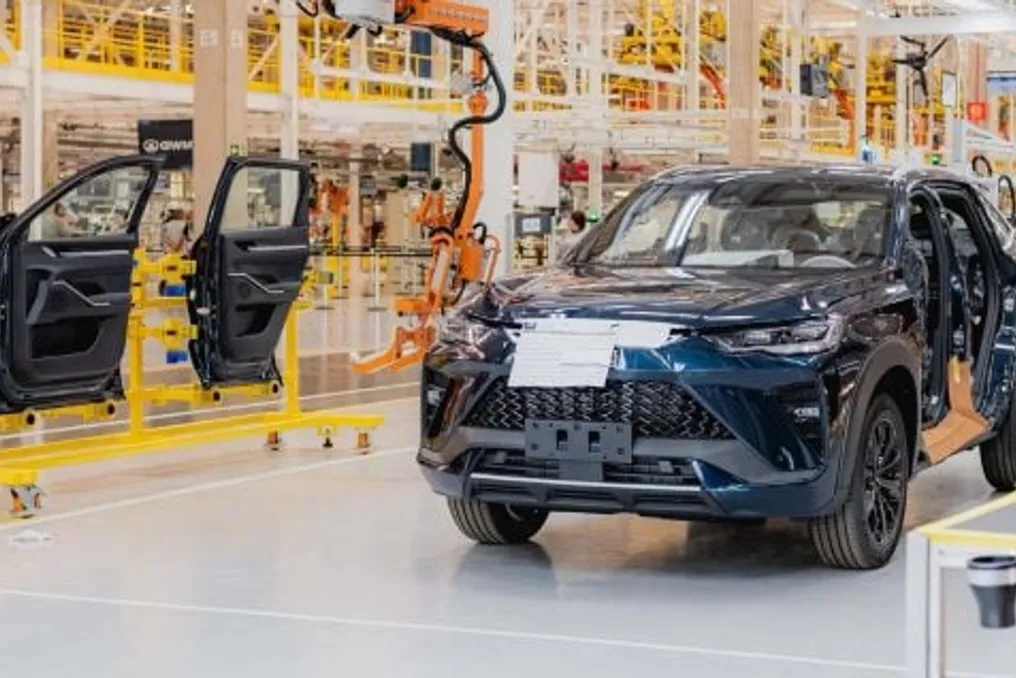
GWM was the first Chinese brand of this new wave to settle in Brazil. In 2021, it acquired the deactivated Mercedes-Benz factory in Iracemápolis, São Paulo, even before commercializing its automobiles in the national territory. Initially, the project planned the production of the medium pickup Poer P30 in hybrid and diesel versions in Brazil, but the success of the Haval H6 forced a change in plans. Local production began on August 15, 2025. After the launch of the Haval H6, GWM introduced the Poer P30 and the Haval H9, both equipped with a turbodiesel engine. The three national models are assembled piece by piece and already feature components manufactured in the country. GWM has already contacted local suppliers aiming to increase the nationalization rate of its vehicles and confirmed the opening of a second factory in the state of Espírito Santo. Furthermore, a development center is being developed in Iracemápolis. The national Haval H6 already has a flex engine, and the entire line marketed in Brazil has received adaptations for local taste, such as firmer suspension and black wheels.
BYD frequently attracts attention in the segment of new Chinese brands due to its aggressive marketing strategy and high sales volume. The company acquired the factory located in Camaçari, Bahia, which had been built by Ford in 2023. Several promises were made regarding production schedules. Initially, production was supposed to start at the end of 2024, but this date was postponed for several reasons. Effective operation began in September 2025. BYD performs the assembly of its cars in Brazil under the SKD regime, where vehicles arrive in semi-finished kits. The processes executed locally are limited to joining the parts, without involving welding, painting, or local components; tires are delivered mounted on wheels and inflated. During the factory inauguration in 2025, it was promised that the transition from SKD to fully localized production would occur in August 2026, but in July 2026, the deadline was extended until the end of the year. Currently, BYD assembles the Dolphin Mini, Song Pro, and King models.
Geely entered Brazil with the support of Renault. This collaboration culminated in Geely acquiring 26.4% of the French brand's Brazilian subsidiary. This gave Geely the advantage of being able to use the Renault factory in São José dos Pinhais, Paraná, as well as all the consolidated infrastructure and distribution network. The first planned national product was the medium SUV EX5 EM-i, but the success of the electric hatchback EX2 required a last-minute change. Geely plans to start assembling the EX2 under the SKD regime by the end of the year, and it will be launched updated, with an improved battery, interior finish improvements, and a more advanced ADAS package. The possibility of nationalizing the EX5 EM-i was not ruled out with this readjustment of plans.
GAC established an agreement with HPE Automotores to utilize the idle capacity of the factory in Catalão, Goiás, which currently only produces Mitsubishi vehicles. The brand has also evaluated other locations to establish its own plant, including the state of Amapá. With this partnership with HPE Automotores, GAC can be enabled in the Mover Program. The company will invest R$ 1.3 billion in the Catalão factory to enable local production. Additionally, GAC will create a local research and development center focused on creating flex engines and other technologies suitable for Brazilian conditions. It has not yet been disclosed what the initial production method of GAC in Brazil will be or which models will be localized first.
The Stellantis group holds 51% of the shares of Leapmotor, a Chinese startup specializing in electrified vehicles. Its operations outside of China are managed by the conglomerate that owns Fiat and other brands. Stellantis has already confirmed that Leapmotor cars will be manufactured at the Goiana, Pernambuco factory in 2026. Production will initially be under the SKD regime, with a gradual progression to CKD until full localization is achieved. The most anticipated model to start this process is the C10 SUV, which will leave the Pernambuco factory already with a facelift, accompanied by the B10 and C16 models.
MG Motor is a British-origin brand owned by the Chinese company SAIC. The company confirmed that it will assemble the MG4 Urban model at the multi-brand PACE factory in Horizonte, Ceará, under the SKD regime by the end of 2026. This plant currently manufactures Chinese electric vehicles from Chevrolet, such as the Spark EUV and the Captiva EV. For now, MG Motor has not presented plans to build its own factory in Brazil.
Regarding Omoda & Jaecoo, Chery global resumed its presence in Brazil with this pair of brands, created with a focus on export. From the beginning, the company indicated its intention to produce vehicles locally. Currently, the company is negotiating to acquire the Jaguar Land Rover factory located in Itatiaia, Rio de Janeiro. Although the deal has not been finalized, there have been discussions between Chinese representatives and the city hall.
The management of the metallurgical and mining conglomerate Vedanta informed Business Standard that the company expects to achieve group revenue (Ebitda) of approximately $10 billion in the 2026–2027 fiscal year (FY27) and reduce total debt by more than 20,000 crore rupees during this period. These statements reflect the company's confidence in maintaining growth momentum after most of its subsidiaries reported record profits in the first quarter (April-June).
Ajay Goel, CFO of the Vedanta group, stated that the group is targeting an Ebitda of around $10 billion for the current fiscal year (FY27), as well as reducing the group's total debt by more than 20,000 crore rupees.
Goel noted that the process of reducing the debt burden is already gaining momentum. The group's parent entity, Vedanta Resources, reduced its debt by $1.1 billion in the first quarter of FY27. Furthermore, the company refinanced its borrowings, which allowed it to decrease financing costs by 280 basis points. This is expected to lead to a reduction in annual interest expenses of over 1,000 crore rupees, strengthening the group's balance sheet.
This forecast comes amid Vedanta demonstrating record quarterly profits across all its segments. According to Goel, this success is attributed to factors within the company's control, including increased production volumes, lower operating costs, and a more favorable mix of value-added products. Favorable macroeconomic conditions, such as rising prices for Brent crude and on the London Metal Exchange, as well as the depreciation of the rupee, also positively impacted the group's export-oriented businesses.
Despite the improved profitability of most subsidiaries, Vedanta Power recorded a quarterly loss despite higher revenue. Rajinder Singh Ahuja, CEO of Vedanta Power, explained this discrepancy by stating that the loss was due to a one-time impact of 487 crore rupees related to litigation in the Supreme Court concerning the acquisition of the insolvent Athena Chhattisgarh Power.
Furthermore, Vedanta representatives shared the company's view on ongoing discussions regarding the imposition of import duties on aluminum and aluminum scrap. Last month, the Ministry of Mining recommended abolishing the basic customs duty of 2.5% on imported aluminum scrap. Lower-tier manufacturers are pushing for tariff reductions to lower raw material costs, while major producers, such as Vedanta Aluminium, represented by the Indian Aluminium Association, advocate for maintaining this duty.
Rajesh Kumar, CEO of Vedanta Aluminium Metal, stated that retaining a portion of the import duty on aluminum scrap would promote long-term investment in the sector. He emphasized that it would be beneficial for the country if scrap imports were taxed, as in a country like India, where per capita aluminum consumption is low, this would stimulate domestic industry to build capacity and facilities. Kumar added that changes in the duty structure would not significantly affect Vedanta, but he believes that maintaining the duty is fundamentally the correct approach to support aluminum investments in the country.
Regarding critical minerals, Vedanta Executive Director Arun Mishra announced that the company has begun exploration in several critical mineral blocks owned by Vedanta and Hindustan Zinc. Among these is a monazite block in Uttar Pradesh, which could become India's first terrestrial source of neodymium—a rare earth element used in permanent magnets. According to Mishra, geological surveys are planned to continue for another two to two and a half years, with mining likely to commence around 2029–2030. Commercial production, including metal refining and processing, is expected in 2030–2031, marking Vedanta's entry into a new portfolio of critical minerals.
Bokaro Steel Plant (BSL), which is part of Steel Authority of India Ltd (SAIL), demonstrated its best ever result in the first quarter of the financial year 2026-27 (Q1FY27), achieving an EBITDA of 1154 crore rupees. This growth was driven by higher operational efficiency and increased production.
The EBITDA of this unit increased from 588 crore rupees to 1154 crore rupees, marking the highest figure among SAIL's integrated steel plants. Operating income grew by 9.37 percent, reaching 5880 crore rupees compared to 5376 crore rupees, and the EBITDA margin improved to 19.62 percent from the previous 10.94 percent, which is also the highest in SAIL. Profit before tax jumped from 97.82 crore rupees to 715.57 crore rupees.
Furthermore, the plant reported its best production in history for the first quarter since its establishment, setting records for furnace production, gross synthesis, hot metal, raw steel, and finished cold-rolled steel. Key operating parameters, such as synthesis machine productivity, coke consumption, and blast furnace productivity, also reached record levels for the first quarter.
The company also set new quarterly benchmarks in technical and economic indicators for the April-June period. The Coal Dust Injection (CDI) rate improved to 96 kg per tonne of hot metal compared to the previous best of 95 kg achieved in the preceding quarter. A higher CDI rate reduces coke consumption while increasing blast furnace efficiency and overall price competitiveness.
Energy consumption per unit of product decreased to a record 6.314 Gcal per tonne of raw steel, reflecting improved energy efficiency and process optimization, compared to 6.328 Gcal. During this quarter, the plant also achieved record monthly and daily milestones, including raw material unloading of 1.17 million tonnes, daily production of gross synthesis and hot metal, as well as the highest ever monthly sales volume of coal chemicals. The company attributed these results to improved operational efficiency, strict cost control, and water conservation measures.
Zee Entertainment Enterprises (ZEE) announced on Sunday that it received an order from the Securities and Exchange Board of India (SEBI) and intends to seek legal advice regarding this decision.
The company's statement emphasized that this order will not affect the current fundraising campaign aimed at strengthening the company's financial position.
A company representative stated that ZEE will take all necessary steps to successfully complete the capital raising process to enhance value for all stakeholders. Furthermore, the company will continue to work on protecting the interests of all stakeholders in connection with the allegations against the company and its promoters, taking appropriate measures in accordance with the law.
Previously, on Friday, the company's shareholders voted in favor of the fundraising proposal. On the same day, the market regulator SEBI imposed a fine of 1.48 crore rupees on the company and its promoters—CEO Puneet Goenka and Honorary Chairman-Founder Subhash Chandra.
The regulator made a final decision that prohibits ZEE from accessing the securities market for two months. A restriction was also placed on Chandra and Goenka, forbidding them from signing or trading securities for one year due to the unauthorized mortgage of ZEE land in Hyderabad to secure loans related to the promoters.