The Palestinian singer, songwriter, and rapper Saint Levant is preparing to hold his first public concert in the Jordanian capital, Amman, scheduled for next Thursday. However, high ticket prices have shocked his fans.
The Palestinian singer, songwriter, and rapper Saint Levant is preparing to hold his first public concert in the Jordanian capital, Amman, scheduled for next Thursday. However, high ticket prices have shocked his fans.
The artist Marwan Abdel Hamid, known by the pseudonym Saint Levant, intends to perform at his first public concert at The Abdali Hall in Amman on August 13, 2026. Saint Levant is known for his musical style, which combines Arabic, English, and French languages.
Thanks to the diversity of his repertoire and unique artistic style, he has gained wide popularity through works such as 'Kalemteena' and 'Ya Sabah El Ward', accumulating a growing international fanbase.
According to information from the online ticketing platform Ticketing Box Office, tickets in the VIP Theater category cost 115 Jordanian Dinars (JOD), which is approximately 162 US dollars. The event is organized by 165 Entertainment.
At the same time, tickets in the Fan Pit – Standing category, priced at 65 Jordanian Dinars (JOD) (approximately 91 US dollars), are already sold out.
Despite the long period without updates on Grand Theft Auto 6, which has led to many speculations among fans, a well-known insider stated that there is no reason to worry. According to NateTheHate, Rockstar Games continues to follow its announcement schedule and plans to present new information about the game as early as August.
In response to fan questions on social media, NateTheHate confirmed that GTA 6 will be released in November, according to the original plan, thereby refuting rumors of a possible delay.
The absence of new trailers and official materials has made some members of the community doubt the progress of the game's development. However, in the opinion of this insider, the silence is part of Rockstar's marketing strategy.
Commenting on the lack of information, NateTheHate emphasized that 'there is no need to worry,' explaining that the developer is simply adhering to its information release schedule. Although Take-Two previously indicated that the marketing campaign would be activated in the Northern Hemisphere during the summer, Rockstar has released little data so far since the start of pre-sales.
When fans asked about the timeline for new content, the insider expressed confidence that they would see a 'good amount' of new material during August. He did not specify the exact format of these announcements, but his statement suggests that upcoming reveals might be more detailed than just another trailer.
It is important to note that Rockstar Games has not officially confirmed the release dates for new materials for Grand Theft Auto 6, despite the positive history of NateTheHate's leaks. Therefore, all information should be considered rumors until an official statement from the developer.
A large budget is not required for decorating to give a house an expensive look. Often, small details, such as room lighting or furniture arrangement, create the biggest difference.
There are several thoughtful and budget-friendly ways to give each room in the house a more luxurious appearance without replacing all existing items. The key to success lies in understanding where to spend money, where to save, and how to make the most of what you already have.
The bedroom should serve as a sanctuary, a place where you can relax and feel completely comfortable.
Ditch overly ornate floral patterns and choose neutral shades such as soft gray, crisp white, or calming beige. Add plush decorative pillows and a textured throw blanket at the foot of the bed.
Replace thin curtains with long ones hung high above the window frame. This will visually increase the ceiling height and give a more elegant, considered look. Natural fabrics like linen or cotton are recommended.
Harsh overhead lighting is undesirable. Instead, use multi-level lighting. Add bedside lamps with warm light to create a cozy glow.
Clear the surfaces and leave only a few significant decorative items. A tidy space contributes to a calm mind.
This room often goes unnoticed, but a little attention here makes a big impact.
First, get rid of all half-empty bottles and forgotten toiletries. A clean and clutter-free space instantly looks more luxurious.
Replace old, worn towels with new, fluffy, and snow-white ones. White or neutral tones always look chic and evoke a spa atmosphere, and you don't need to buy the most expensive sets for this.
You might be surprised how much difference new, affordable faucet handles can make if yours are old and tarnished. Consider matte black or aged gold options for a modern accent.
A small plant, such as a snake plant or spathiphyllum, instantly brings life and freshness. Even a small vase of fresh flowers can improve the overall atmosphere.
This is often the busiest area of the house, so creating a good look on a limited budget depends on smart updates and proper organization.
Hardware: Just like in the bathroom, new handles for cabinets and drawers can completely transform the look of kitchen facades. It may be a small change, but it has a huge impact.
If you want to update the backsplash without the hassle and cost of a complete tile replacement, peel-and-stick tiles offer incredible variety in patterns and colors, imitating everything from subway tile to marble, while costing significantly less.
Painting the kitchen walls can refresh and modernize the entire space. Consider a neutral color for a timeless feel.
Clear the countertops. Store appliances that you don't use daily. Invest in stylish storage systems, such as jars for dry goods. A tidy kitchen always looks more well-kept.
A simple bowl of fresh fruit or a small pot of aromatic herbs on the counter adds life and color without major expense.
This is the place where you relax, host guests, and create memories.
Before buying anything, try changing the layout of your existing furniture. Sometimes a new arrangement plan is all it takes.
These are your secret weapons for instant luxury. Combine and mix textures such as velvet, faux fur, and chunky knitwear. Choose colors that complement your current furniture.
A good rug can be the foundation of the room, adding warmth, texture, and sophistication. You don't need a huge, expensive rug; look for geometric patterns or natural fibers like jute for a chic look.
Create a gallery wall using inexpensive prints or even your own photographs. Look for frames in discount stores or thrift shops.
Using a single overhead light source is unacceptable. Add a floor lamp and a couple of table lamps to create warm, inviting pools of light.
Coffee tables and bookshelves can quickly turn into dumps. In the pursuit of a luxurious feel, less is often more.
In conclusion, it is not about the amount of money spent, but how wisely it was spent. With these budget tips, your home will soon look perfect for social media, and friends will start asking about your decorating secrets.
In honor of Railway Workers' Day, an employee of Sputnik Uzbekistan visited the Tashkent Museum of Railway Transport to examine various locomotives and carriages from different eras.
The museum is located in the center of the capital, near the North Station, and is often called the 'Steam Locomotive Museum' by city residents. Here, the history of railways is presented not only through archival documents and photographs but also through real locomotives that served on the railway lines of Central Asia for decades.
The creation of the railway network in the region was one of the largest engineering projects of the late 19th century. The construction of the Zakaspiysk Military Railway began in 1880, passing through the Karakum Desert, arid areas, and nomadic sands. In 1885, the railway reached Ashkhabad, in 1886, Chorgi, and in 1888, Samarkand. Later, the network was expanded towards Tashkent, the Fergana Valley, and Andijan. The opening of the Orenburg–Tashkent main line in 1906 directly connected Central Asia with the central territories of the country.
The museum's history began in 1988 during the celebration of the 100th anniversary of the Central Asian Railway. A temporary exhibition of locomotives was organized at the Tashkent-Yulovchi station. Since it generated great interest among the residents and guests of the capital, the decision was made to preserve this exhibition. The museum was solemnly opened on August 4, 1989. According to the institution, today there are about 43 large exhibits stored outdoors, including steam locomotives, diesel locomotives, electric locomotives, passenger carriages, a locomotive car of an electric train, as well as samples of equipment for track construction and repair.
The museum's fund also includes over two thousand historical photographs, archival documents, railway uniforms, tools, and communication equipment. Vladimir Lankevich, the chief curator of the museum's fund, notes: 'Every exhibit is a monument to the people who worked day and night, in the heat and the cold during the era of creating this equipment.'
At the entrance to the museum, visitors are greeted by the narrow-gauge steam locomotive KCh-4-228, manufactured by the Škoda plant. Such steam locomotives were used in narrow-gauge enterprises and children's railways. Vladimir Lankevich emphasizes: 'This is the only such narrow-gauge steam locomotive preserved in Uzbekistan. Today it has become a symbol of our museum.'
One of the oldest exhibits is the passenger steam locomotive SU-250-94, built in 1924. Thanks to the large diameters of its driving wheels, it could reach a speed of up to 115 kilometers per hour. Also displayed is the TGK2-2245—a low-power, two-axle shunting diesel locomotive manufactured at the Kaluga Plant. It was used in industrial enterprises and major railway stations of the USSR, including in Uzbekistan. This diesel locomotive is equipped with a U1D6 diesel engine and a hydro-mechanical transmission, has a power of 250 horsepower, and can travel at speeds of up to 60 kilometers per hour.
Nearby is an American freight steam locomotive delivered under the Lend-Lease program during World War II. Museum specialists note that painting freight steam locomotives black was practical: soot from coal and a dirty body attracted less attention. Exhibit Ea-2371 is a powerful freight steam locomotive created at the Baldwin Locomotive Works in the USA in 1944. The locomotive, with a power of almost 2200 horsepower, could reach a speed of up to 70 kilometers per hour and is currently displayed in the Tashkent Museum of Railway Transport.
Also significant is the American electric locomotive DA20-68. Machines of this series later formed the technical basis for the Soviet diesel locomotive TE1. The collection also houses a rare German trophy steam locomotive manufactured in 1943.
DA20-68 is a six-axle diesel locomotive delivered to the USSR under the Lend-Lease program and manufactured in the USA. Its power was 1000 horsepower, and its speed reached 96 kilometers per hour; it served as a prototype for the Soviet diesel locomotive TE1. One of the locomotives of this series managed the train traveling to the Potsdam Conference of Stalin.
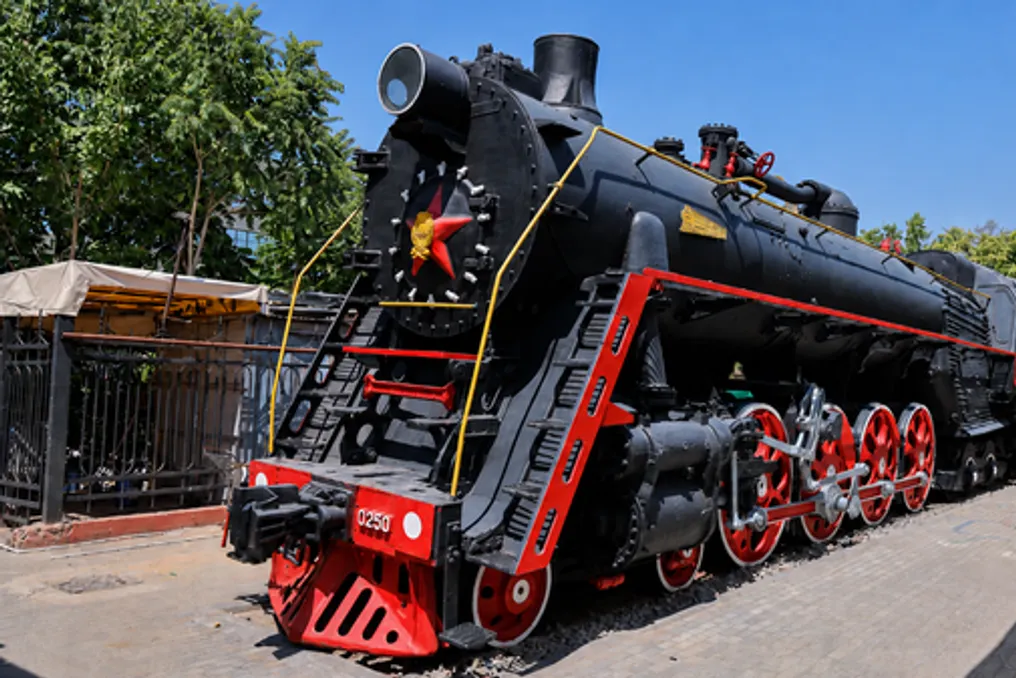
One of the most magnificent exhibitions in the museum is the passenger steam locomotive P36-0250, known to railway workers as 'General'. It was built in 1956, had a power of three thousand horsepower, and reached a speed of 125 kilometers per hour. It is one of the last steam locomotives produced in the USSR.
Visitors are also attracted by a double-decker carriage with a panoramic dome, manufactured in Leningrad in 1965. Only 25 such carriages were made, and according to museum staff, the specimen in Tashkent is unique in the world. It was originally used on tourist and mainline routes. However, after the electrification of railways, the height of the carriage began to pose a danger when traveling under the overhead contact network. Many carriages were destroyed, but this copy was preserved because it was detached from the train due to a malfunction in Termiz. It was later brought to Tashkent and added to the museum's exhibition.
The German steam locomotive captured in 1943 as a trophy was transferred to the Soviet Union after the end of World War II and converted for operation on standard gauge. Due to difficulties in technical maintenance, most of them were subsequently dismantled for scrap metal. According to some data, about 30 such specimens are preserved worldwide today.
The transition from steam to diesel and electric drive continues with the TE1, TE2, TE3, TEM2 diesel locomotives, as well as the VL60K-157 electric locomotive. The control of this equipment is based on a simple relay system, which ensured reliable operation in the hot conditions of Central Asia. VL60K-157 is the first mass-produced Soviet mainline AC electric locomotive, manufactured at the Novocherkassk Electric Locomotive Plant. It was used on electrified sections of railways in Siberia, the Urals, and Uzbekistan. The electric locomotive, with a power of up to 4800 kW, could reach a speed of up to 100 kilometers per hour.
TE3 is a freight diesel locomotive that became the basis for the creation of the more powerful 2TE10L model. The main difference between them lies in the engine: the TE3 diesel locomotive is equipped with a turbocharger-less diesel engine, while the 2TE10L is equipped with a power unit with a turbocharger. TEM2 is one of the most common shunting diesel locomotives in the former Soviet railways. In Uzbekistan, such locomotives perform daily work in assembling and separating trains at stations, and many young drivers undergo initial practical training specifically on TEM2 diesel locomotives.
2TE10L, manufactured at the Lugansk Plant, is known to railway workers as 'Luganka'. It is a two-section freight diesel locomotive that was used until the 1990s, after which it was replaced by more modern 2TE10M diesel locomotives. TU7-0544 is a diesel locomotive designed for narrow-gauge railways with a width of 750 millimeters. It was used in raw material extraction enterprises, logging, and children's railways. Equipped with a YMZ-238 diesel engine, this locomotive has a power of 300 horsepower and can travel at speeds of up to 50 kilometers per hour. Today, it transports visitors along a route in the park area of the Tashkent Museum of Railway Transport.
The homemade children's roller coaster has become one of the favorite spots for young visitors to the museum. Children can have fun here, riding endlessly.
The Tashkent Museum of Railway Transport is not just an exhibition to view. Guests can enter the cab of some locomotives to closely examine the driver's console, brake valves, measuring instruments, and other control elements. There is also a narrow-gauge railway with a width of 750 millimeters in the vicinity, on which an excursion train with open carriages runs. This ride is particularly popular among children.
Museum staff pay special attention to working with students. During tours, they talk about the construction of locomotives, railway safety rules, and professions: driver, assistant driver, carriage observer, dispatcher, and track worker.
For Vladimir Lankevich, his activity in the museum is connected to his personal life path. He says: 'I grew up in this museum and saw how it changed year by year. When I was still in school, I met diesel locomotives here, and then I became an assistant driver. Now my task is to preserve history, enrich the exhibition, and pass it on to the new generation.'
The chief curator emphasizes: 'The smiles and joy of visitors are a big incentive for improving tours and finding new information. Without knowing the past, it is impossible to build the future.'