In the town of Ladnun, situated amidst the arid plains of Rajasthan, approximately two hundred and thirty miles west of Delhi, there is a settlement that many travelers might pass by without noticing. Its narrow streets, whitewashed temples, and unhurried pace contrast sharply with the bustling metropolises of India.
However, this summer, the quiet town became an unexpected destination for those seeking one of the world's oldest philosophies. For over three centuries, Ladnun has served as a spiritual center for the Terapanth order of Jainism—a reformist sect known for its disciplined monastic tradition and emphasis on non-violence, self-restraint, and spiritual inquiry.
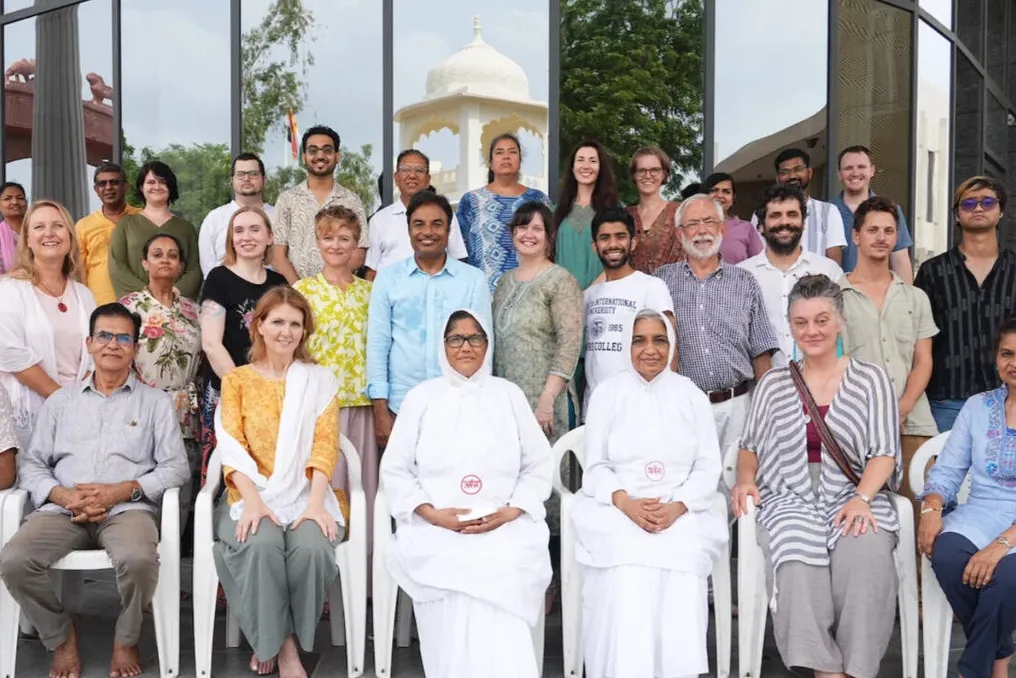
Last month, these traditions welcomed an unusual group of visitors: nearly three dozen students, scholars, and faculty members from eight countries who spent three weeks not just studying Jainism, but living it. This immersive summer program, which began on July 20th and concluded on Friday, was the result of a collaboration between the University of Florida International, Long Beach State University, the Jain Education and Research Foundation (JERF), the Vishwa Bharati Jain Institute, and South Californian philanthropist Dr. Jaswant Modi, whose support made this initiative possible.
Rather than viewing Jainism as an academic subject confined to classrooms and textbooks, the organizers designed a program that allowed participants to experience the philosophy through daily practice. Each morning began with meditation. Students attended lectures on Jain philosophy, Prakrit—the ancient language of many Jain scriptures—as well as on the fundamental principles of 'Ahimsa' (non-violence), 'Anekantavada' (multiplicity of viewpoints), and 'Aparigraha' (non-attachment to possessions).
Furthermore, they interacted with monks and nuns, observed their strict daily routines, and experienced a life based on simplicity, compassion, and mindfulness. Ann Valleli, a professor at the University of Ottawa and one of the leading scholars of Jainism in the Western world, noted: 'It was a very intense week, and it was a huge experience.' Describing the packed schedule, she added: 'Our classes start at 9:00 AM and run until 10 o'clock, 11 PM.'
The program is the result of months of planning by scholars in India and the United States. The University of Florida International, which hosts the first established Jain studies departments in the US, worked closely with Long Beach State University to develop the curriculum. The Jain Education and Research Foundation helped coordinate the academic and logistical aspects of this initiative, while the Vishwa Bharati Jain Institute opened its extensive campus and monastic community to international participants.
At the heart of this effort lies a broader mission: to present Jain philosophy to a global audience at a time when its central teachings on non-violence, environmental sustainability, restraint, and respect for diverse viewpoints have gained new relevance. A significant part of this vision was supported by Dr. Jaswant Modi, a physician, entrepreneur, and philanthropist, whose long-standing support for Jain education and higher learning has helped create academic programs across the United States. Modi, who has contributed tens of millions of dollars to educational and religious causes in the United States, India, and worldwide, provided the primary financial backing for this year's summer school.
This physician-entrepreneur, based in La Canada, California, told The American Bazaar: 'I was born in India into the Jain faith, and these principles of Ahimsa, compassion, and respect for all living beings guided my entire life as a doctor.' He continued: 'After my medical career, I realized that philanthropy allows me to heal on a larger scale, not just one patient at a time. I contribute to Jain education because I believe that young students in America should be introduced to this ancient wisdom of tolerance, non-possessiveness, and multiplicity, which is currently undervalued.'
The program also coincided with an important date: this year marks the 300th anniversary of the founding of the Terapanth order, giving participants the opportunity to witness commemorative events while studying one of Jainism's most influential traditions. Founded in the 18th century by Acharya Bhikshu, the Terapanth order is characterized by centralized leadership and a disciplined monastic structure. Its monks and nuns actively travel to propagate Jain teachings rather than remaining in permanent monasteries.
Over the three weeks, students discovered that the learning extended far beyond formal lectures. Meals turned into lessons in mindful eating. Silence became a form of contemplation. Conversations with monks and nuns often continued long after scheduled sessions. Participants learned not only the philosophical foundations of Jainism but also how these principles shape daily decisions—from diet and consumption to conflict resolution and environmental responsibility.
For many students, such deep integration transformed abstract ideas into real-life experience. 'I was surrounded by scholars and was able to meet Sadhvis and Sadhus, and it was simply wonderful,' shared Carol Rodriguez, one of the participants holding a Ph.D. in Jain Studies from the University of Florida.
The Cuban scholar earned her bachelor's and master's degrees in Jain Studies at the University of Florida International in Miami, where she translated parts of the 'Lilavatisara,' a 13th-century work by the Jain monk Jinaratnasuri. The international composition of the group further enriched discussions, as participants brought diverse academic experiences and cultural perspectives, fostering conversations that reflected Jainism's emphasis on dialogue and multiple viewpoints, rather than absolute certainty.
Organizers hope that this program will serve as a model for future international collaborations in religious studies, philosophy, sustainable development, and peace education. Unlike traditional exchange programs, the Ladnun initiative invites participants to become temporary members of a living spiritual community, where learning occurs not only through formal classes but also through observation and daily practice.
When the summer school concludes on July 7th, participants will return to their universities and communities around the world, taking with them not only lecture notes and academic credits. They will leave with direct experience of a philosophy that has quietly existed for millennia, and memories of a small Rajasthani town where Jainism was not just studied, but lived, for three weeks.