Several Chinese brands have expressed ambitious plans to establish domestic production in Brazil, with some having already started the process and others holding contracts or being in the planning phase for vehicle localization.
The first Chinese brand to establish itself in the country was Chery, which inaugurated its unit in Jacareí, São Paulo, in 2014. Subsequently, in 2017, operations began to be managed by the Brazilian group Caoa, which already operated a factory in Anápolis, Goiás, dedicated to producing Hyundai models.
In the current scenario, new manufacturers are arriving, with their operations supervised by the Chinese headquarters. There is a strong focus on developing electrified vehicles, although some manufacturers also offer combustion engine options in specific niches.
Caoa Chery
Currently, Caoa manufactures Chery vehicles exclusively at the Anápolis, Goiás plant. Models such as Tiggo 5X, Tiggo 7, and Tiggo 8 are produced under the CKD regime, while plug-in hybrid versions are imported directly from China. The Caoa Group will continue to represent Chery, even with the entry of the Chinese headquarters through other brands. Cars manufactured in Brazil already incorporate local processes such as painting, welding, and the use of certain components.
Caoa Changan
The Caoa Group also represents Changan in the Brazilian market, starting its activities with the luxury division Avatr in 2025. In 2026, domestic production of the Uni-T and CS75 models began in Anápolis, Goiás, using the piece-by-piece assembly system. This method is similar to that adopted by GWM, as components do not arrive in kits, which simplifies parts localization. Locally produced Changan vehicles already undergo welding, painting, and other procedures carried out in Brazil. The brand plans to introduce a third model soon, the CS55.
GWM
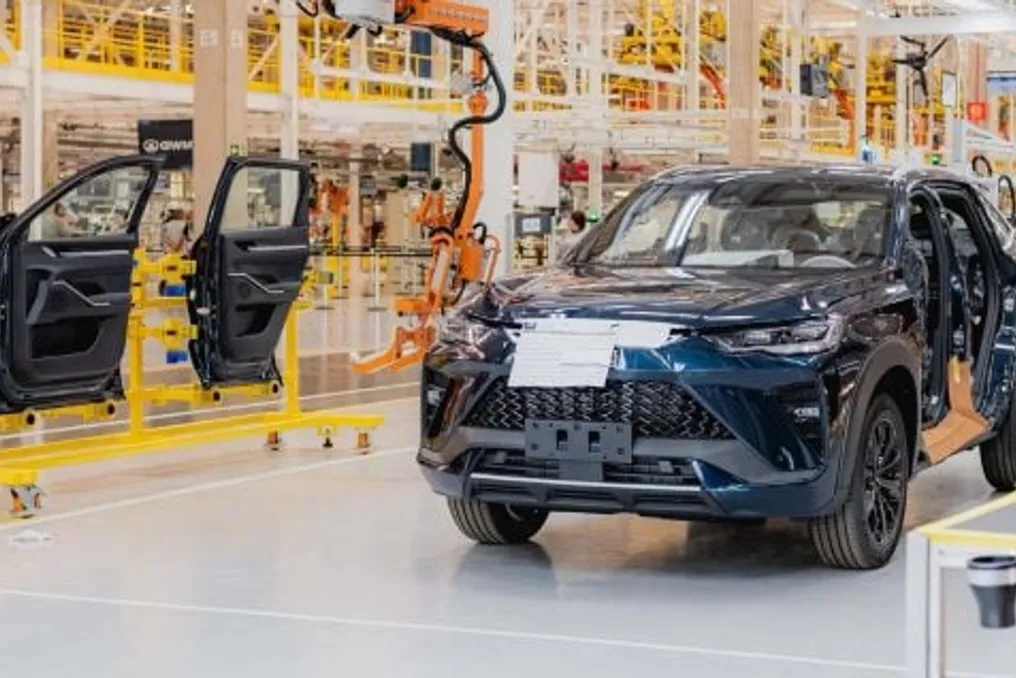
GWM was the first Chinese brand of this new wave to settle in Brazil. In 2021, it acquired the deactivated Mercedes-Benz factory in Iracemápolis, São Paulo, even before commercializing its automobiles in the national territory. Initially, the project planned the production of the medium pickup Poer P30 in hybrid and diesel versions in Brazil, but the success of the Haval H6 forced a change in plans. Local production began on August 15, 2025. After the launch of the Haval H6, GWM introduced the Poer P30 and the Haval H9, both equipped with a turbodiesel engine. The three national models are assembled piece by piece and already feature components manufactured in the country. GWM has already contacted local suppliers aiming to increase the nationalization rate of its vehicles and confirmed the opening of a second factory in the state of Espírito Santo. Furthermore, a development center is being developed in Iracemápolis. The national Haval H6 already has a flex engine, and the entire line marketed in Brazil has received adaptations for local taste, such as firmer suspension and black wheels.
BYD
BYD frequently attracts attention in the segment of new Chinese brands due to its aggressive marketing strategy and high sales volume. The company acquired the factory located in Camaçari, Bahia, which had been built by Ford in 2023. Several promises were made regarding production schedules. Initially, production was supposed to start at the end of 2024, but this date was postponed for several reasons. Effective operation began in September 2025. BYD performs the assembly of its cars in Brazil under the SKD regime, where vehicles arrive in semi-finished kits. The processes executed locally are limited to joining the parts, without involving welding, painting, or local components; tires are delivered mounted on wheels and inflated. During the factory inauguration in 2025, it was promised that the transition from SKD to fully localized production would occur in August 2026, but in July 2026, the deadline was extended until the end of the year. Currently, BYD assembles the Dolphin Mini, Song Pro, and King models.
Geely
Geely entered Brazil with the support of Renault. This collaboration culminated in Geely acquiring 26.4% of the French brand's Brazilian subsidiary. This gave Geely the advantage of being able to use the Renault factory in São José dos Pinhais, Paraná, as well as all the consolidated infrastructure and distribution network. The first planned national product was the medium SUV EX5 EM-i, but the success of the electric hatchback EX2 required a last-minute change. Geely plans to start assembling the EX2 under the SKD regime by the end of the year, and it will be launched updated, with an improved battery, interior finish improvements, and a more advanced ADAS package. The possibility of nationalizing the EX5 EM-i was not ruled out with this readjustment of plans.
GAC
GAC established an agreement with HPE Automotores to utilize the idle capacity of the factory in Catalão, Goiás, which currently only produces Mitsubishi vehicles. The brand has also evaluated other locations to establish its own plant, including the state of Amapá. With this partnership with HPE Automotores, GAC can be enabled in the Mover Program. The company will invest R$ 1.3 billion in the Catalão factory to enable local production. Additionally, GAC will create a local research and development center focused on creating flex engines and other technologies suitable for Brazilian conditions. It has not yet been disclosed what the initial production method of GAC in Brazil will be or which models will be localized first.
Leapmotor
The Stellantis group holds 51% of the shares of Leapmotor, a Chinese startup specializing in electrified vehicles. Its operations outside of China are managed by the conglomerate that owns Fiat and other brands. Stellantis has already confirmed that Leapmotor cars will be manufactured at the Goiana, Pernambuco factory in 2026. Production will initially be under the SKD regime, with a gradual progression to CKD until full localization is achieved. The most anticipated model to start this process is the C10 SUV, which will leave the Pernambuco factory already with a facelift, accompanied by the B10 and C16 models.
MG Motor
MG Motor is a British-origin brand owned by the Chinese company SAIC. The company confirmed that it will assemble the MG4 Urban model at the multi-brand PACE factory in Horizonte, Ceará, under the SKD regime by the end of 2026. This plant currently manufactures Chinese electric vehicles from Chevrolet, such as the Spark EUV and the Captiva EV. For now, MG Motor has not presented plans to build its own factory in Brazil.
Regarding Omoda & Jaecoo, Chery global resumed its presence in Brazil with this pair of brands, created with a focus on export. From the beginning, the company indicated its intention to produce vehicles locally. Currently, the company is negotiating to acquire the Jaguar Land Rover factory located in Itatiaia, Rio de Janeiro. Although the deal has not been finalized, there have been discussions between Chinese representatives and the city hall.