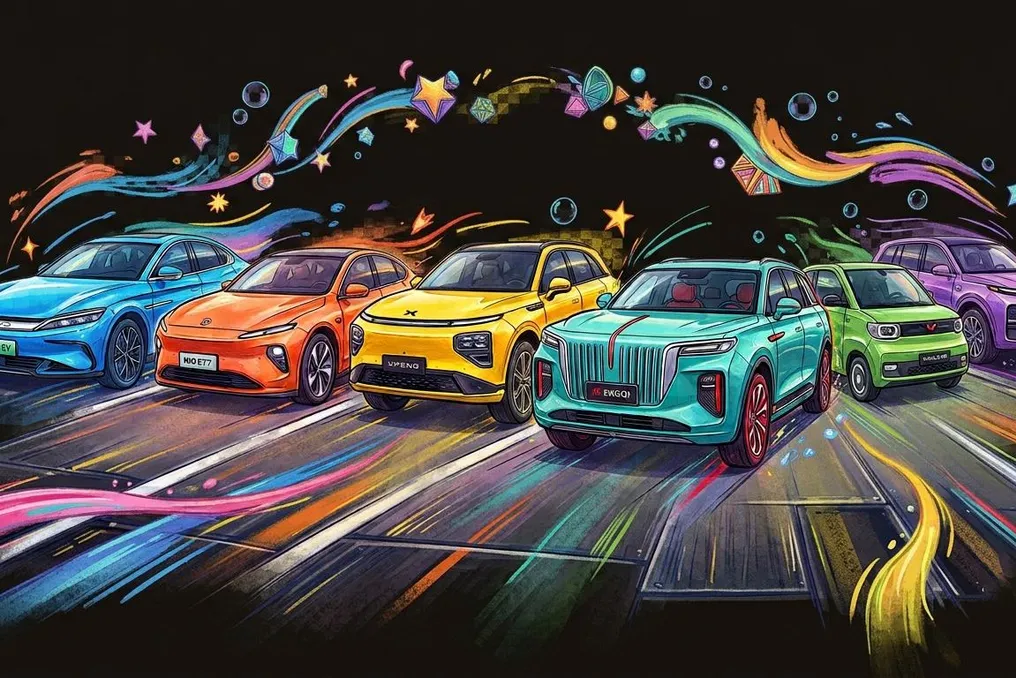
The Chinese automotive market is showing significant growth, reaching 34.4 million sold vehicles in 2025, which is 9.4% more than the previous year. Furthermore, China has established itself as a leading global exporter of vehicles, shipping 8.32 million units in 2025, representing a 30% increase and marking the third consecutive year in this role.
The share of Chinese brands in China's domestic passenger car market exceeds 70%. Among the ten largest global automakers, three companies have Chinese origins: BYD ranks 5th, Geely 7th, and Chery 10th.
The table presents the total shipments of major Chinese automotive groups for 2025. The overall figures for five state-owned groups include products from joint ventures with foreign brands such as Volkswagen, Toyota, General Motors, and Honda, indicated by an asterisk.
Various cities in China are production centers: Shenzhen, founded in 1995 (batteries) and producing cars since 2003, showed a volume of 4.60 million in 2025. Hangzhou, existing since 1986 and producing cars since 1997, reached a volume of 4.12 million. Wuhu, Anhui province, produced 2.63 million since 1997.
Other production centers include Baoding in Hebei province (since 1984, 1.32 million), Chongqing (origins dating back to 1862, 2.90 million), Shanghai (state-owned, about 4.5 million), Changchun (China's first factory, since 1953, about 3.3 million), Beijing (state-owned, about 2.0 million), Guangzhou (state-owned, about 1.72 million), and Wuhan (state-owned, since 1969, about 1.85 million).
The cumulative sales volume of brands such as NIO, Li Auto, XPeng, Leapmotor, and Xiaomi Auto amounted to 2.16 million in 2025. The AITO brand showed a volume of 0.59 million in 2025.
In Uzbekistan, several Chinese groups are simultaneously carrying out local assembly or have already launched it. Among the three prominent centers are Jizzakh, Tashkent, and Bukhara, and the list of brands on the assembly lines continues to expand.