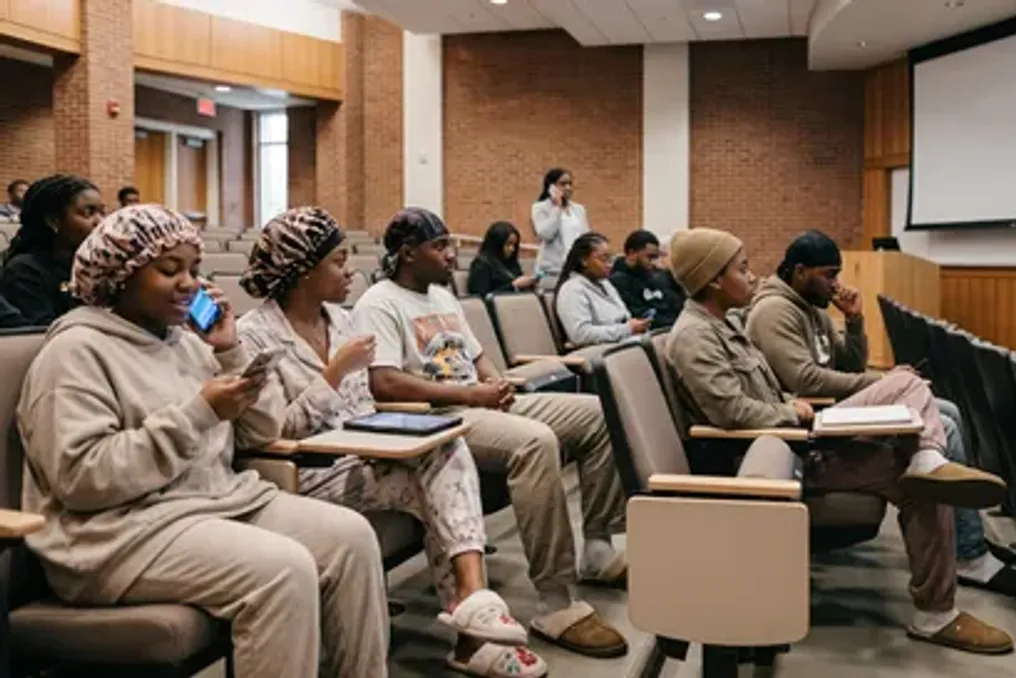
The new dress code at Tuskegee University, which prohibits the wearing of hats, slippers, and dressing gowns, has sparked active discussions. The question arises whether these rules are a step towards increasing professionalism or an outdated restriction.
The university's decision to ban students from attending lectures in casual wear, including slippers, sleeping caps, and dressing gowns, was met with mixed reactions. Earlier this week, IOL reported that students are also prohibited from wearing revealing clothing, and they are strongly advised to refrain from using phones during classes.
In a letter addressed to prospective students' parents, the American Tuskegee University stated that students should dress in business suits and appropriate footwear, as they would for meetings and other professional events. Tuskegee President, Dr. Mark A. Brown, stated that the goal of these measures is not to restrict students but to prepare them for the workplace environment.
Although many believe that the university, located in Alabama and part of the Historically Black Colleges and Universities (HBCU), is moving in the right direction, others argue that these rules are long outdated.
Is the situation really that serious?
According to Linda Herbst of Nomin8 Recruitment, the situation is indeed important. She stated that she personally agrees with the view that sleepwear, including slippers, hats, and similar attire, should not be allowed in university classrooms. In her words, this is ultimately related to self-respect, respect for other students, faculty, and the institution itself.
Discussing the situation with IOL, Herbst added that the requirement to wear formal business attire, such as suits, is an excessive tightening of the dress code. She noted that for many years, universities and colleges have maintained a culture of casual wear.
Herbst emphasized that there is a clear distinction between ordinary casual wear and what is inappropriate in an academic setting. Clothing that is too revealing or resembles home wear should not be considered acceptable. She also mentioned that there has been a long-standing discussion about whether educational institutions should teach only academic subjects like history or geography.
In her opinion, many parents and the public believe that educational institutions should equip students with practical life skills, including financial literacy, professionalism, and workplace etiquette. Encouraging an appropriate dress code, in her view, is part of preparing young people for the expectations they will face after graduation.
Job Hiring Prospects
Herbst believes that first impressions are crucial when hiring personnel. She advises candidates preparing for interviews to dress appropriately for the position they are applying for. For example, when applying for a Chief Executive Officer position, one cannot arrive in chinos and a golf shirt; a business suit is expected. Conversely, showing up in a three-piece suit for a diesel engine mechanic interview would be equally inappropriate. Appropriate attire demonstrates an understanding of the environment, the role, and the expectations of those around them.
Herbst notes that people form opinions based on appearance within seconds. While clothing should never be the sole measure of a person's abilities or character, it undoubtedly influences the first impression. Universities have the opportunity to help students understand this reality in a balanced and practical way. A sensible dress code is aimed not at restricting individuality but at instilling professionalism, self-respect, and awareness of how appearance can affect career opportunities.
Neatness is Respect
Renowned South African model, entrepreneur, and founder of Roberta Alessandri Models and Roberta Alessandri Events, Roberta Alessandri, stated that a neat appearance is a sign of respect. She shared that when going shopping, she doesn't care how she looks and often goes out in home clothes without makeup. However, when she has a meeting or is working, she makes sure to look neat and professional, paying attention to everything from her nails to her hair. For her, this is a demonstration of respect for the interlocutor, showing that she made an effort, and it is reflected in her appearance.
Alessandri argues that this shows self-care, which in turn reflects on work. She believes that the first impression plays a decisive role—from how a person enters a room to their facial expression and style. She emphasizes, however, that clothing does not necessarily have to be expensive; it just needs to look good. This is her starting point, to which one must add manner of speaking, eye contact, and personality. Thus, it is not just about clothing or appearance, since all people are beautiful, but about having confidence, while the clothing should look neat along with well-kept hair and good makeup.
IOL Reader Opinions
Commenting on this issue on the IOL Facebook page, Tasha Tasha stated that such rules should be implemented in universities, South African shopping malls, or any other public places. Valerie Oliphant, another IOL reader, supported this view, noting that students already do whatever they want and cannot wear anything to school, and called for respect for oneself and others.
Reader Beverly Yanse van Rensburg added that education is a privilege, and appropriate clothing is a sign of respect for oneself and others. On the other hand, Mark Studius argued that dressing gowns, slippers, and hats are not revealing items, but rather cover the body, and asked why mini-skirts are not banned then. Mahene Patrice Benzan added that this is a desire of universities to introduce a school uniform.