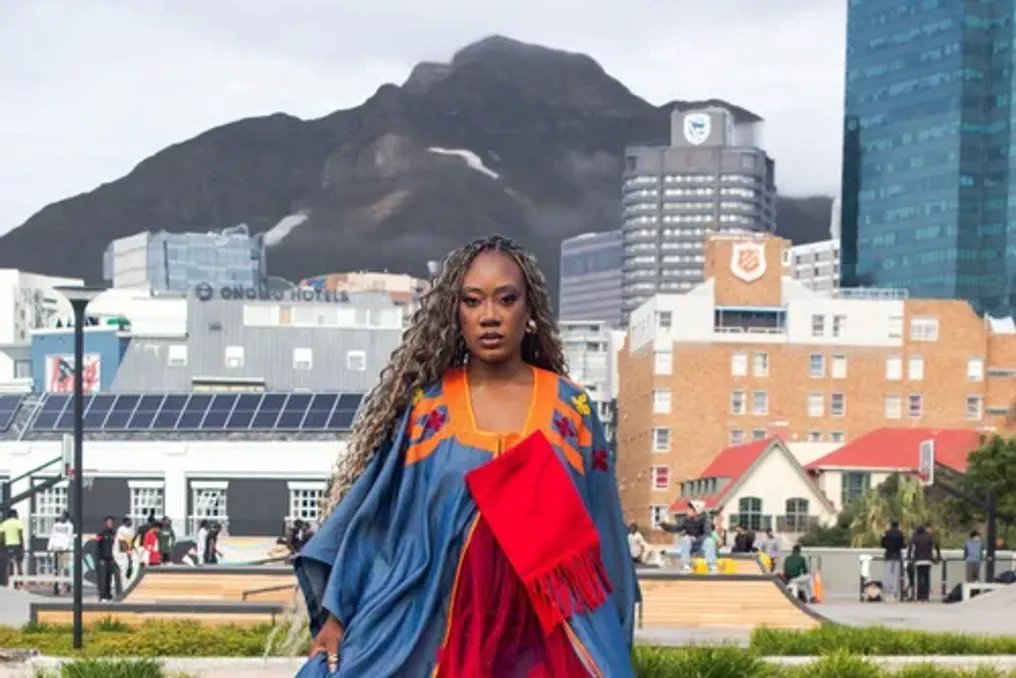
Nyaniso Bouris, founder of OneThread Africa, challenges conventional notions of sustainability in the fashion world, highlighting ancient African practices that harmoniously blend culture, community, and the environment.
For a long time, the fashion industry viewed sustainability as a set of requirements: using organic fabrics, reducing carbon emissions, recycling materials, and minimizing waste. However, according to Nyaniso Bouris, this definition is too narrow because it ignores what Africa has practiced for many generations.
In an interview with IOL, Bouris asserts that sustainability on the continent was never solely about saving the planet; rather, it has always been about balancing the interests of people, culture, and nature so that communities can thrive. She explains: 'The definition of sustainability is simply the ability of something to sustain itself at a certain level. It has nothing to do with the environment. We took this huge definition and made it tiny.'
This perspective challenges the mainstream discourse on sustainable fashion, which often focuses on eco-friendly materials and production methods while overlooking issues of accessibility, cultural preservation, and economic realities.
Sustainability starts with people
One of Bouris's most striking observations is that environmental conversations can sometimes come from a privileged position. She gives a simple but powerful example: 'People will say you shouldn't use plastic straws because of turtles. True. I love turtles. But for someone living in the suburbs of Uganda, have they seen a turtle? Why should I worry about a turtle when my child is hungry?'
Her goal is not to reject climate change or environmental responsibility, but to prove that sustainability must primarily address people's immediate needs. She insists: 'We must think about sustainability from the perspective of how we take care of ourselves to be better prepared to take care of the world around us.'
This philosophy is at the core of OneThread Africa—a platform Bouris created after six years of research into what sustainability looks like across various African industries, including fashion, agriculture, hospitals, and schools. Her findings contradict many models imported from Europe and North America.
Africa has always practiced sustainability
For Bouris, one of the biggest misconceptions is that African brands need to learn how to be sustainable. She believes they practice it constantly. 'As an African brand, you are inherently sustainable. It is inevitable,' she states.
The problem, in her view, is that many brands fail to recognize the value of everyday practices because they have always been part of daily life. She recalls a common domestic habit: 'Every Black person has a bag full of other bags. For us, it's just what you do. Woolworths is now running a whole campaign around this. I like their work. However, it is labeled as sustainability. For us, it is just logical. Why would I throw away store bags that I already have?'
This example perfectly illustrates her argument: many practices currently celebrated globally as sustainable innovations have long existed in African households and communities.
More than dashikis
As international interest in African designers grows, Bouris hopes the world will begin to see the continent's fashion industry more broadly than through stereotypes. 'I am happy that people are starting to understand that African fashion is more than dashikis,' she says.
She points to a rising generation of designers creating world-class collections while remaining deeply rooted in local craftsmanship and narrative. 'We have brands that create fashion on a scale that Western fashion could never achieve, something Western fashion only dreams of.'
Among the brands that inspire her are LilaBare Design House from Kenya, Kilèntàr from Nigeria, and Vintu from South Africa, all demonstrating the breadth and sophistication of contemporary African design.
Nyaniso Bouris, founder of OneThread Africa, questions traditional views on fashion sustainability, emphasizing ancient African practices that balance culture, community, and nature.
A different kind of luxury
While luxury fashion increasingly uses sustainability as a marketing ploy, Bouris believes African designers offer something more authentic. 'Because sustainability is so woven into who you are, you are simply creating art,' she asserts.
Instead of designing around sustainability trends, many African brands naturally integrate responsible production, cultural heritage, and community impact, as these values have always been part of the creative process. For Bouris, this is a competitive advantage that the continent has yet to fully realize.
'African brands are experts in sustainable fashion,' she declares. 'Other people will say they are sustainability experts, but that is because they conducted research, not because they do it. There are African brands that have been doing it for years and years, and nothing makes you more expert than that.'
As global fashion continues to seek more ethical ways to produce clothing, Bouris believes the industry does not need to reinvent sustainability. It simply needs to acknowledge that some of the most valuable lessons have been woven into African fashion throughout history.