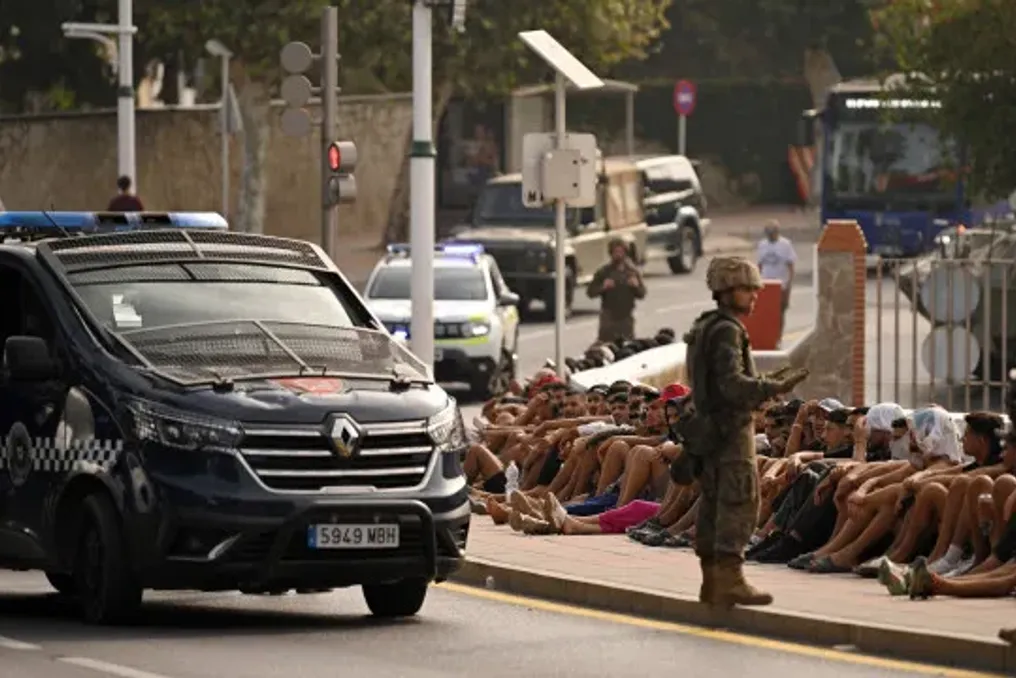
Most European Union countries called for urgent negotiations on Saturday regarding the sudden arrival of tens of thousands of migrants in the North African enclave of Ceuta, which belongs to Spain.
Most European Union countries called for urgent negotiations on Saturday regarding the sudden arrival of tens of thousands of migrants in the North African enclave of Ceuta, which belongs to Spain.
In an open letter signed by leaders from 22 of the 27 EU countries, a demand was made for the bloc's interior ministers to hold a video conference 'as a matter of urgency.' The goal of this meeting is to agree on an immediate coordinated response and prevent further uncontrolled border crossings.
Twenty-two European Union leaders issued an open letter requesting an emergency video conference to address the crisis in Ceuta. The signatories argue that massive and uncontrolled crossings, or the instrumentalization of migration and other hybrid threats, cannot be allowed to create the impression that it is feasible to enter the European Union illegally and that this entry could evolve into a legal stay.
In this letter, addressed to the Irish presidency of the EU, the President of the European Council Antonio Costa, and the President of the European Commission Ursula von der Leyen, the leaders state that recent events demand an immediate and coordinated European response.
The initiative was led by Italian Prime Minister Giorgia Meloni, whose country had temporarily suspended Schengen area rules regarding Spain, and by her Danish counterpart Mette Frederiksen, who suggested on Friday that the EU should consider suspending Schengen cooperation with Spain.
Other participants in the signing included German Chancellor Friedrich Merz and the prime ministers of Hungary, Sweden, and Poland, although the French and Portuguese leaders, direct neighbors of Spain, did not sign the document.
The proposed meeting aims to enable a joint assessment of the situation and reach a consensus on a coordinated European response. This includes the rapid activation of available European Union mechanisms and the necessary support for Spain to restore effective control of its external border and block new disorderly entries.
The letter emphasizes that ministers must specifically analyze the possibility of intensifying the support of Frontex, the agency responsible for border surveillance, as well as the efficiency of collaboration between the European Union and Morocco.
In recent days, tens of thousands of migrants have illegally crossed into the Spanish enclave of Ceuta, coming from Morocco. Spain stated that the situation was almost normalized, while its Prime Minister Pedro Sanchez criticized the stance he described as 'selfish' by certain EU countries.
On the other hand, the French Minister of the Interior, Laurent Núñez, stressed that there is no reason to suspend Spain from the Schengen area, given that cooperation on irregular immigration control is 'very, very good'.
During a press conference about the fires in France, Núñez was questioned about the implications of the Ceuta crisis. He defended that the focus should be on implementing the asylum and immigration pact, which came into force on June 2nd, but which requires legal instruments to be effective.
Categorically responding to the question of suspending Spain's participation in the Schengen area, the French minister stated: 'Not at all'. He highlighted the importance of the partnership with Spain, citing the example that when France detains irregular migrants near the Spanish border, approximately 70% of them are readmitted to Spain.
The arrival of a large flow of people from Morocco to Ceuta generated criticism of the Spanish government's migration policy from various European countries, with Italy being a pioneer in requesting the suspension of free movement with Spain and announcing measures to restrict and increase border surveillance.
Additionally, France announced on Friday, in reaction to the Ceuta crisis, the reinforcement of its surveillance system on the borders with Spain, and the Interior Minister confirmed today that this will result in the addition of 334 agents.
Núñez recalled that since the jihadist attacks in France in November 2015, Paris decided to reestablish controls on borders with neighboring countries, but that this measure will be intensified due to the current migration crisis between Spain and Morocco, for as long as necessary.