For many decades, the dominant scientific view held that the extinction of dinosaurs, which occurred 66 million years ago, was primarily the result of a long period of intense cold following an asteroid collision. However, a recent investigation points to a much faster and more destructive event: global firestorms capable of killing large reptiles within hours.
The impact of the asteroid, which was about 10 kilometers in diameter and struck the Yucatán Peninsula in Mexico, resulted in the formation of the Chicxulub crater and the vaporization of enormous amounts of rock. Part of this material turned into small rocky droplets, called spherules, which dispersed across the planet and returned to the atmosphere at very high speeds.
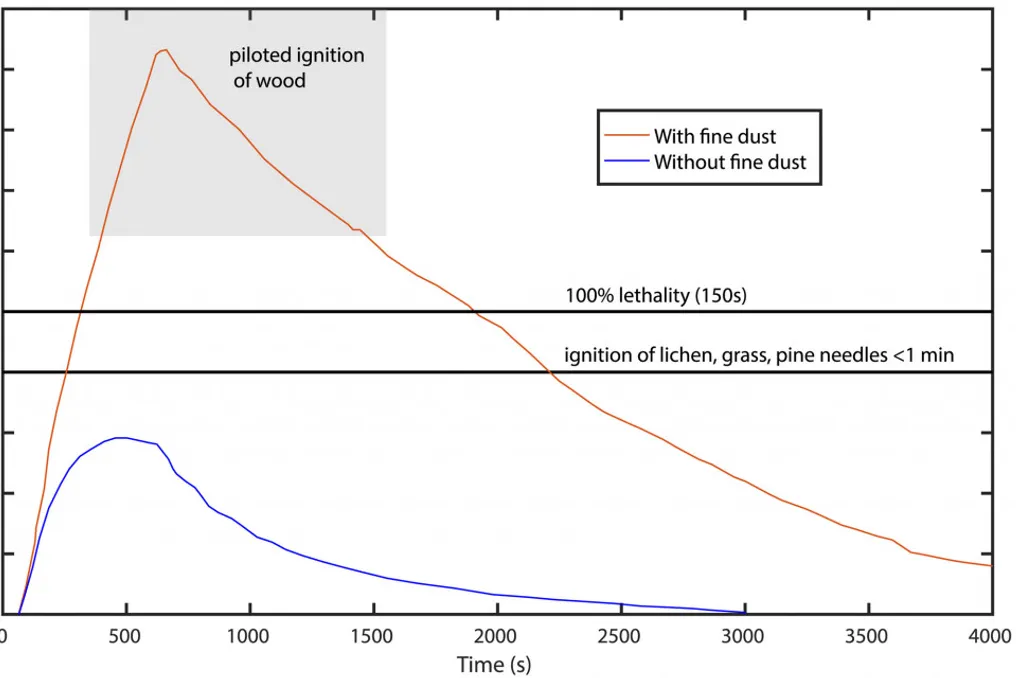
Previous computational models predicted that the friction of these particles during their fall would generate a strong pulse of thermal radiation, lethal to sensitive animals, but insufficient to start widespread fires in global vegetation. However, the analysis of a new study revealed that these calculations neglected an essential factor: a dense layer of fine silicate dust, originating from rock vapor that did not immediately condense into spherules.
Evidence of this dust was detected in 2023 at the Tanis fossil site in North Dakota (USA) and later confirmed in the Raton Basin, located on the border between Colorado and New Mexico, a key area for the geological marker marking the transition from the Reptile Age to the Mammal Age.
A fatal greenhouse effect in minutes
According to the scientists, this dust acted as a thermal insulator, functioning like a blanket that prevented radiation from escaping into space and consequently returning heat to the Earth's surface. It is estimated that the intensity of the heat on the surface was 3.5 times greater than what would be calculated considering only the fall of spherules.
The study concluded that terrestrial animals exposed to this thermal storm suffered heat exposure about 17 times higher than the level considered fatal to humans. Brandon Johnson, the study's lead author, stated to Space.com: 'We are in a scenario where we could have essentially killed almost everything on the surface within the first or second hour.'
Although the radiation might not have been sufficient to ignite thick tree trunks directly, it easily exceeded the ignition point of grasses, lichens, and dry leaves, providing the flammable material necessary for catastrophic wildfires.
Survival and theoretical flaws
Organisms that managed to shelter underground or in water had better chances of surviving the initial heat wave. Later, the same dust that caused the surface burning remained suspended, blocking sunlight for several years and initiating the prolonged 'impact winter' traditionally associated with mass extinction.
Despite the coherence of the presented model, there is still one point that needs verification: to date, direct records of wildfires caused by this dust layer have only been found in North America. Paleontologist Alfio Alessandro Chiarenza, from University College London, who was not part of the research, observed: 'It is possible that we will eventually find the record of these burnings on a truly global scale, but we simply do not have it yet.'