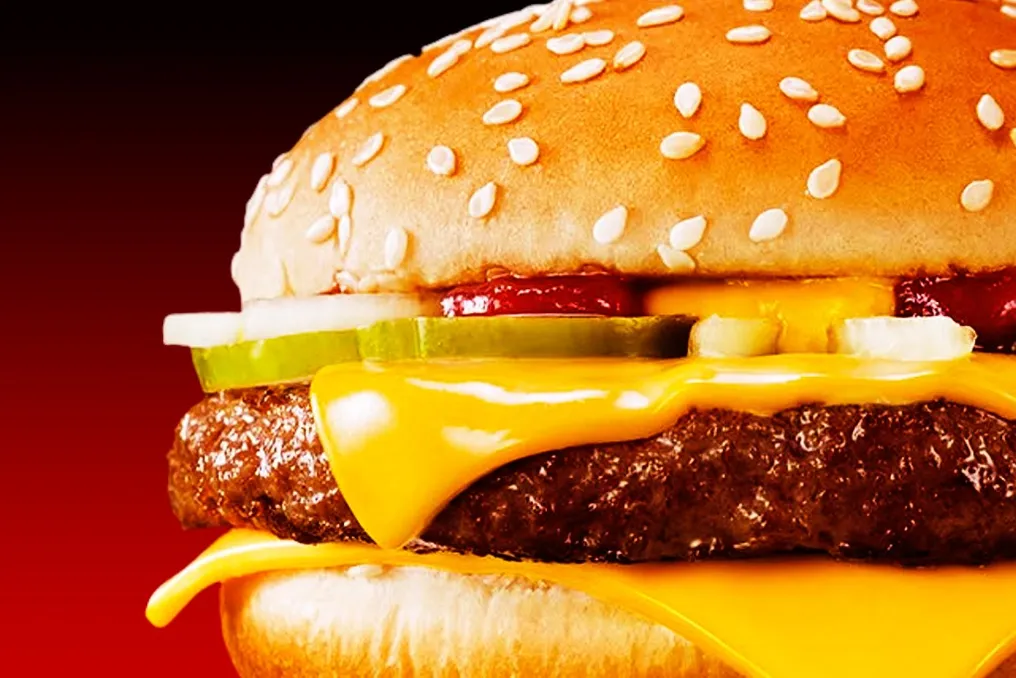
The name of the McDonald's Quarter Pounder sandwich derives from a unit of measurement, written as 'Quarter Pounder,' without the letter 'i'. This very popular item on the McDonald's menu appeared in 1971.
Al Bernardin, an entrepreneur who owned two franchises of the restaurant in Fremont, California, identified a gap in the menu: the need for a sandwich with a higher proportion of meat to bread. To meet this demand, he created a new snack containing a quarter pound of meat.
The pound (lb in English) is a mass unit used in the United States, equivalent to 453.6 grams. A quarter of this measure corresponds to approximately 113 grams, which was the weight of the raw hamburger in the sandwich. The sandwich's name functioned as a marketing strategy because the term Quarter Pounder immediately communicated that it was a more substantial meat option compared to other items on the menu. At that time, a quarter-pound hamburger was considered quite voluminous compared to market offerings, although today there are options with even larger meats.
The Quarter Pounder was implemented nationwide in the US in 1973. When it arrived in Brazil, the chain opted to adjust the name to 'Quarterão com Queijo,' omitting the 'i' from 'quarteirão' (which means a city block). This translation is peculiar, since 'quarteirão' in Portuguese usually refers to an urban block, and not a fraction of weight, but the name was ultimately accepted by the public.
Although Brazil managed to adapt a name based on a foreign unit of measurement, other countries adopted different solutions. In France, the snack is called Royal Cheese; in Portugal, it received the name McRoyal Cheese. In Germany, the designation is Hamburger Royal TS, where TS stands for 'Tomate und Salat' (tomato and salad), due to the inclusion of these ingredients in the snack. In Sweden, QP Cheese is used, while in Spain the company maintained a more literal translation: Cuarto de Libra con Queso.
Hong Kong presents a notable case. There, the snack was called 足三兩 (zú sān liǎng), which translates to 'three full taels.' The tael is a traditional unit of mass in the country. Since one tael equals 37.8 g, three taels total 113.4 g, corresponding to the original weight of the sandwich. Thus, the inhabitants of Hong Kong sought to preserve the concept of the original name, but using a unit of measurement familiar to the local population. However, this sandwich is no longer offered in Hong Kong.