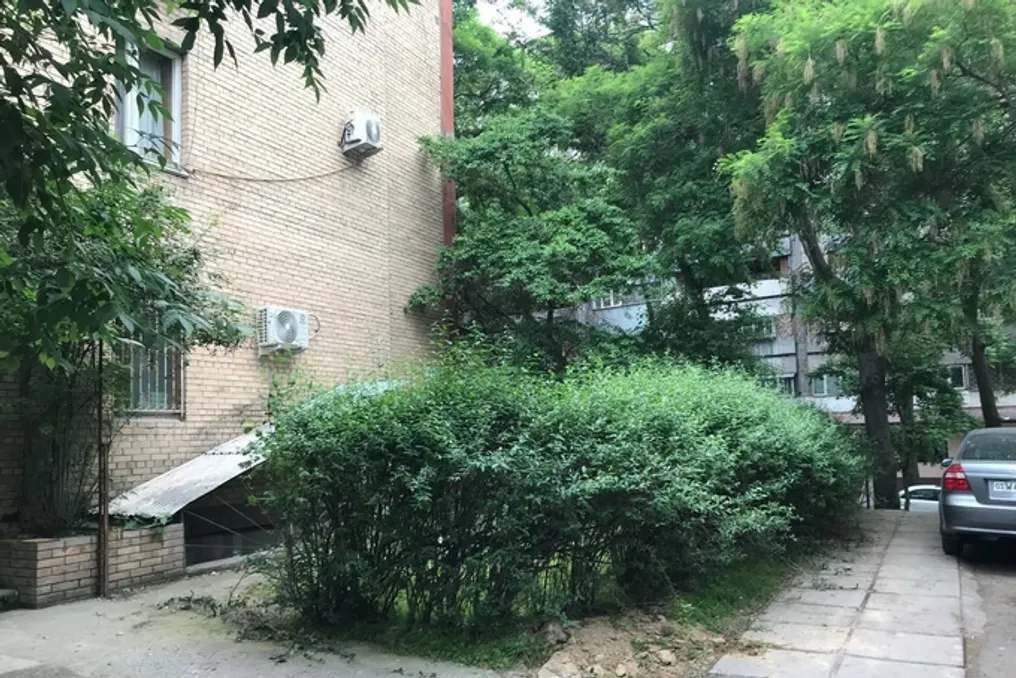
Despite the obvious need to cool the urban environment, there is persistent concreting of courtyard spaces. Just recently, the head of the Presidential Administration, Sa'id Mirziyoyev, condemned the destruction of trees and a playground in the 'Lolazor' mahalla in Tashkent, calling it an act of barbarism and a crime.
Similar stories
Popular
A few days earlier, following public outcry, construction in the 'Chulpan' mahalla was halted in the middle of a once green courtyard, but the district hokim's promise to consider residents' opinions was not fulfilled.
In 2021, as part of the 'Obod Mahalla' ('Improved Mahalla') program, the capital's hokimiyats conducted large-scale landscaping, during which flowerbeds were destroyed, fences were cut down, and hedges were pulled out and then covered with imported soil. Courtyards and playgrounds were concreted, and high curbs were installed everywhere.
Today, in the summer, the playgrounds are subjected to excessive heating during the day, and mini-ponds form during rainfall. Furthermore, the installed curbs pose a threat to children when vehicles are moving.
Uzbekistan President Shavkat Mirziyoyev questioned the advisability of such massive curbs that same year. Previously, a year before that, the head of state warned that due to the dishonesty of some leaders in the capital's residential areas, open space for walking, sports, and outdoor recreation with children was disappearing.
In accordance with the State Program Strategy 'Uzbekistan-2030', last year it was planned to implement measures to improve the ecological appearance of mahallas, increase street greenery, and form a favorable living environment. Last autumn, it was reported that 'large-scale' restoration of occupied green areas and playgrounds had begun by presidential order, pointing to hundreds of possible violations in Tashkent.
Continued disregard for residents' interests
Despite numerous regulations, directives, and promises to consider citizens' wishes, district hokimiyats continue to turn former green courtyards into concrete structures.
Residents of the 'Chulpan' mahalla, where courtyard construction was stopped after a conflict that lasted over a year, raised the alarm again. According to them, the excavation site located where a football field, a former mahalla building, and part of a playground were situated was filled in (although the foundation was left underground), but now a significant part of this area is covered with gravel and is being prepared for concrete pouring.
Lola Saifi, founder of the Human House gallery and a resident of the mahalla, reported that the project has been changed multiple times despite discussions with residents and assurances from the district hokim Bakhtiyor Rakhmankulov that suggestions would be taken into account. She noted: 'Residents discussed the project for several days. Our hokim Bakhtiyor Rakhmankulov told everyone that everything would be built as the residents asked. And what happened? Everything is being poured with concrete.'
Saifi also pointed to the constant change in the project, the reduction of green areas, and the sudden desire to replace the stadium with a barbecue area. She recalled that Sa'id Mirziyoyev had previously urged officials to focus on developing a green city, emphasizing the difficulty of conveying the importance of greenery and clean air to officials.
Residents demanded that the hokim provide for more green areas and abandon the construction of wide concrete paths and fences. One resident said that builders ignore their requests, citing instructions from the chief.
Another resident mentioned that before work began in the courtyard, there was a lawn with an irrigation system maintained by neighbors. Residents tried to preserve natural ground cover on the playground, but when asking mahalla officials about urban planning standards and rules (SHNK) regarding surfacing, the employees evaded answering.
Plans to install metal fences between the children's and workout areas also caused concern. Residents insisted on creating an accessible environment but faced plans to install a metal fence with bushes in the middle.
A participant in the appeal emphasized that previously children played on grass where they could run barefoot, but now the workout and children's playground is planned to be completely covered with concrete and plastic.
Residents also protested against the three-meter path provided for in the project, questioning its purpose other than possibly for military or vehicle passage.
In the 'Turon' mahalla, which the 'Gazeta' previously wrote about, the entire courtyard was also covered with concrete, leaving the playground exposed to direct sunlight.
The possibility of turning courtyards and streets into parks
Worldwide, people prefer to have more greenery, trees, and shade directly near their homes. However, authorities, using arguments about 'improvement' and 'creating a comfortable environment,' are effectively emptying courtyard areas, thereby forming new 'heat islands' in the city, which negatively affects both the temperature in the courtyard and inside residential buildings.
An example is the open playground near the Obama Center in Chicago, USA, where wood chips are used instead of concrete, and natural materials, abundant greenery, and sun shelters are used instead of artificial elements.
American architect Christopher Alexander argues in his book 'The Language of Space' that people need open, quiet green areas that they can use if they are available.
Tashkent suffers from a severe shortage of parks, and on many streets, even those that appear green, it is difficult to find shelter from the sun. There are entire streets where not a single tree has been planted for years after the road widening, such as Parkentskaya.
Courtyard spaces in residential areas are fully capable of becoming such green and shady zones. Authorities can support residents in creating a beautiful environment, and then residents themselves will be interested in taking care of the yard and plants. Restoring flowerbeds destroyed by previous waves of improvement is one such area of support.
Contact with the earth and the process of growth is important for humans. Caring for plants helps strengthen bonds between different generations and fosters a sense of responsibility in children. However, authorities have deprived people of this opportunity, leading to a loss of a sense of belonging and the neglect of ruined flowerbeds.
A global trend is community gardens, which promote human unity, biodiversity development, and aesthetic improvement of courtyards, while also helping to combat loneliness, for example, among the elderly.
Residents must act as co-creators of all improvement projects, as they are the ones who live in these places. Only through open discussions involving people of all ages can a sense of belonging be achieved. If authorities continue to operate under the principle of 'We know best,' conflicts and dissatisfaction will persist.
World cities are implementing strategies to reduce temperature
In recent years, rising temperatures have forced megacities around the world to develop emergency plans for 'cooling' cities and protecting the population from the consequences of extreme heat.
London adopted its first adaptation plan for increasing heatwaves—Heat Ready London. According to a study, heatwaves in 2022 cost the city £1.5 billion, including damage to health, transport, utilities, and emergency services, as well as wildfires. 4,000 additional hospitalizations and 300 preventable deaths were recorded. It is projected that by 2050, the rate of heat-related hospitalizations in the UK could triple, and in 2025, London firefighters will extinguish 86 elderly fires in the summer months.
The London plan includes increasing the number of trees and green areas to ensure long-term cooling and shade, expanding access to water bodies, modernizing housing to create cool rooms and free water points, and strengthening healthcare and critical infrastructure systems.
In New York, the mayor announced the adoption of the Urban Forest Plan in the spring, aiming to increase the city's tree canopy coverage from 23.4% to 30% by 2040. Mayor Zohran Mamdani stated that every resident deserves clean air and shade in the heat.
It is noted in New York that trees bring benefits worth $260 million annually, including cleaning 1,100 tons of air, saving energy equivalent to the consumption of 8,000 homes, and absorbing 1.95 million cubic meters of rainwater. The city is also reallocating part of the roadway to favor pedestrians.
Economist Botir Kobilov, Doctor of Sciences from Harvard Business School, USA, asserted back in 2018 that preserving trees and increasing green areas is critically important for Tashkent and other cities in Uzbekistan. He emphasized that trees are an integral part of infrastructure and public health.
Kobilov noted that trees can lower city temperatures by 2–8 degrees Celsius, and planting them near buildings can reduce air conditioning consumption by 30% and decrease thermal energy consumption by 20–50%, according to data from the UN-Habitat. He also pointed out that the presence of trees improves residents' well-being, and most people are willing to pay more for housing near beautiful parks.
Customs authorities play an increasingly important role in ensuring state economic security, the legal and transparent conduct of foreign trade operations, and the stable increase of state budget revenues. Thanks to modern approaches, digital technologies, and strengthened control mechanisms, this system is becoming not only a pillar of economic stability but also an important foundation for protecting public safety.
In this regard, an expanded Council meeting was held at the Bukhara Regional Customs Administration, dedicated to the results of the first half of 2026, with the participation of Deputy Chairman of the Customs Committee N. Musamukhamedov. During the meeting, the work performed during the reporting period was analyzed in detail, achievements and shortcomings were identified, and priority tasks for the second half of the year were determined.
At the meeting, the head of the Bukhara Regional Customs Administration, B. Muratov, presented a report detailing the work done in increasing state budget revenues, strengthening economic security, combating smuggling and customs offenses, and creating more favorable conditions for participants in foreign economic activities.
It was noted that in the first six months of the current year, the administration collected customs payments totaling 2 trillion 120 billion sums. Of this amount, 881.9 billion sums were provided as customs benefits stipulated by legislation. The remaining 1 trillion 238 billion sums were timely and fully paid into the state budget, contributing to the stability of the country's economy.
The meeting also highlighted the results of operational measures aimed at ensuring public health and safety. Specifically, 14.68 kilograms of narcotics planned for illegal import were discovered in a timely manner, as well as 147.23 kilograms of medicinal products, preventing their spread within the country. Such achievements are the result of systematic work conducted in cooperation with law enforcement agencies.
A total of 9,947 customs inspections were conducted during the reporting period to enhance the efficiency of customs control. As a result, 182 cases of customs rule violations were identified, which allowed for the interception of illegal movement of goods and material assets worth almost 27.9 billion sums.
Furthermore, 782 cases of offenses were uncovered within the framework of anti-smuggling and investigative activities. Goods and material assets amounting to 63.3 billion sums related to these cases were processed as material evidence. These figures once again demonstrated the active fight of customs authorities against economic crimes.
The meeting also focused on comprehensive support for system employees and strengthening their social protection. During the reporting period, 48 employees were commended for exemplary performance of their duties, and 12 received subsequent ranks. Additionally, a quota for preferential admission of children to higher educational institutions was allocated for 8 employees, and two employees were granted a loan to improve housing conditions. Such social support measures are of great importance for increasing the labor productivity of system personnel and encouraging their devoted service.
During the meeting, the activities of structural units were critically discussed, and specific instructions were given to strengthen the fight against corruption, ensure service discipline and supervisory activities, and approach every task with a sense of responsibility. Important goals were also set for the effective use of digital technologies, improving the risk analysis system, and enhancing the quality of services provided to participants in foreign economic activities.
Based on the meeting results, priority areas were defined: further increasing state budget revenues, expanding a favorable business environment for entrepreneurs, elevating the level of services for participants in foreign economic activities, increasing the effectiveness of combating smuggling and customs offenses, and strengthening the service and executive discipline.
Mammalian teeth generally possess two distinct specializations: crushing or cutting. However, the ideal shapes to fulfill these functions are inherently contradictory.
In the human dental structure, for example, there is a basic division: premolars and molars are adapted for grinding and crushing food, while canines and incisors are used for tearing and cutting. This organization imposes a trade-off: a tooth may be excellent at grinding but poor at piercing, or it may be extremely sharp for cutting, sacrificing crushing ability.
This concept of evolutionary compensation is common in various biological processes. Over the last 66 million years, mammal teeth have followed this principle, making it extremely rare to find a single tooth capable of performing both cutting and crushing with equal mastery.
A recent investigation sought to unravel the evolutionary origins of this dilemma. Researchers analyzed the dentition of carnivorous species to identify mechanical constraints in different dental shapes that favored this specialization.
The study, published on the 16th in the journal Science, involved analyzing the jaws of 250 species, including dogs, cats, and bears, as well as extinct mammals like creodonts. The focus was on 'carnassials,' teeth highly specialized in tearing flesh and bone, which evolved independently in several predator lineages.
Each tooth was digitized using high-precision 3D scans and subsequently replicated by 3D printers. These replicas underwent mechanical tests to determine how each tooth shape performed its respective function.
To assess cutting ability, the teeth were pressed against a medicinal gelatin designed to simulate animal tissues and muscles. To test crushing, the teeth were applied onto 3D models imitating the physical characteristics of bones.
Upon concluding the experiments, scientists managed to map which shapes were best suited for each task. Blade-shaped, elongated, and pointed teeth demonstrated greater competence in slicing simulated meat, although with a very narrow margin of error, where small changes in shape could drastically reduce their cutting effectiveness.
In contrast, teeth optimized for crushing showed greater tolerance to shape variations without significant performance loss. In the tests, the teeth that best withstood crushing pressure were characterized by being wider, possessing thick and rounded, bowl-like edges.
These two patterns are clearly opposite. Because of this, researchers identified only two species whose teeth could crush and cut with equivalent competence: the Spotted Hyena (Crocuta crocuta) and the Asian Palm Civet (Paradoxurus hermaphroditus), representing less than 1% of the animals examined.
Despite this, the finding is notable when considering the evolutionary origin of mammalian teeth. Current dental arches, with their highly specialized teeth, derive from a tribosphenic dental ancestor, which, unlike them, possessed both functions. Although the new experiments suggest this ancestral form had limitations, it is from it that various mammal species developed distinctly specialized teeth, generating the vast diversity of dentitions observed in carnivores, omnivores, and herbivores, a unique characteristic in the animal kingdom.