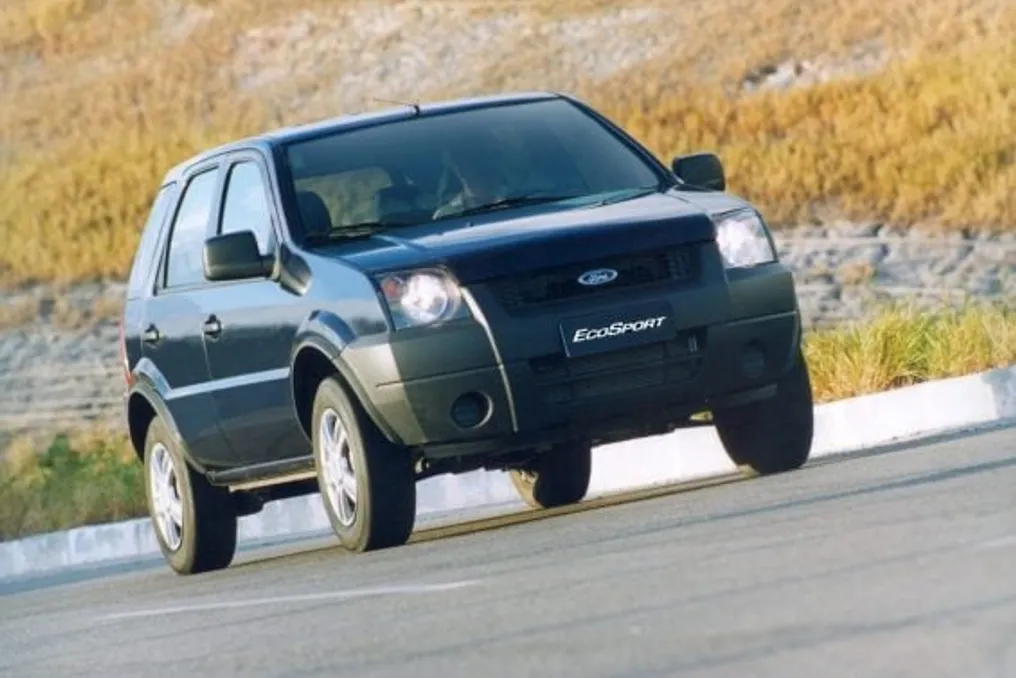
In the early 2000s, Ford achieved remarkable success by introducing the EcoSport in 2003, which was the first compact SUV manufactured in Brazil. Unlike most automakers who focused on minivans to meet the needs of Brazilian families, the American brand opted to create a smaller and more affordable model based on the Fiesta platform, which facilitated its development and production.
In a market where vehicles like Mercedes-Benz Class A, Renault Scénic, Citroën Xsara Picasso, Fiat Idea, and Chevrolet Meriva competed, Ford presented a distinct alternative. The EcoSport featured an adventurous look, a high driving position, and an appearance more aligned with sports utility vehicles popular abroad. This positioning resulted in a rapid conquest of the Brazilian market, surpassing the sales volume of rival minivans.
When launched in 2003, the EcoSport was available in three engine configurations: 95 hp 1.0 Supercharger Zetec Rocam, 98 hp 1.6 Zetec Rocam, and up to 143 hp 2.0 Duratec. Ford's strategy with the 1.0 version was motivated by the possibility of achieving more competitive prices for the end consumer, since vehicles with engines up to one liter benefited from reduced IPI and ICMS rates at the time.
Company executives expected that a compact SUV with a price similar to that of a popular car would be widely accepted. There was an expectation that the EcoSport 1.0 would achieve high sales volumes, capitalizing on both the growth of the segment and the tax incentives applied to smaller displacement engines. The Brazilian consumer showed appreciation for SUVs, and Ford recognized this trend before its competitors.
However, the public looking for an SUV did not want a 1.0 engine. At that time, engines of this capacity were often associated with entry-level cars, primarily intended for those prioritizing economy and low initial cost. Even equipped with a mechanical compressor to boost power and torque, the small Zetec Rocam failed to change this buyer perception, who demanded performance commensurate with the vehicle's image, regardless of its size.
Additionally, the price disparity between versions was not significant. Upon launch, the EcoSport 1.0 Supercharger cost about R$ 31 thousand, while the 1.6 version was sold for approximately R$ 35 thousand. For the extra amount, the customer received a car with better performance, more agile acceleration, and, under certain usage conditions, more balanced fuel consumption. Thus, the market decision almost automatically leaned towards the 1.6 option, due to its tradition and reliability.
While the EcoSport established itself as a major commercial success for Ford in Brazil, the 1.0 Supercharger variant followed a different path. Its sales were very low, and the model failed to gain consumer trust. After only three years in the market, Ford opted to discontinue its production in 2006, removing the EcoSport 1.0 from the lineup without direct successors.
The situation was aggravated by the fact that the Supercharger system required specific maintenance care. The mechanical compressor used its own lubrication, and many owners and workshops were unaware of the correct conservation procedures. Over time, frequent cases of premature unit deterioration, excessive noise increase, performance drop, and considerable rise in fuel consumption emerged. Thus, the version designed to be the most accessible ended up being one of the least sought after, marking a curious episode in the history of the national automotive industry.