The global economic process is entering a stage of redistribution, where traditional trade routes are changing, new technological centers are forming, and the competitiveness of states is determined by the digital economy and artificial intelligence. In the context of these complex and rapid changes, the International Economic Forum in St. Petersburg, held in June 2026, became a significant political and economic platform for discussing models of future development, rather than just a venue for economic meetings.
One of the key events of the forum was the participation of the President of the Republic of Uzbekistan, Shavkat Mirziyoyev, and the initiatives he put forward. Political scientist Saifiddin Jo'raev noted that relations between Uzbekistan and Russia have gone beyond simple bilateral interaction and have turned into comprehensive partnership. He emphasized that the proposals and ideas voiced at the forum in St. Petersburg indicate the transition of this process to a new level.
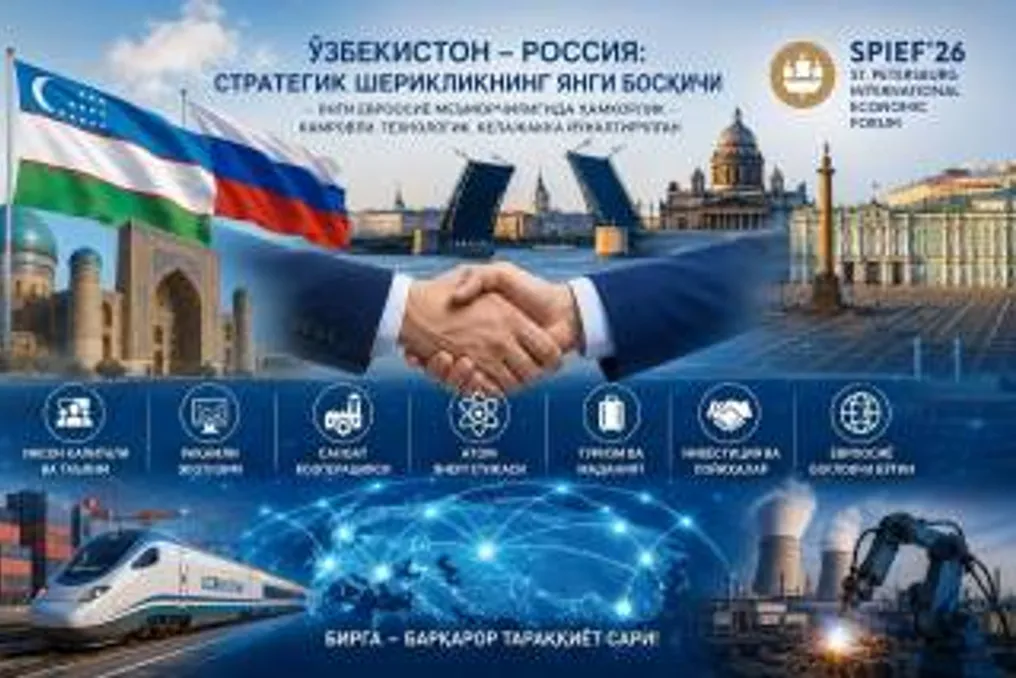
If cooperation was previously focused mainly on trade and investment, now strategic areas such as the digital economy, high technologies, human capital, industrial cooperation, and nuclear energy have appeared on the agenda.
The initiatives presented by the President of Uzbekistan at the summit are interconnected. They represent not separate projects, but an integral part of a unified system aimed at shaping the future economy. Special attention is paid to the proposal to create a joint online platform for human capital development.
In modern economic realities, the value of knowledge and technology surpasses the value of natural resources. Therefore, the initiative to create a digital platform to support education, IT technologies, professional training, and entrepreneurship among youth in cooperation with the Russian Federation was assessed as an investment in the future. This approach will help bring the labor markets of the two countries closer, prepare highly qualified personnel, and form competitive human capital.
Another important proposal put forward by the head of state is the idea of forming a unified digital employment profile. Although this may seem like a technical initiative at first glance, in essence, it marks a new stage of economic integration. The digital labor market allows for effective management of workforce movement, accurate forecasting of specialist needs, and the development of new services based on artificial intelligence.
Based on these initiatives, the goal of digital transformation became clear: Uzbekistan emphasized the need to create a joint digital ecosystem, align the rules of digital trade, and promote national brands on common platforms. This aligns with the trend that economic ties are increasingly moving into virtual space.
In the economy of the 21st century, the digital sphere functions as a new transport route. States that manage such platforms or actively participate in this process gain additional economic advantages. From this perspective, the desire to expand cooperation with Russia in the digital space is viewed as a long-term strategy for creating new sources of economic growth.
Updated data within the SPKhIF-2026 demonstrates the volume of bilateral relations. Over the last decade, trade between the two countries has increased more than threefold. The value of joint projects, which has reached 50 billion dollars, indicates a shift in relations from the level of trade to the level of investment and production cooperation.
Furthermore, information was announced at the forum about a new package of investments worth about 5 billion dollars, oriented towards the near future. Thus, not only are the rates of existing cooperation being maintained, but the business circles of both countries are looking to the future with confidence.
Among the initiatives presented at the summit, industrial cooperation stands out. The concept proposed by President Shavkat Mirziyoyev, the 'Eurasian Belt of Technological Industrialization,' is assessed not only as a matter of bilateral relations but also as an idea concerning the economic future of the entire region.
The essence of this initiative lies in linking production processes, forming a technology cluster, and producing high value-added products. It is not just about trade relations, but about forming a single chain, starting from technology creation and personnel training, to product manufacturing and its export to external markets.
Amid global changes, there is a tendency to seek new production models. In the situation of geopolitical competition, supply chain disruptions, and technological restrictions, economic stability largely depends on domestic industrial potential. In this context, the emerging industrial cooperation between Uzbekistan and Russia is an important element of long-term economic security for both countries.
Cooperation in the field of nuclear energy has also reached a new stage within the framework of the forum. As Uzbekistan's economy develops rapidly, the demand for energy sources is constantly growing. According to expert estimates, the country's electricity demand will double within the next decade. Under such conditions, nuclear energy acquires special significance as a stable and long-term energy source.
One of the most important events noted during the presidents' meeting was the start of construction of a nuclear power plant. The feature of the project is its implementation based on a complex of reactors of different capacities. This strengthens Uzbekistan's energy independence and creates a solid foundation for the development of the high-tech industrial sector.
Nuclear energy requires not only electricity generation but also highly qualified engineers, scientific research, and modern technological systems. Therefore, the President's initiative to establish a branch of the National Research Nuclear University in Uzbekistan is not unfounded; thus, the national engineering school will continue to strengthen in the future.
The humanitarian aspect of economic cooperation also attracted attention. The proposal to create a creative-tourism route 'Samarkand – St. Petersburg' aims to enrich cultural ties between the two countries with new content. It was emphasized that art festivals, film forums, museum exhibitions, and gastronomic events will contribute to strengthening trust between peoples.
In the current competitive environment, the success of economic cooperation largely depends on the atmosphere of trust between people. In this regard, contacts in tourism, culture, and education are considered an important pillar of the partnership. An example of this process is the visit of almost one million Russians to Uzbekistan in 2025.
The forum also discussed the issue of forming Central Asia as a center of sustainable economic growth. As the President emphasized, the region is no longer just a transit zone or a space where the interests of major powers intersect. Central Asia is becoming a new growth center with independent economic, demographic, and investment potential.
Uzbekistan plays a special role in this process. Due to its geographical location, growing economy, and active foreign policy, the country serves as an important bridge connecting the markets of Russia, China, South Asia, and the Middle East. Harmonizing transport corridors, energy grids, digital platforms, and production chains serves precisely this purpose.
The results of the summit showed that Uzbekistan-Russia relations are moving to a qualitatively new level. Cooperation, which was previously defined mainly by trade and economic ties, is now turning into a comprehensive partnership covering technology, nuclear energy, digital transformation, human capital, and cultural diplomacy.
It is important to note that this process has the potential to influence not only the interests of the two countries but also the economic situation throughout the Eurasian space. Consequently, the initiatives voiced at the St. Petersburg forum undoubtedly serve as an important political and economic roadmap for both today and for development in the coming decades.