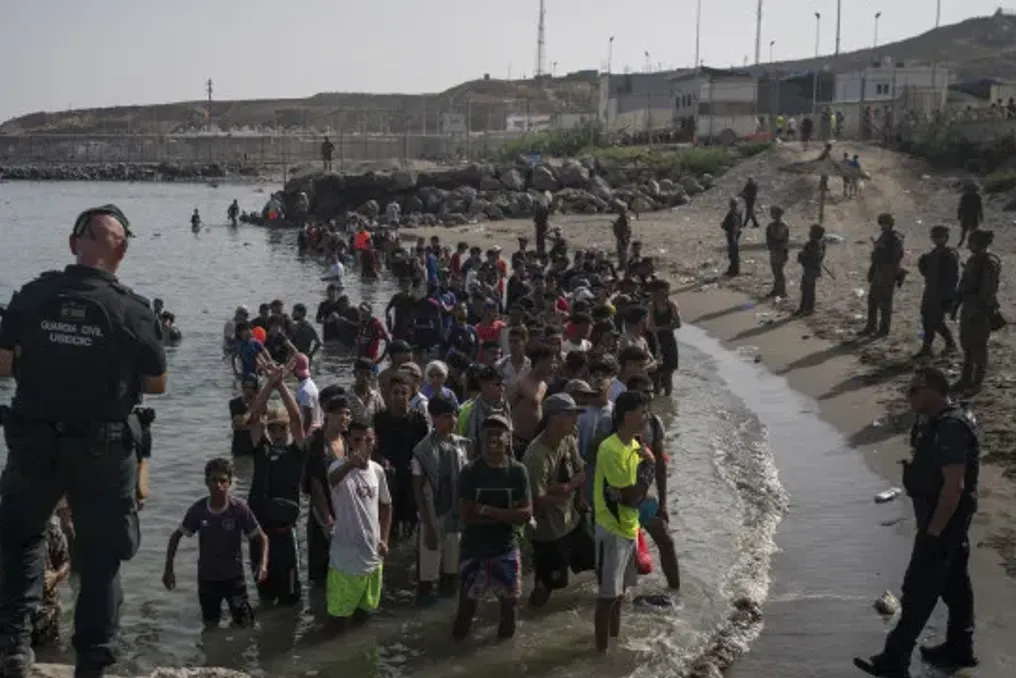
On the morning of this date, the installation of containment barriers began at the Tarajal border crossing quay. Police sources informed Efe that this number may include migrants who arrived in the autonomous city on days prior to the massive flow, as well as individuals who entered and exited more than once on Friday.
Additionally, the Spanish Ministry of the Interior informed Efe that at 7:50 local time, the assembly of containment barriers began at the Tarajal border quay. This action was announced by the Spanish Prime Minister, Pedro Sánchez, on Friday, departing from Ceuta.
The central component of this system is a pneumatic barrier spanning 500 meters, featuring a surface height between 30 and 70 centimeters and a submerged section up to one meter deep. This structure is complemented by a first line of anchored buoys provided by the Navy. An intermediate channel was added to allow the Civil Guard vessels to ensure continuous protection of the pneumatic barrier.
Regarding the data on the massive entry of migrants from Morocco, the Ministry of the Interior registered 50,000 entries on the 30th, while the president of the autonomous city, Juan Jesús Vivas, estimated that this number could reach 60,000.
Interior sources reported this morning that the night in Ceuta passed normally, with entries having 'completely stopped,' although departures to Morocco continued. After the large influx on Thursday, thousands of people returned to the border on Friday to head to Morocco, motivated by various factors, including the agreement announced between Spain and Morocco for repatriation, as well as the lack of open shops or bars in Ceuta to meet their basic needs.
On the other hand, calm returned to the Melilla border fence after a night, the second consecutive night, of migratory pressure at different points of the perimeter and irregularly counted entries. This scenario generated intense movement of patrols and the use of anti-riot material to repel migrants.
According to Efe, one of the areas of greatest tension during the night was near the Beni-Enzar border post, the only operational one between Melilla and Morocco, which remains closed while more than a thousand travelers from Operation Strait Passage (OPE) await reopening. Entry attempts in this area were constant from before dusk until close to the first hour of the morning, carried out by groups of young Maghrebi migrants moving along the fence; some of these individuals caused damage to Moroccan surveillance garrisons and even started a fire near the perimeter.
On Thursday night, a total of 130 irregular entries were recorded in Melilla, 84 of them minors. This raised the number of people sheltered in the city's protection centers to 260, exceeding more than three times the maximum limit stipulated in the migration contingency declaration.
This Saturday, the Maritime Police and the Portuguese Navy announced the reinforcement of maritime border control, implementing daily and regular patrols both by sea and on land along the Algarve coast.
According to the Maritime Police, these actions are executed in a coordinated and integrated manner, aiming to ensure an apparatus both at sea and on land, strengthening the surveillance, detection, and interception of vessels that may be associated with illegal migration phenomena or other illicit activities.
The Maritime Police and the Navy emphasized that maritime security constitutes a shared mission and requested public collaboration, asking that any suspicious movement be reported to the Lisbon Maritime Search and Rescue Coordination Centre (MRCC Lisbon) or the Local Command of the Maritime Police in the respective region.