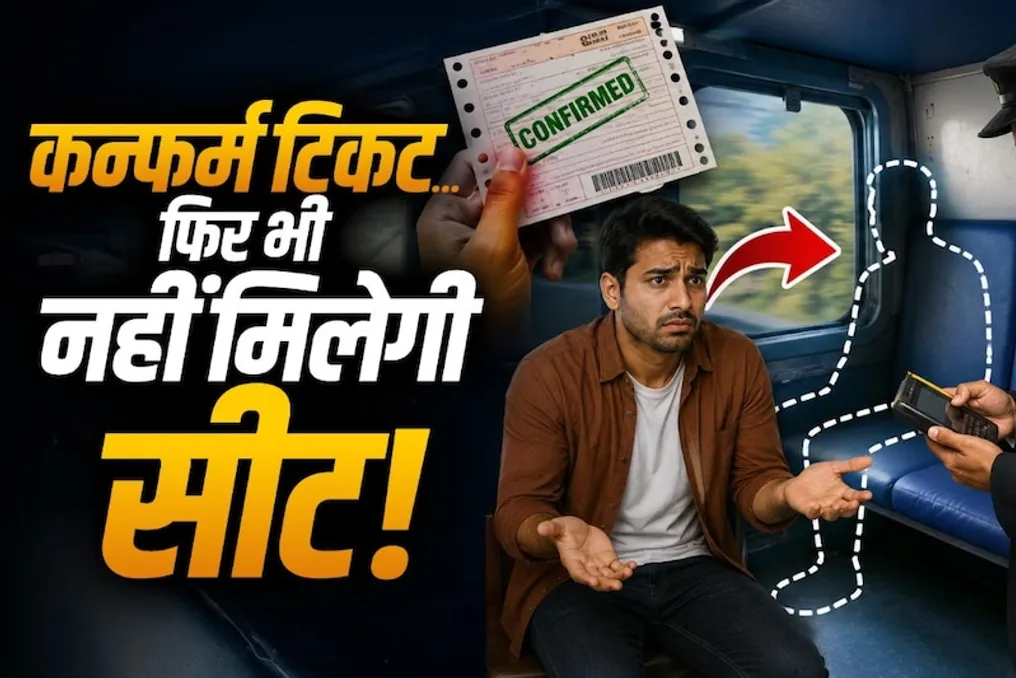
Indian Railways is one of the largest railway networks in the world, transporting millions of passengers daily. Various rules have been developed to ensure traveler convenience and efficient use of seats, which every passenger should know. According to Indian Railways rules, having a confirmed ticket usually implies that the seat belongs only to you throughout the entire journey. However, there is a rule that few people know: under certain circumstances, your seat may be given to another passenger.
This happens if a passenger does not board the train at their original boarding station and fails to inform the railway about it. In such cases, the Ticket Examiner (TTE) has the right, according to the rules, to allocate this seat to another suitable passenger. Next, we will examine in detail how this rule works, in which situations the seat might be occupied by someone else, and what should be done to avoid this.
According to Indian Railways rules, if a passenger's ticket is confirmed, but they do not board the train at the designated departure station and do not board within the next two stations, the TTE may consider the seat vacant. Subsequently, if there is a waiting list passenger, an RAC passenger, or any other suitable passenger awaiting a seat on the train, the TTE may allocate this seat to them in accordance with the rules. Thus, a confirmed ticket alone is not enough; timely boarding is also crucial.
Millions of passengers use the services of Indian Railways every day. Sometimes passengers book tickets but do not travel for some reason. On the other hand, many travel with waiting list or RAC tickets. If vacant seats are not utilized, it will lead to resource wastage and cause inconvenience to needy passengers. This is why the railway introduced this system to utilize vacant seats to provide convenience to other passengers.
Suppose your boarding station is New Delhi, but for some reason, you wish to board the train at the next station, such as Ghaziabad or Aligarh. In this situation, missing the train from the first station without notification can be disadvantageous for you. In this scenario, you must change your boarding station before the journey begins. Passengers can change their boarding station within the stipulated time through the IRCTC service before the train departs. By doing so, you will retain your seat, and the railway will know from which station you will board the train.
Sometimes a passenger fails to reach the boarding station due to traffic jams, flight delays, or missing a bus. In such a situation, it is better not to remain silent but to take immediate action. If possible, contact the TTE or report your situation through the railway's hotline. Nevertheless, the final decision is made by the TTE and in accordance with the current railway rules. Therefore, it is always best to notify them in advance.
Missing the train only at the first station does not automatically mean your ticket is cancelled. However, if you have not changed your boarding station, have not informed them of your intention to board the train, and have not started traveling even at the next two stations, the TTE may consider the seat vacant and allocate it to another suitable passenger. Consequently, even with a ticket in your name, you have no guarantee of retaining the seat.
If you have booked a confirmed ticket, the fare will be calculated according to that ticket. Even if you board the train later, there is no guarantee that you will get the same seat. If the seat has already been allocated to another passenger, further accommodation will be based on availability.
These points should always be kept in mind: choose the correct boarding station when booking a ticket. If you plan to board at another station, change the boarding station in time. Do not miss the train from the boarding station without prior notification. If there is a delay in the journey, inform the railway or the TTE, if possible. Do not assume that your seat will remain empty throughout the journey after the train has departed.