Large-scale reforms aimed at modernizing industrial sectors, developing transport and logistics infrastructure, and increasing the efficiency of major production enterprises are being implemented consistently across the country.
Large-scale reforms aimed at modernizing industrial sectors, developing transport and logistics infrastructure, and increasing the efficiency of major production enterprises are being implemented consistently across the country.
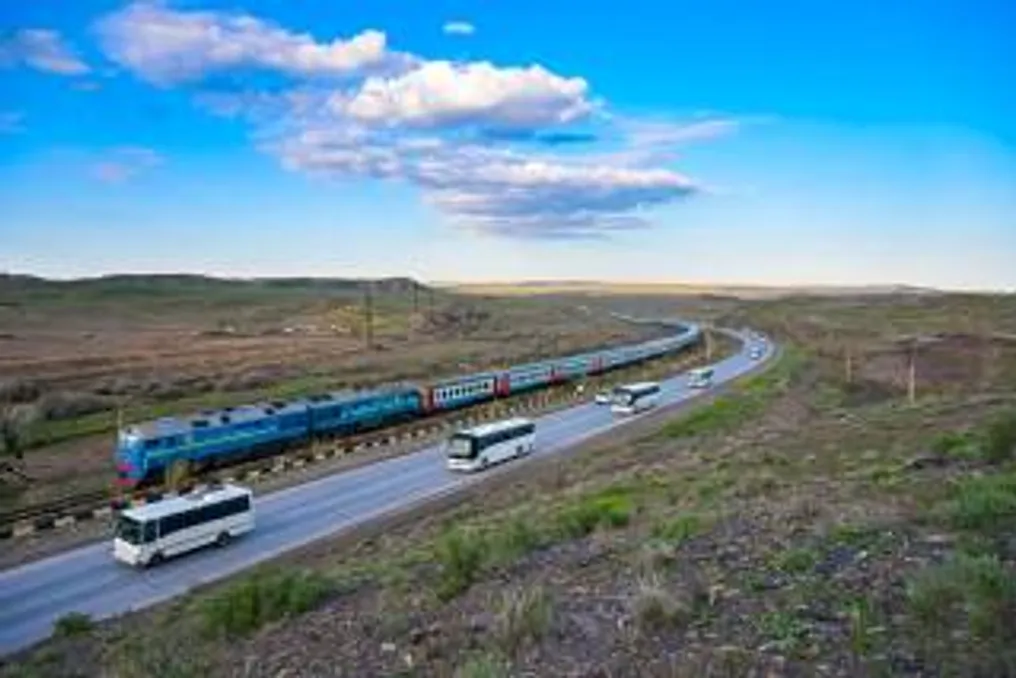
Railway transport is one of the key components ensuring the continuity of the production process at the Navoi Con-Metallurgy Combine. This system plays an important role in delivering ore mined from deposits to hydrometallurgical plants, as well as in the safe and timely transportation of employees to their workplaces and ensuring the stability of the finished product production chain.
Currently, nearly two thousand employees work at the combine across two railway transport departments and one railway workshop. Zafar Saiemov, head of the railway transport department of NKMK AJ, reported that extensive work has been carried out in recent years to modernize the railway infrastructure, create new railway lines, and gradually replace the fleet of locomotives and wagons.
This year, the Central Mining Department, through the railway transport department, constructed over 1.2 kilometers of new railway tracks at the Murunt mine. Additionally, the Shimoli ore loading point was commissioned, capable of delivering about 500 thousand tons of ore monthly to the 2nd hydrometallurgical plant. Another important project is the creation of a new railway line spanning 6.3 kilometers between the 5th hydrometallurgical plant and the Auminzo-Amantoy mine. These infrastructure facilities are becoming an important factor in accelerating transportation processes, reducing fuel and lubricant consumption, and increasing logistical efficiency.
Work on expanding infrastructure and equipping rolling stock with modern equipment continues. Specifically, within the investment project 'Ore Extraction in Qoqpatas and Dovgistov Deposits (Phase III),' new locomotives and self-propelled semi-wagons have been delivered to the railway transport department of the Central Mining Department, meeting high technical and economic indicators.
Thanks to these updates, it is planned to transport over 38 million tons of ore to the hydrometallurgical plants in the first half of 2026, and to reach 75 million tons by the end of the year. This creates a solid foundation for the further expansion of the combine's production capacity and the increase in export volumes.
Special attention is paid to the digitalization of the railway transport system. Digital management of preventive maintenance and traffic control using automated systems allows for increased operational efficiency, prevention of technical malfunctions, and ensuring traffic safety. Simultaneously, training sessions are organized this year for about 300 industry employees, aimed at developing skills in working with modern equipment and technologies.
The modernization of railway infrastructure not only improves the combine's internal logistics but also contributes to increasing the volume of valuable metal production, efficient resource utilization, and making a corresponding contribution to the sustainable development of the country's economy.
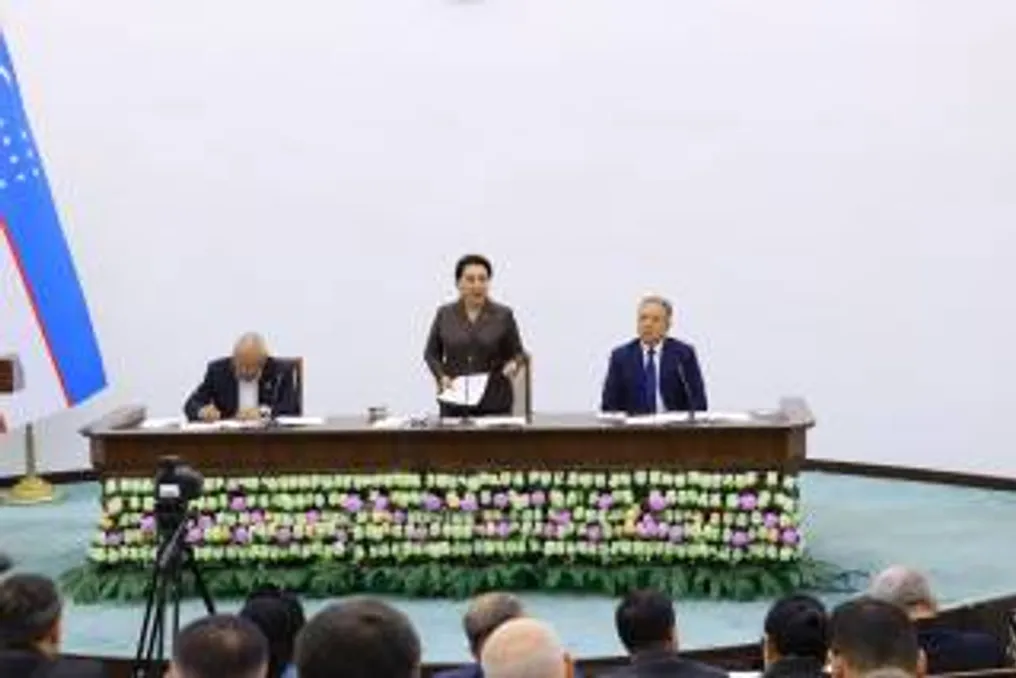
During a scheduled meeting of the Senate Council of the Supreme Majlis, which was attended by the Chairman of the Senate Council of Navoi Region, Tanzila Norboeva, the council convened. At the meeting, the process of implementing programs for comprehensive socio-economic development of the region, ensuring employment, and reducing poverty was analyzed in detail. Furthermore, tasks set by the President were reviewed, and existing problems in this area were discussed.
According to the data presented, the region's gross regional product reached 113.9 trillion soums in the first half of the current year, with economic growth rates at 6.7%. Industrial production increased by 5.4%, construction works by 28.3%, market services by 18.9%, and agriculture by 4.4%.
In fulfillment of the President's instructions given during video selection meetings aimed at supporting entrepreneurship and turning the private sector into the main driver of economic growth, nearly 1,500 new business entities were created in the region. Additionally, 3.2 trillion soums in credit funds were allocated for the financial support of small and medium-sized businesses. Of this amount, 945 billion soums were directed through programs such as 'Development of Family Entrepreneurship,' 'Constant Support for Small Business,' 'First Step for Business,' and 'Local Project.' This contributes to the creation of new jobs in settlements and an increase in population income.
Concurrently, to develop socially vulnerable territories, over 60 projects totaling 156 billion soums are being implemented in the Konimeh and Navbahor districts, as well as in 12 'hard settlements.' These projects are designed to improve engineering and communication infrastructure, promote entrepreneurship, and create new jobs.
Nevertheless, the meeting noted that shortcomings persist in several areas that were previously criticized during the President's video selection meetings. Specifically, construction work growth could not be ensured in the Tomdi district, and projected industrial production targets were not met in the city of Gazgon and the Konimeh district. In the Khatirchi district, the growth rate of agricultural output is low, and per capita gross output indicators are not rising.
Moreover, export forecast targets were not met in six regions. The lowest results were recorded in the Tomdi and Uchquduk districts. Meanwhile, no projects have yet been launched in the industry and entrepreneurship zones for youth in the Karman, Konimeh, Tomdi, Khatirchi districts, and the city of Gazgon; in the cities of Navoi and Zarafshon, as well as in the Konimeh, Khatirchi, and Nurota districts, the debt burden on taxes is growing.
The meeting emphasized that ensuring economic growth rates, increasing employment, and reducing poverty is the personal responsibility of the heads of every district, city, and settlement. To ensure the full execution of the tasks set by the President, strict control over every investment project, every new job, and every economic opportunity in each settlement is necessary.
In this regard, it was recommended that people's deputies regularly hear reports from leaders on the implementation of programs to provide decent work, reduce poverty, and achieve socio-economic development in the regional, district, and city Councils. This will strengthen the influence of parliamentary oversight and ensure the effectiveness of decisions made.
Following the meeting, relevant decisions were adopted by the Senate Council of the Supreme Majlis, based on the proposals and comments submitted, defining specific measures to ensure the full and qualitative fulfillment of the set tasks, launching the economic potential of the regions, increasing employment, and reducing poverty.
From January to June 2026, the average nominal wage in Uzbekistan was 7.09 million soms, with the highest figure recorded in Tashkent.
The wage for January-June 2026 reached an average of 7,911 thousand soms nationwide. This figure exceeds the same period last year by 18.4%. For comparison, in January-June 2022, the average wage was 3,551.6 thousand soms, which represents an almost twofold increase in the average salary over four years.
When comparing by region, the highest average wage level was noted in the city of Tashkent, where it reached 12.014 million soms. Following in terms of income level is the Navoi region, where the average salary amounted to 8.723 million soms.
The lowest values for the average wage were registered in the Kashkadarya region, where it was 4.865 million soms, as well as in the Surkhandarya region, where the indicator reached 4.937 million soms.
A large-scale investment project aimed at advancing agriculture and the textile industry to a new level is being implemented in the Bukhara province. This step is expected to be an important contribution to revitalizing the desert territories, creating thousands of new jobs, increasing export potential, and widely implementing modern agricultural technologies.
In this regard, the Governor of Bukhara Province, Botir Zaripov, received a delegation led by Wang Xuntou, a representative of one of the major Chinese industrial companies, 'Lihua Group' in Uzbekistan. During the meeting, the parties discussed in detail issues of expanding cooperation, achieving high efficiency in agriculture, and actively implementing investment projects.
According to the project plan, 20 thousand hectares of land are planned to be acquired in Shofirkon district and 9 thousand hectares in Romitan district. A modern agro-industrial cluster will be created on these territories, covering the entire production cycle—from cotton cultivation to the production and processing of finished textile products.
Currently, the Chinese investors have established the limited liability company 'Zhemchuzhina Romitan,' and work on developing the 'Varakhsha' desert area in Romitan district is progressing rapidly. At the initial stage of the investment project, special attention is paid to infrastructure formation, bringing lands into agricultural circulation, and installing modern irrigation systems.
This year, cotton of the 'Xin Lu Zao-57' variety, which is part of Chinese breeding, has been planted in this area, and advanced agricultural technologies based on Shenzhen's experience are being used. In particular, methods of growing under film, water-saving technologies, and innovative agrotechnical approaches that promote increased yield, rational use of water resources, and improved product quality are being tested.
During the discussions, specific measures were defined for the timely and effective implementation of the project, and existing organizational issues were resolved. The parties reached mutually beneficial agreements regarding further expansion of partnership, increasing the volume of investments, and the widespread introduction of modern technologies into Bukhara's agriculture.
This project is viewed not just as an investment but as a strategic initiative designed to transform the deserts of Bukhara into fertile lands, form a modern agro-industrial ecosystem, and give a new impetus to the regional economy. Most significant is the expectation of creating stable jobs for hundreds and even thousands of residents through the production of high value-added products and the expansion of exports. This will be a prime example of investment cooperation and industrial development in New Uzbekistan.