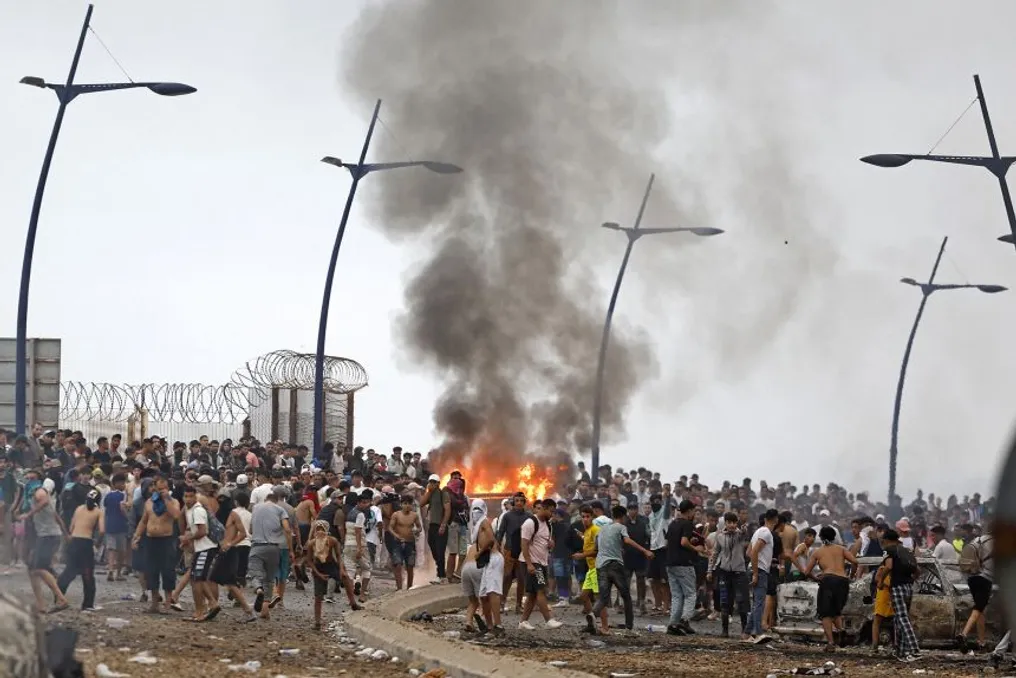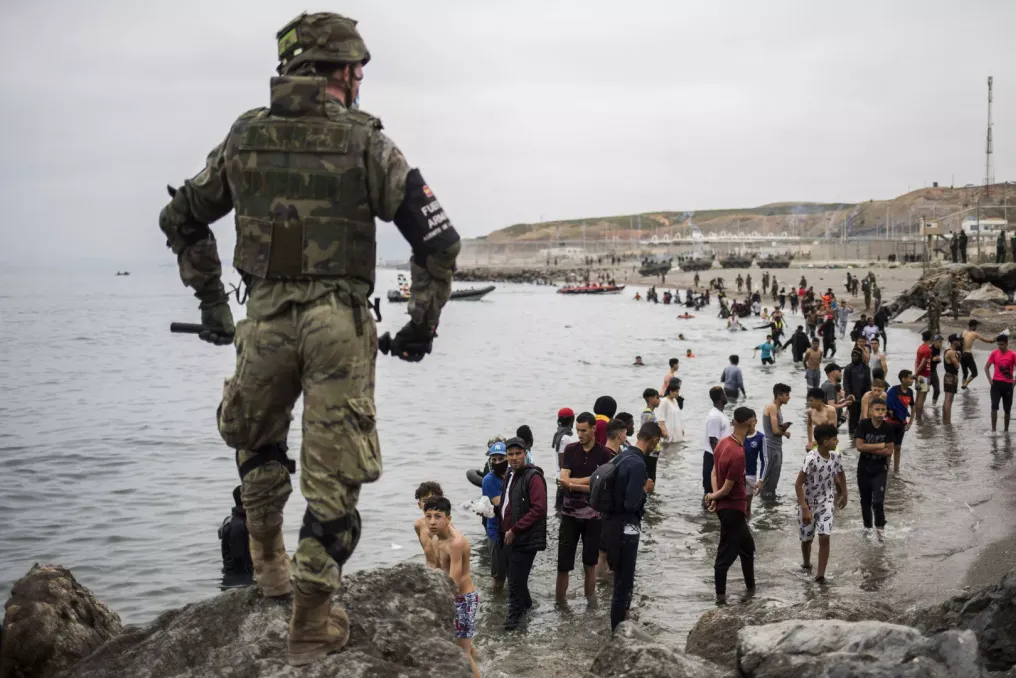
Most migrants who illegally entered Ceuta have returned to Morocco. According to data from Spanish security services, over 53 thousand migrants were returned to Morocco in a single day.
Most migrants who illegally entered Ceuta have returned to Morocco. According to data from Spanish security services, over 53 thousand migrants were returned to Morocco in a single day.
Previously, the day before, about 60 thousand Moroccan migrants crossed the Spanish borders in Ceuta, either by sea or through land crossings. According to local media reports, this was due to a decision by the Supreme Court of Spain that prohibited the immediate return of illegal migrants arriving by sea.
As a result of this situation in Ceuta, a state of emergency was declared, and the Prime Minister of Spain, Pedro Sánchez, arrived there. In the city of Ceuta, migrants remained on the streets looking for food in grocery stores in the evening.
More than 60 migrants died during the sea crossing. Ceuta is a Spanish enclave located on the northern coast of Africa, bordering Morocco. Together with Melilla, it forms the only land border between the European Union and Africa and is considered the main route for illegal migration into the EU.
Spain has reported that most of the approximately 50,000 migrants who attempted to enter its territory from Morocco have returned. During the mass influx of migrants trying to enter the Spanish exclave of Ceuta from Morocco, at least 57 people died. Estimates suggest there were about 50,000 crossing attempts this week, but Spanish authorities stated that by Friday evening, most of them had returned to Morocco.
The sudden arrival of tens of thousands of migrants prompted Spanish Prime Minister Pedro Sánchez to urgently travel to the exclave's territory. Italy decided to temporarily reinstate some border checks on entry from Spain, while France ordered increased control along its border with Spain.
Ceuta authorities reported that many of the deceased drowned when crowds crossed the border both by land and sea on Thursday, overwhelming border guards. Spanish authorities announced their intention to deport illegally entered individuals as soon as possible, despite a recent ruling by the Spanish Supreme Court prohibiting the return of migrants arriving by sea to Morocco.
By Friday, many had apparently left voluntarily. Reuters reported that observers saw hundreds of people returning to Morocco through border crossings and gaps in the fence; some claimed they could not find food or housing in Ceuta.
The Spanish Ministry of the Interior stated that about 50,000 people crossed the border since Thursday morning, while the regional government of Ceuta cited a total figure of 60,000. Sánchez called the mass crossings a 'violation of Spain's territorial integrity' and blamed the influx on disinformation spread by human traffickers following the Supreme Court's decision.
Reuters spoke with 16-year-old Moroccan Ayoub El Abiad, who said he and his cousin decided to make a 12-hour journey towards Ceuta after watching an Instagram video about other migrants crossing. El Abiad told the agency that they agreed to try the idea and trust in God because 'migration is an improvement in our lives.'
These videos were circulating on social media against the backdrop of reports about the Spanish Supreme Court's decision, prompting many young Moroccans to see an opportunity to cross. Broader economic problems are also playing a role: official data provided to Reuters shows that one in four Moroccans aged 15 to 24 is neither educated, employed, nor undergoing training. Furthermore, the calm sea during this time of year makes swimming a more feasible option.
Morocco does not recognize Spanish sovereignty over Ceuta or Melilla, calling the centuries-old Spanish exclaves 'occupied,' which leads some analysts to doubt whether Moroccan authorities have taken any conscious steps to prevent crossings.
The arrival of tens of thousands of people in Ceuta overwhelmed the small Spanish exclave of only 84,000 inhabitants and sparked a wave of criticism both domestically and internationally. Italy announced the temporary reinstatement of part of the border control on air and sea transport from Spain for a period of 30 days. Italian Foreign Minister and Deputy Prime Minister Antonio Tajani stated on X that 'the temporary suspension of Schengen regarding Spain is a necessary step to protect the security of our citizens and the defense of European borders.'
Usually, all travelers flying or sailing between Spain and Italy do not undergo standard border control. However, Italian state broadcaster RAI reported that 'targeted checks' on some arrivals will be conducted starting August 1st and will last for a month. Citing sources from the Ministry of the Interior, RAI specified that the checks will only concern non-EU citizens arriving from Spain into Italy to confirm their right to enter. According to RAI, Spanish citizens and other EU citizens traveling to Italy, as well as everyone traveling from Italy to Spain, will not be subject to additional requirements.
Italian Prime Minister Giorgia Meloni previously called for the suspension of Spain's membership in the Schengen Agreement, which usually allows travel without internal border checks across most of Europe. CNN contacted major airlines operating flights between Spain and Italy to learn about the potential impact on their services. Vueling reported that its flights are operating normally and the schedule has not been affected, but reminded passengers to carry valid travel documents. Iberia also stated there were no changes to flights to or from Italy and promised to notify customers if the situation changed.
Although Ceuta and Melilla, other Spanish exclaves in North Africa, are part of the Schengen area, checks are still applied to goods and travelers between these territories and mainland Spain.
Other European leaders have also expressed concern. European Commission President Ursula von der Leyen stated in an X post: 'we cannot allow anyone into our Union without complying with our rules.'
French Interior Minister Laurent Nuñez announced that he had ordered increased checks at the French border with Spain.
Migration remains one of the most divisive issues in Europe. Radical right-wing parties opposing immigration are gaining popularity, and governments in many continental countries are adopting tougher policies. The pro-immigration policy of Sánchez's socialist government sets him apart from others, and Thursday's events will put pressure on the prime minister.
The US Department of State criticized Spain's immigration policy, stating that the incident was a direct result of 'deliberate efforts by the Spanish government to facilitate and ease mass illegal migration into Europe.' Meanwhile, US President Donald Trump warned that the surge in migrants is an example of what will happen if Republicans are not elected in November, calling it a 'topic for discussion in the middle of the election campaign.'
The leader of the ultra-right opposition party Vox in Spain called the prime minister a 'traitor' in a social media post on Thursday. Santiago Abascal wrote: 'He is acting like an enemy of the Spanish people. The national emergency can only be resolved by his expulsion.'
This is not the first such incident in Ceuta—in May 2021, over 8,000 migrants flooded Ceuta in two days, although the scale of the current influx seems unprecedented. A young Moroccan from Tangier told Reuters: 'Honestly, I don't even know why I came, and now I am leaving. I haven't eaten since yesterday's lunch, although I brought some money... What we are doing is neither good nor pleasant.'