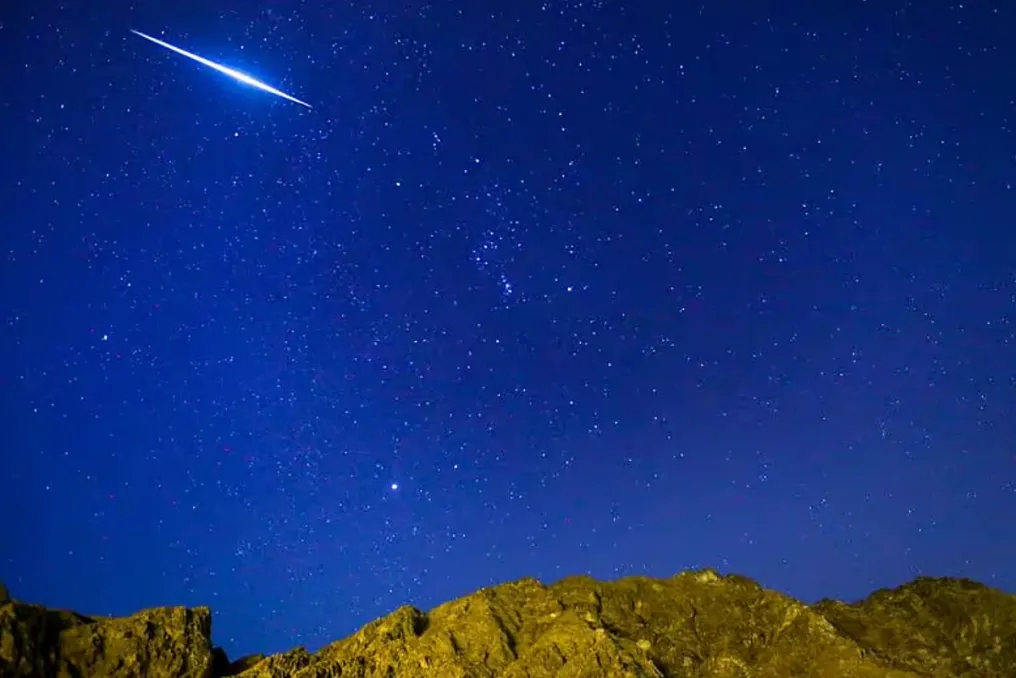
The sky of the United Arab Emirates (UAE) is set to light up with streaks of light thanks to the Perseid meteor shower. According to Hadija Al Khouri from Dubai Astronomy Group, this shower is considered 'the most reliable' and is known for bright, fast meteors, as well as rare fireballs. Fireballs are exceptionally bright meteors, brighter than Venus, and are sometimes accompanied by sound.
Perseid activity will last from July 17th to August 24th, with the peak occurring on August 12th and 13th. This year, the meteor shower coincides with the new moon on August 12th, which minimizes the influence of moonlight. Residents of the UAE can expect to see up to 100 meteors per hour, and due to the moonless night conditions, even the faintest objects can be observed. Hadija advises that the best time for observation is after midnight on August 12th until dawn on August 13th.
How to Observe
Residents of the UAE should find a viewing spot away from city lights. No telescope or binoculars are required for observation; meteors are visible to the naked eye. Patience is crucial: phones must be turned off, and all screens avoided to allow eyes to adapt to the darkness for 20–30 minutes.
Deserts are ideal viewing spots, but precautions must be taken. Groups should travel, and sufficient supplies, including water and adequate lighting depending on the expected duration of stay, must be carried. Depending on the desert, permits may be required for extended camping, so local emirate authorities should be consulted for information.
How do Perseid meteors occur?
The Perseids consist of tiny particles of dust and ice that are fragments of Comet Swift-Tuttle. According to the Dubai Astronomy Group, these particles are 'no bigger than a grain of sand.' When Earth passes through this cosmic debris, the atmosphere causes them to burn up, creating bright light trails. If a fragment survives the flight, which is rare, it reaches Earth as a meteorite.
DAG reported that Comet Swift-Tuttle is a large periodic comet with a core diameter of about 26 km, which is roughly twice the size of the object that caused the extinction of dinosaurs. It orbits the Sun every 133 years and last passed near Earth in 1992. Its next return is scheduled for 2126, promising an even more spectacular sight for future generations. Astronomers estimate that the comet poses no threat to Earth for at least the next several thousand years.
How to Photograph the Perseids
For photography enthusiasts, DAG has prepared recommendations for capturing the Perseids: a DSLR or mirrorless camera should be used for complete manual control over settings such as shutter speed, aperture, and ISO. A tripod ensures stability, and a wide-angle lens helps cover most of the sky, increasing the chances of capturing a meteor.
It is recommended to use a remote shutter release or intervalometer, and to have spare batteries, as long exposures drain power quickly. In high humidity or cold, a lens heater can be used to prevent condensation. Autofocus must be disabled, and focus should be set manually on a bright star, planet, or infinity for maximum sharpness. Point the camera toward the radiant of the stream in the constellation Perseus to increase the number of captured meteors. Set the aperture to f/2.8 or lower, use an exposure of 15 to 30 seconds, and set ISO to 1600 or higher.