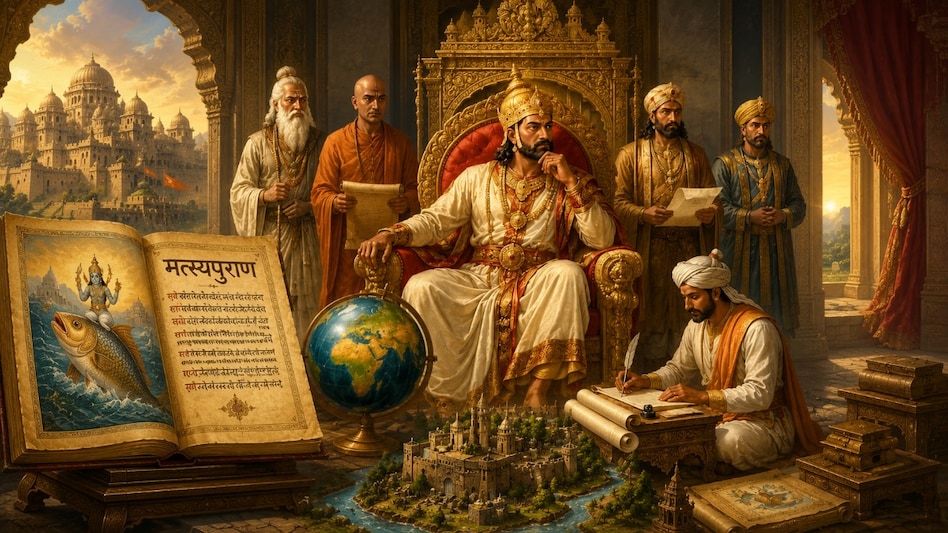
Our Puranas describe what a ruler should be like to care for their people. The ruler must ensure the population is protected from corruption and rising prices. This article examines the principles that the head of state should follow and the system he should establish. A ruler who follows the rules laid out in the Matsya Purana makes his country prosperous and strong.
According to the Matsya Purana, the concepts of Rajadharma (the duty of the ruler) and Rajkarta (governmental responsibilities) are considered extremely important in the system of governance. These principles cover not only caring for subjects and charity but also contain practical knowledge about state management. Although the modern era is scientific, and warfare methods have changed, giving way to missiles, fighters, and ballistic rockets, some ancient theories remain relevant.
In ancient times, the existence of the state depended entirely on the monarch; any threat to the ruler could lead to the collapse of the entire system. Therefore, the ruler must always maintain vigilance regarding his own safety.
Physical Security
The Matsya Purana instructs the ruler to behave constantly cautiously and suspiciously, like a crow. Before using anything—food, clothing, jewelry, or anything else—it should be thoroughly checked. It is also recommended to avoid crowded places and not stop or bathe in unfamiliar locations. Any items or places must be inspected through trusted individuals.
The ruler should not use unfamiliar elephants, horses, or any unknown means of transportation of the modern age. Furthermore, the importance of distancing oneself from strangers, especially suspicious contacts, is emphasized. Before trusting any information, it should be verified through multiple sources.
History has examples where rulers attached people resembling themselves for personal security. For instance, the German dictator Hitler also used such a measure. In Indian history, during the Battle of Haldighat, heroes resembling Maharaja Pratap, such as Jalkari or Jala Man Singh, sacrificed themselves to protect his life.
Military Security
In ancient times, forts and fortifications were built to protect the state. Today, these functions are performed by residential complexes with high-tech protection, equipped with secret passages, helicopter pads, and situation centers. Previously, soldier selection was based on their intelligence, bravery, and loyalty. They received complex training, which continues in modern form. Today, all three branches of the military—land, air, and naval—undergo specialized training.
Medical Care and Security System
In ancient times, Vaidyas (doctors) were appointed for soldiers, who treated them with herbs. Today, modern hospitals, medicines, and medical services are available. Where shields and armor were once used, bulletproof vests and advanced equipment are now employed.
The Matsya Purana insists on the critical importance of having a strong intelligence network. Spies must be loyal and competent. Ancient texts also mentioned Vishiknyas (female assassins) who secretly eliminated enemies. Even today, every country relies on its intelligence services to ensure security.
Selection of Ministers and Staff
According to the Matsya Purana, the ruler must select his ministers based on their knowledge and abilities. It concludes that if the ruler entrusts duties to capable people and governs according to Dharma, the state becomes prosperous and safe. Thus, the message of the Matsya Purana is that a successful ruler is one who gives the people not fear, but security; not plunder, but justice. He must consider service his duty, not power. It is this kind of leadership that makes a state truly prosperous and oriented towards public welfare.