One of astronomy's greatest enigmas lies in understanding how supermassive black holes manage to reach masses equivalent to millions or even billions of times the mass of the Sun. A team of scientists believes they have found new clues to solve this question with the help of artificial intelligence (AI).
By employing a machine learning model to process data collected by the Dark Energy Spectroscopic Instrument (DESI), astronomers were able to point out seven promising quasar candidates that also exhibit the gravitational lensing effect—an unusual event predicted by Albert Einstein's theory of relativity.
The researchers suggest that these arrangements provide a unique opportunity to observe supermassive black holes in a growth phase and thus gain a deeper understanding of their evolution throughout the Universe's trajectory.
This study was formally published on July 22 in the scientific publication The Astrophysical Journal.
Quasars reveal the initial phase of black holes
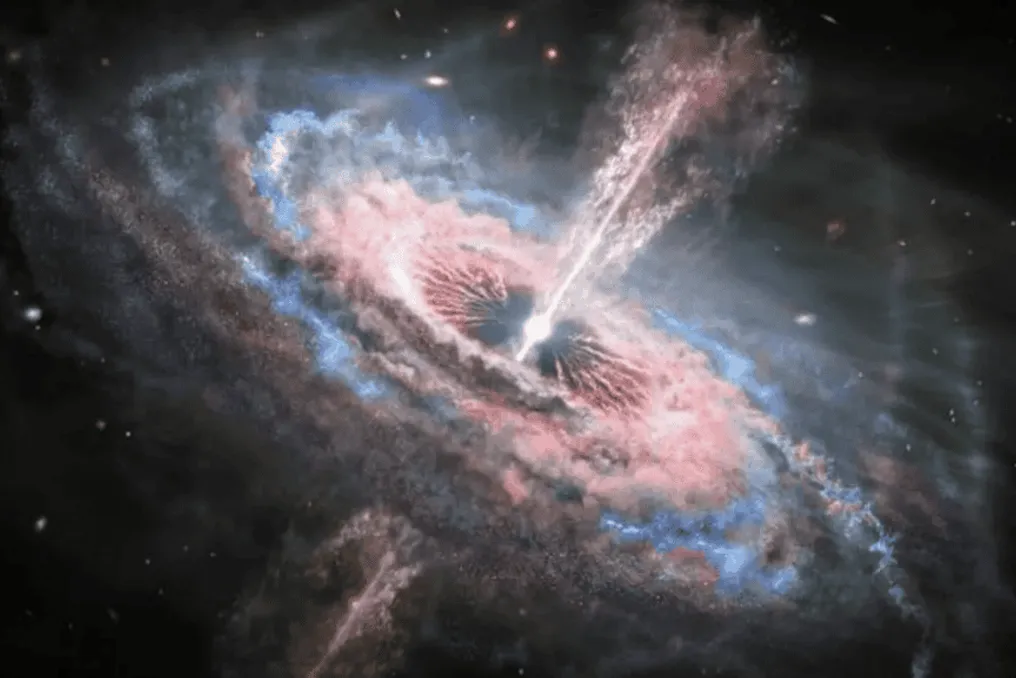
Quasars are defined as the extremely luminous centers of certain galaxies, which are fed by supermassive black holes consuming vast amounts of gas and dust. During this feeding process, an immense amount of energy is released, giving quasars such intense brightness that they can completely obscure the galaxies in which they are located.
For Everett McArthur, a doctoral student in astronomy at Ohio State University and the lead author of the work, such objects serve as records of the early stages of the evolution of these cosmic giants. He commented: 'Quasars are like baby pictures of a supermassive black hole. Understanding how we transition from quasars to these enormous black holes is truly important.'
Unusual alignment in the Universe
In exceptional situations, a quasar also functions as a gravitational lens. This occurs when the powerful gravity of the object bends and intensifies light coming from an even more distant galaxy, acting as a large-scale natural lens. Such alignments are extremely rare but bring a crucial advantage: they allow scientists to simultaneously monitor both the quasar and the galaxy whose light is being amplified, aiding in reconstructing the evolution of both the black hole and the galaxy itself.
AI identified seven candidates
To locate these specific systems, the researchers examined a catalog containing about 800,000 quasars cataloged by DESI. Given that there are few known examples of quasars acting as gravitational lenses, the team had to develop simulations of these phenomena to train the AI algorithm. After training, the model managed to narrow the search scope to approximately 200 potential cases. Subsequently, astronomers performed a manual analysis of each of these cases, selecting seven promising systems.
According to the researchers, this discovery nearly doubles the number of quasars of this type detected in comparable astronomical research.
The next step is to confirm the findings
The seven identified candidates still require validation through new observations. If confirmed, they could provide a new investigative tool to understand how supermassive black holes grew and what influence they had on the formation and evolution of galaxies throughout the history of the Universe. Additionally, the study illustrates the capacity of AI to assist scientists in locating extremely rare phenomena hidden within vast astronomical datasets, such as those generated by DESI, which is responsible for mapping millions of galaxies and quasars.