ChangXin Memory Technologies (CXMT), a Chinese memory manufacturer whose market capitalization exceeded 3.6 trillion yuan within a week of listing, has reached a significant milestone in LPDDR6 development. According to sources, the development validation stage is nearing completion, bringing the product closer to mass production.
The standard LPDDR implementation process involves four stages: single crystal verification, development validation, small batch qualification, and official mass production. Development validation includes testing for compatibility, system stability, performance, power consumption, and mechanical reliability. Since validation is in its final phase, the commercialization of LPDDR6 has completed half its journey.
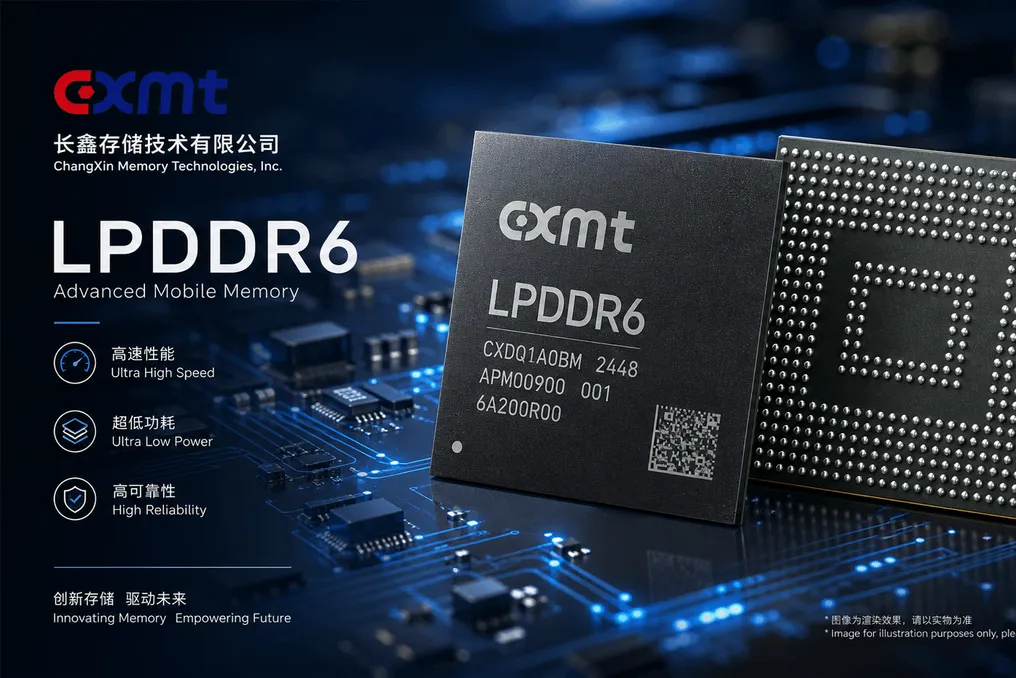
CXMT's first LPDDR6 product is designed with a data clock frequency of 12,800 Mbps, a base frequency of 10,667 Mbps, a die density of 16 Gb, and a chip capacity of 16 GB, utilizing POP 1295-ball packaging. Previously, at the end of 2023, CXMT released an LPDDR5 series featuring 12 Gb crystals and 12 GB POP chips with frequencies of 6,400 Mbps. In 2025, LPDDR5X was introduced with 12 Gb and 16 Gb densities, reaching 10,667 Mbps, representing a 66% improvement over LPDDR5 while reducing power consumption by 30%.
Over three years, CXMT has progressed through two generations of DRAM from LPDDR5 to the selection of LPDDR6 for key customers, supported by R&D investments of 9.593 billion yuan in 2025, which is 51.28% higher than the previous year. Total investments from 2023 to 2025 exceeded 20.6 billion yuan, and 6,972 patents were filed by the end of 2025.
SK Hynix is the international leader in the LPDDR6 race, having announced in March the completion of development validation for the world's first 16 Gb LPDDR6 DRAM on a 10-nanometer class sixth-generation process, planning mass production in the second half of 2026. Samsung and Micron have shown greater restraint in investing in LPDDR6, redirecting production capacity to higher-margin server DRAM and HBM, which opens a growth window for CXMT.
According to Omdia data, CXMT holds a 7.67% share of the global DRAM market, while Nomura forecasts around 10% with potential growth to 18% by the end of 2028, calling CXMT's DRAM the 'crown pearl of China' with a target price of 116 yuan. CXMT expects revenue in the first half of 2026 to be between 110–120 billion yuan, a 612.53–677.31% increase compared to last year, with net profit reaching 50–57 billion yuan, an increase of 2244–2544%.
CXMT's LPDDR products are already integrated into the supply chains of companies such as Xiaomi, Transsion, Honor, OPPO, and vivo. Apple is actively seeking to include CXMT in diversifying its suppliers: in June, the Financial Times reported that Apple requested approval to purchase DRAM from CXMT and contacted the U.S. Department of Commerce. In July, it became known that Apple began internal testing of CXMT chips for products intended for sale in China.
During Apple's financial quarter call on July 30th, Tim Cook stated that the company is evaluating all options, emphasizing that having more DRAM suppliers would benefit supply security and potentially pricing. However, progress in LPDDR6 is more significant than Apple's inclusion, as approaching mass production means domestic memory is closing the gap with foreign leaders, which could change the established model of dominance by foreign giants in advanced memory iterations and transform the structure of the global DRAM market.