The Starship, developed by SpaceX, remained afloat in the Indian Ocean for a week following its most recent test flight. This event is seen as an unprecedented milestone that strengthens the company's progress toward the complete reusability of the largest rocket ever built.
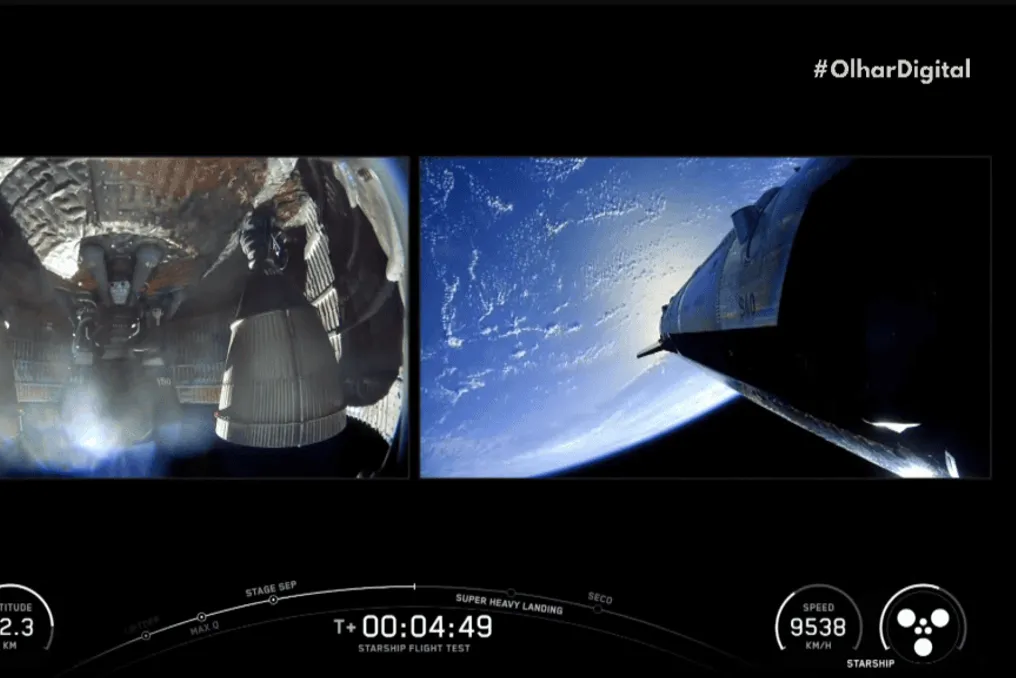
The thirteenth Starship test flight took place last Friday (24th). The vehicle, which stands 124 meters tall, was launched from the Starbase facility located in South Texas, United States. During the launch, the Super Heavy booster fell into the Gulf of Mexico, while the upper stage traveled over 16,000 kilometers before executing a controlled splashdown in the Indian Ocean.
According to SpaceX, this was the smoothest water landing achieved by Starship, allowing the craft to remain nearly intact and float days after mission completion. Images released by the company show the vehicle in the sea, and other recordings, captured both by Starship itself and by third-generation Starlink satellites launched, evidence an atmospheric reentry performed at notable angles.
Elon Musk, CEO of SpaceX, commented that the landing precision was such that the ship could have been caught by the launch tower's arms. He posted on X: 'The ship's landing was precise, meaning it could have been caught by the tower arms. Unless we find problems in the mission data analysis, SpaceX will attempt to catch the ship on the next mission.'
In addition to the successful controlled landing, the mission successfully placed 20 Starlink Version 3 satellites into orbit, proving Starship's capacity to rapidly expand the company's internet network.
Reusability still faces major challenges
Despite the mission's success, experts point out that the main obstacle to making Starship a fully reusable rocket has yet to be overcome: the thermal shield. The vehicle uses approximately 18,000 ceramic tiles to protect its structure during passage through the Earth's atmosphere.
Although the system functioned adequately to enable the craft's return, post-landing image analysis reveals signs of deterioration, such as whitish scratches between the tiles, as well as cracked parts and damaged edges. Dan Rasky, a retired NASA engineer and co-author of the PICA material used in the Crew Dragon capsule's thermal shield, told Ars Technica that current technology constitutes a dead end for the goal of rapid reusability.
He drew an analogy to the challenge faced by NASA during the Space Shuttle program. At that time, thousands of ceramic tiles protected the spacecraft, but each required inspection after every flight, resulting in a slow and costly process. Starship's stainless steel structure tolerates temperatures higher than those of the space shuttles' aluminum, allowing for some damage tolerance. However, experts indicate that the observed wear will require inspections and repairs before any new launch.
SpaceX acknowledges the difficulty
SpaceX itself admits that developing a truly reusable thermal shield is one of the biggest hurdles of the program. In various recent interviews and publications, Elon Musk emphasized that solving this issue is the primary impediment for Starship to land, be refueled, and resume flights within a few days.
To overcome this, the company has invested in new compositions for the ceramic tiles, standardization of formats, and different thermal protection strategies, all of which are being evaluated during the Starship test campaign. External experts agree that such improvements represent an advance compared to the technology of the old space shuttles, but they understand that the solution is still based on the same principle.
Implications for Moon and Mars plans
Rapid reusability is seen as crucial for SpaceX's plans to conduct hundreds or even thousands of annual launches at reduced costs, a fundamental prerequisite for establishing permanent bases on the Moon and subsequently on Mars. Starship is also central to NASA's Artemis program. SpaceX expects to have the rocket fully operational by 2027, in time to participate in Artemis 3, which aims to return astronauts to the lunar surface for the first time in over five decades.
Subsequently, Artemis 4 is expected to use the Starship's Human Landing System (HLS) version—or Blue Origin's Blue Moon module—to transport crew from lunar orbit to the lunar surface. This mission is scheduled for early 2028, despite having undergone several postponements. Meanwhile, experts argue that NASA should resume investment in research on advanced materials for thermal protection, as the space agency has practically halted significant investments in this area over the last three decades, leaving the industry dependent on technologies developed during the Space Shuttle and X-33 programs.