Astronomers, led by Carlos Marrero-de la Rosa from the Canary Islands Institute of Astrophysics, have for the first time established the outer boundaries of IC 1101, one of the largest galactic structures ever observed. The research results, published in July of this year, confirmed that this object is the largest known galaxy.
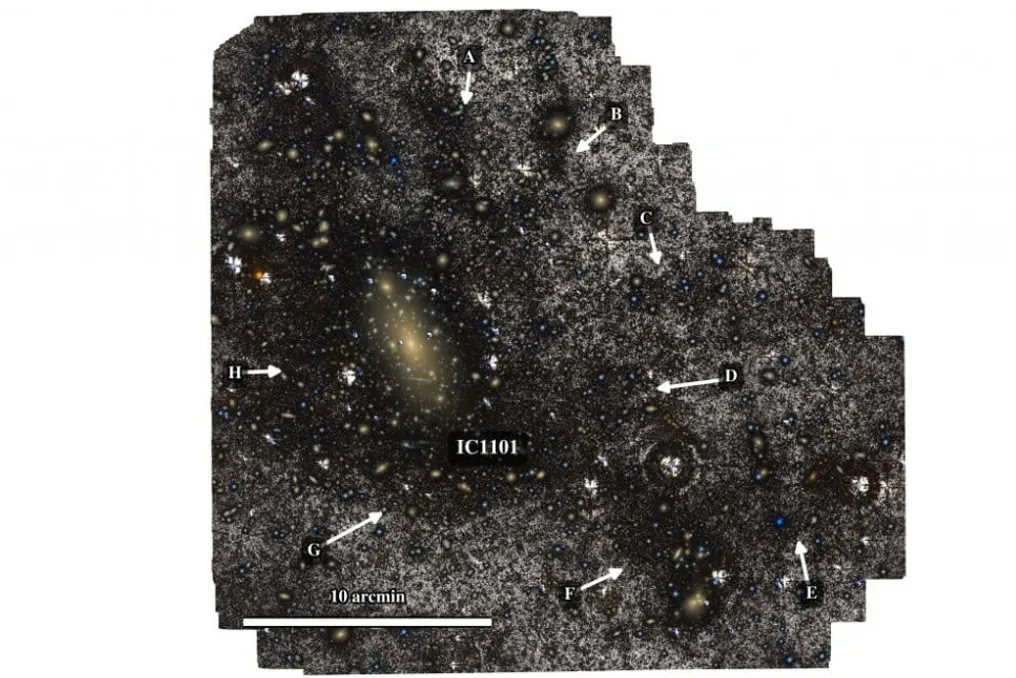
Ultra-deep images obtained using the Isaac Newton Telescope in the UK were used to define the boundaries. These images allowed for the identification of the region where the galaxy's light merges with the surrounding background. The data obtained showed an extent of about 520 kiloparsecs, equivalent to approximately 1.7 million light-years. This discovery contributes to the understanding of the processes of formation and growth of the largest galaxies in the Universe over billions of years. Galaxy IC 1101 is located at the center of the Abell 2029 galaxy cluster and retains signs of accreting surrounding matter.
Searching for the Limit of a Cosmic Giant
Galaxies that are the brightest in clusters and known as BCGs are among the largest stellar systems. They increase in size throughout cosmic history by accreting smaller galaxies, accumulating stars, and forming vast luminous halos. The complexity of measuring these structures lies in defining the point where the galaxy itself ends and the diffuse material of the surrounding cluster begins. The outer regions of BCGs often blend with the diffuse light present between galaxies, which makes identifying their boundary difficult.
IC 1101 was already considered a candidate for the title of the largest known galaxy. Before the new survey, its size was estimated at approximately 607 kiloparsecs. To refine this measurement, researchers applied deeper observations and detailed image processing. One of the main obstacles was separating the actual light of the galaxy from the scattered light of nearby stars. This effect, caused by light scattering within the telescope's optical system, could obscure the faintest regions of the structure.
To solve this problem, the team developed a specific model of the image behavior created by the telescope, using dozens of calibration stars with varying light intensities. This model was then applied to eliminate interference from more than 250 stars present in the images. After correcting the data, researchers were able to observe a gradual decrease in the brightness of IC 1101 as it moved away from the center. This analysis showed that the galaxy's boundary is located approximately 260 kiloparsecs from the core, resulting in a total diameter of about 520 kiloparsecs. Furthermore, the estimate indicates that the galaxy contains about 3.4 trillion solar masses in stars alone. For comparison, the Milky Way spans approximately 30 kiloparsecs, and its total mass, including dark matter, is calculated to be between 1 and 1.5 trillion solar masses.
A Galaxy That Continues to Grow
Despite its extraordinary size, IC 1101 does not appear to be a fully completed structure. During observations, scientists discovered eight extensive and asymmetric stellar formations in its outer regions. Two of these formations coincide with disturbances previously observed in the cluster's hot gas via X-ray emission. This connection suggests that the galaxy continues to accumulate matter and undergo growth processes. According to the research team, the peripheral regions of IC 1101 show clear signs of continuous mass assembly. This interpretation supports the idea that the galaxy is still evolving, rather than being a completely stable system.
The results are also consistent with previous research based on X-ray observations, which identified similar disturbances as possible traces of a collision that occurred between 2 and 3 billion years ago with another group of galaxies. The analysis of IC 1101 provides a new perspective on the evolution of the largest galaxies in the Universe. By determining its size with greater accuracy, the study shows that these cosmic giants hold records of their own formation and continue to change over time.