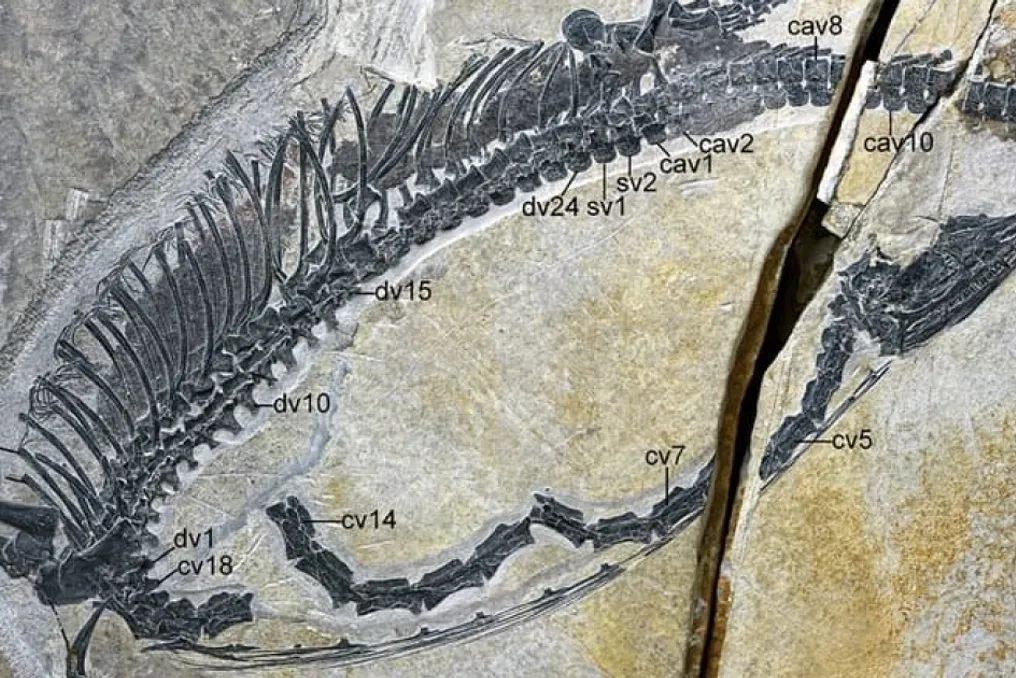
Scientists were able to discover and study the perfectly preserved digestive system of a marine reptile that inhabited Earth 245 million years ago. Specialists described an specimen of the archosauromorph Austronaga minuta, which existed in the Middle Triassic in the Yunnan province of China.
Details of the find and classification
Analysis confirmed that this species belonged to the family Trachelosauridae and led a marine lifestyle. In addition to skeletal remains, this animal had fossilized skin, muscles, blood vessels, as well as stomach, small and large intestines, and liver preserved. According to a publication in the journal Science Advances, this is the oldest preserved reptilian digestive system.
History of marine archosauromorphs
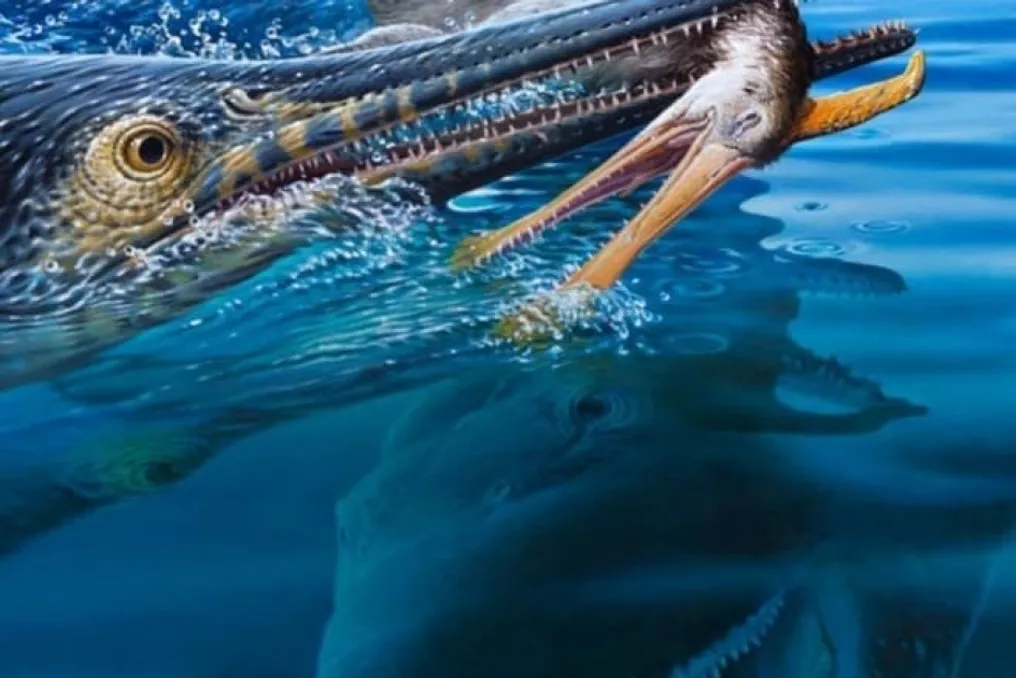
Archosaurids and other archosauromorphs have repeatedly inhabited the oceans. Among the most successful representatives are seabirds and Mesozoic Thalattosuchians, which are distant relatives of crocodiles. Some of the first marine archosauromorphs were members of the Middle Triassic families Tanystropheidae and Trachelosauridae, belonging to the recently identified clade Tanysauria, such as Tanystropheus with their very long necks. It is assumed that the transition of these two families to oceanic life occurred independently.
Study of Austronaga minuta
A team of scientists led by Wayne Van from the Institute of Vertebrate Paleontology and Paleoanthropology of the Chinese Academy of Sciences presented new data on the marine tanysaur Austronaga minuta. This small species was first described by Van and his colleagues in 2023 based on a fossil specimen from Yunnan province—a limestone slab containing a skull, part of the neck, and tail. The age of the find was determined to be 245 million years, corresponding to the Middle Triassic. Since A. minuta was found in marine deposits, and its nostrils were shifted back from the snout, and it had conical teeth in its mouth, the discoverers hypothesized that it fed on fish and lived in the sea.
Full analysis of the specimen
In a subsequent study, Van and his team analyzed another limestone slab where missing parts of the same A. minuta specimen were found: a remnant of the neck (which turned out to be quite long), torso, limbs, and base of the tail. Analysis of the entire specimen confirmed the species' belonging to the tanysaurids, specifically the family Trachelosauridae. Its closest relative was Dinocephalosaurus orientalis, which also inhabited the seas of Yunnan at the same time.
Lifestyle and size of the reptile
Researchers, based on the complete skeleton of A. minuta, concluded that its length was only 60 centimeters, significantly smaller than the six-meter D. orientalis. However, it remains unclear whether an adult or juvenile specimen was studied. Scientists also found additional signs of a marine lifestyle: the forelimbs and hindlimbs, due to the proportions and structure of the bones (including elongated fingers due to extra phalanges), functioned as flippers for swimming. Furthermore, the scapula, coracoid, pubis, and ischium of A. minuta were thinned, resembling plates, which is characteristic of other marine reptiles. There was partial reduction of the pelvic girdle, which reduced its ability to support weight on land. It is likely that A. minuta swam excellently, using its tail for propulsion and its limbs as rudders, while its long neck helped it catch fish. Notably, its relative D. orientalis, despite living in the sea, did not have such strong adaptation to the aquatic environment.
Condition of internal organs
The second limestone slab preserved soft tissues of A. minuta: remnants of skin and muscles in the sacral region, as well as the stomach, small and large intestines, liver, and blood vessels. Traces of undigested food, presumably fish scales, were found in the intestine, further confirming A. minuta's aquatic lifestyle. Nevertheless, overall, the internal organs of this species did not show a high degree of specialization for marine life. The authors emphasize that A. minuta represents the oldest reptile whose digestive system has been preserved to this day.
Vulnerability of tanystropheids
Previously, paleontologists established that the excessively long necks of tanystropheid archosauromorphs made them easy prey for predators. This is confirmed by fossil remains of two such reptiles, preserved only as heads and parts of cervical vertebrae. Predators likely attacked them from above and behind, using a powerful bite to sever the cervical vertebrae, after which they would drag the head with part of the neck and eat the rest of the body.
Another paleontological find
In a separate study, paleontologists discovered a tooth of the fossil spiny sunfish Neocometes brunonis in a German clay pit. The age of this find was estimated at 11.58 million years, which refutes the previous opinion that spiny sunfish had completely disappeared from Europe 1.7 million years earlier. The description of this find was published in the journal Fossil Imprint.