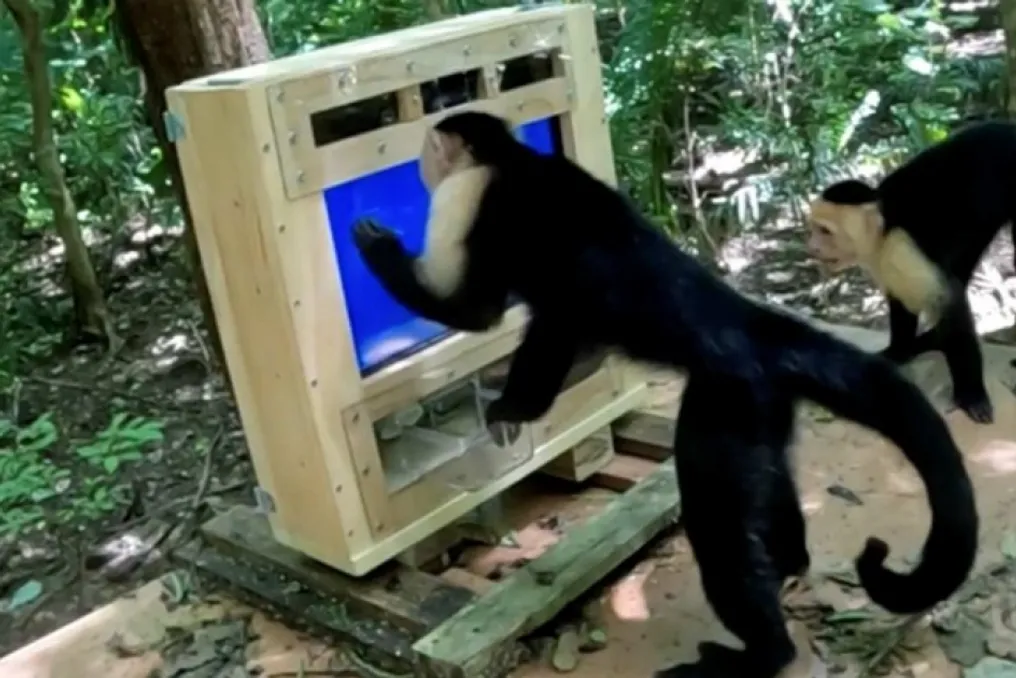
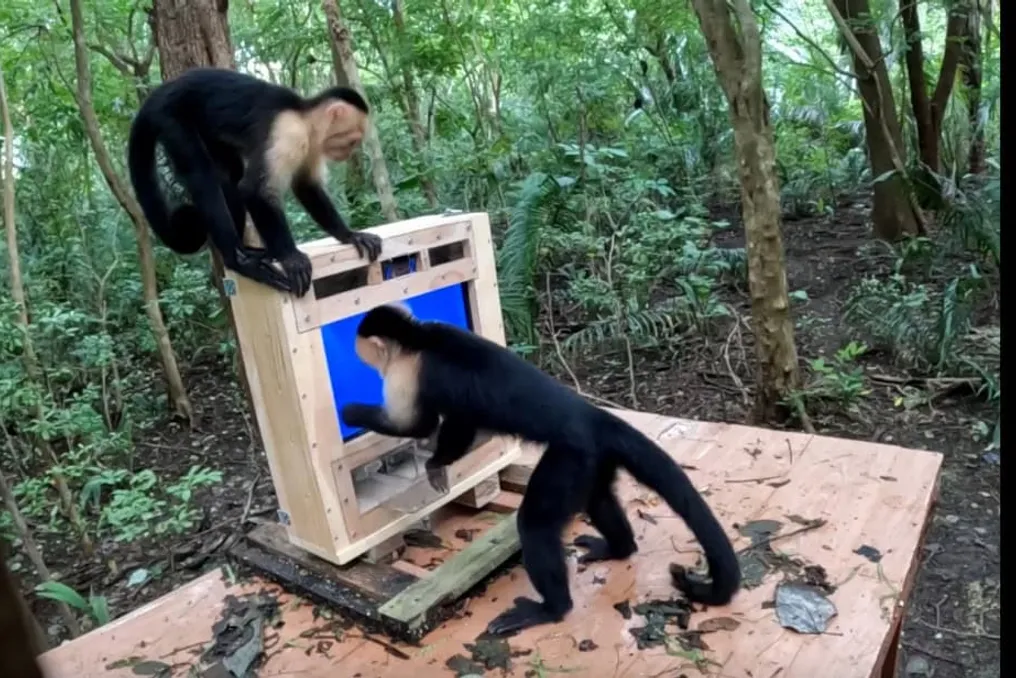
Scientists used a capuchin monkey to test a new methodology for studying animal intelligence in a forest in Costa Rica. A station equipped with artificial intelligence, a camera, and a touchscreen was implemented to monitor how these primates acquire knowledge.
How the CapuchinAI device works
This apparatus, named CapuchinAI, has the potential to elucidate how cognitive abilities affect the choices and survival of animals in their natural habitat, something that is notoriously difficult to observe in laboratory settings, according to The New York Times.
Association between touch and reward
The first contact occurred last summer when Papi, a dominant male, found a wooden box containing a 15-inch screen at the Taboga Forest Reserve. Initially, the monkey only inspected the object. After a few touches, a slice of dried banana was released onto a tray, quickly establishing the correlation: touching the screen resulted in a reward.
The station was designed to identify animals in real time and record their reactions during simple learning tests. To achieve this, researchers trained an artificial intelligence model using images of the very monkeys being studied in that region. Marcela Benítez, a primatologist from Emory University, emphasizes that to understand how primates make decisions and use their evolved brains, it is crucial to contextualize this in the environment where they live.
Initial challenges and test results
The initial phase faced an unforeseen obstacle: during the first two days, no monkey showed interest in interacting with the equipment. Doctoral student Federico Sánchez Vargas even considered restarting the project. However, the situation changed on the third day with the appearance of Papi. Throughout the tests, 16 monkeys interacted with or explored the station. Although not all understood the premise, a portion managed to assimilate the task.
The collected data showed that ten out of the sixteen monkeys learned to press the screen to get food. Furthermore, at least eight of these animals were able to retain this knowledge in subsequent sessions. It was also observed that some animals attempted to interact through alternative means, without grasping the mechanism. The system was effective in documenting individual variations in the learning process.
Next steps and future goals
The next phases of the project will include a more sophisticated facial recognition model capable of distinguishing each individual monkey, with a previous version of this technology already achieving over 97% accuracy in this identification. Researchers plan to introduce new challenges to measure skills such as mental flexibility and impulse control. In certain tests, the animals will need to touch green squares while avoiding red ones, and adapt when the rules are changed.
The team seeks to determine whether specific experiences of the animals, such as drought periods, can impact their cognitive development. According to Benítez, the ultimate purpose is to 'relate cognition to real-world challenges, outcomes, and ultimately, survival.' Despite the technological progress, scientists emphasize that they do not wish to turn the forest into a place full of screens, stating that the intention is to use technology merely as an aid for understanding primates, without replacing human observation.