Researchers from Spain conducted a comparative analysis of five different species of marine sponges and found that only the sponge Chondrosia reniformis was able not only to survive its time in a polluted harbor but also to reproduce successfully.
Researchers from Spain conducted a comparative analysis of five different species of marine sponges and found that only the sponge Chondrosia reniformis was able not only to survive its time in a polluted harbor but also to reproduce successfully.
The results of this work were published in the scientific journal Frontiers in Marine Science.
Water areas around harbors are constantly subjected to intense anthropogenic pressure. The water in these places is contaminated with various substances, including petroleum products, plastic, and toxins used for fouling control, as well as invasive species carried by ballast water from ships. This results in the degradation of local ecosystems and a decrease in overall biodiversity.
Under the guidance of Manuel Maldonado from the Center for Advanced Studies in Blanes, Spanish ecologists initiated an experiment to restore the Marina-Palomos harbor ecosystem using marine sponges. These sessile filter-feeding invertebrates have long been recognized as potential 'ecosystem engineers.' They are capable not only of filtering significant volumes of water, removing bacteria, heavy metals, and other toxins, but also of creating a favorable environment for colonization by other species.
In autumn 2024, Maldonado and his team installed an artificial reef in the Marina-Palomos water, located ten meters from a floating refueling station. This reef consisted of a metal support covered with a layer of calcium carbonate. In the following months, 42 marine sponges of five different species were attached to this reef: 24 individuals of Chondrosia reniformis, 6 individuals of Petrosia ficiformis, and 4 individuals each of Ircinia fasciculata, Sarcotragus foetidus, and Agelas oroides. The authors acknowledge that the sample distribution was uneven. Nevertheless, the initial interest in Chondrosia reniformis was due to the fact that this species is the most common in the region, whereas the others are much rarer. Ecologists carefully collected the sponges in the natural environment, striving to minimize harm to natural populations.
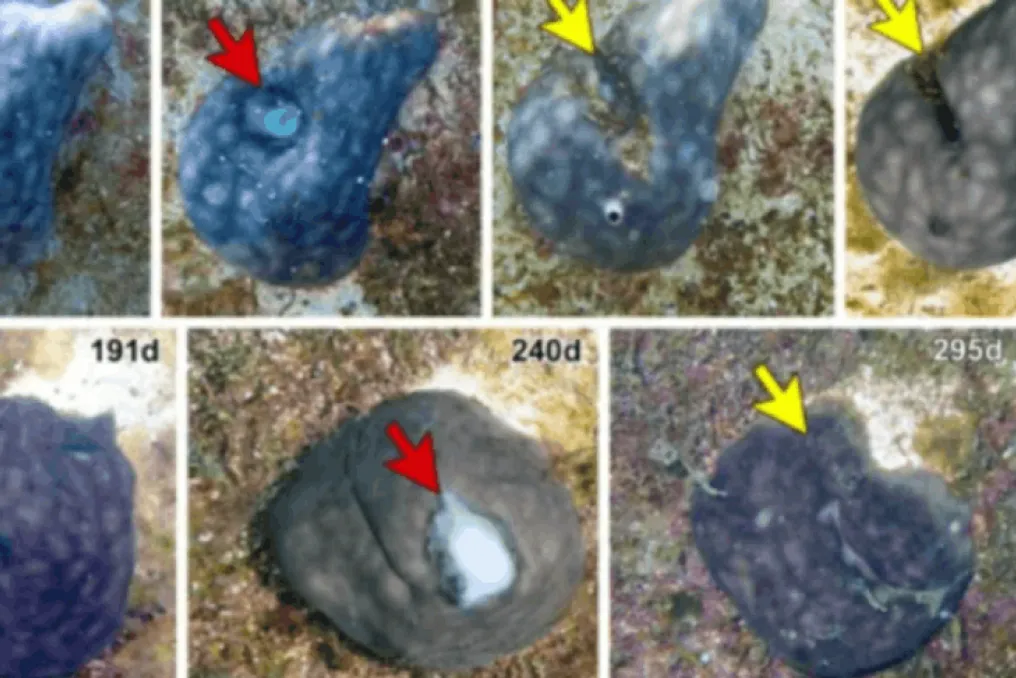
Over the course of 455 days, monitoring of the sponges' viability was conducted, which included photography, measurements, and shape analysis through computer modeling. As expected, the harbor's polluted water proved to be unfavorable: all individuals, except for Chondrosia reniformis, gradually decreased in size and died between 20 and 165 days after transplantation. However, the Chondrosia reniformis sponges not only survived these difficult conditions but also began asexual reproduction. At the end of the 455-day observation period in the harbor, 22 original individuals remained (accounting for 91.7 percent), and 18 new individuals appeared. Despite the unfavorable conditions, these sponges experienced stress: one individual became ill twice and lost parts of its tissue, but recovered completely each time.
The researchers also recorded unusual behavior: the sponges demonstrated the ability to 'crawl,' moving across the surface and detaching fragments of their bodies. Scientists hypothesized that this mode of movement allows them to move away from unfavorable zones and simultaneously stimulates asexual reproduction. An example cited is a case where a small sponge passed through a hole in the plate on the shaded side and subsequently increased in size by 486%.
Maldonado and his colleagues consider Chondrosia reniformis a promising subject for further work on restoring polluted harbors. It is planned to continue monitoring the transplanted sponges for several years to determine whether their symbiotic microorganisms contribute to the transfer of pollutant impact. Furthermore, the researchers intend to test other sponge species.
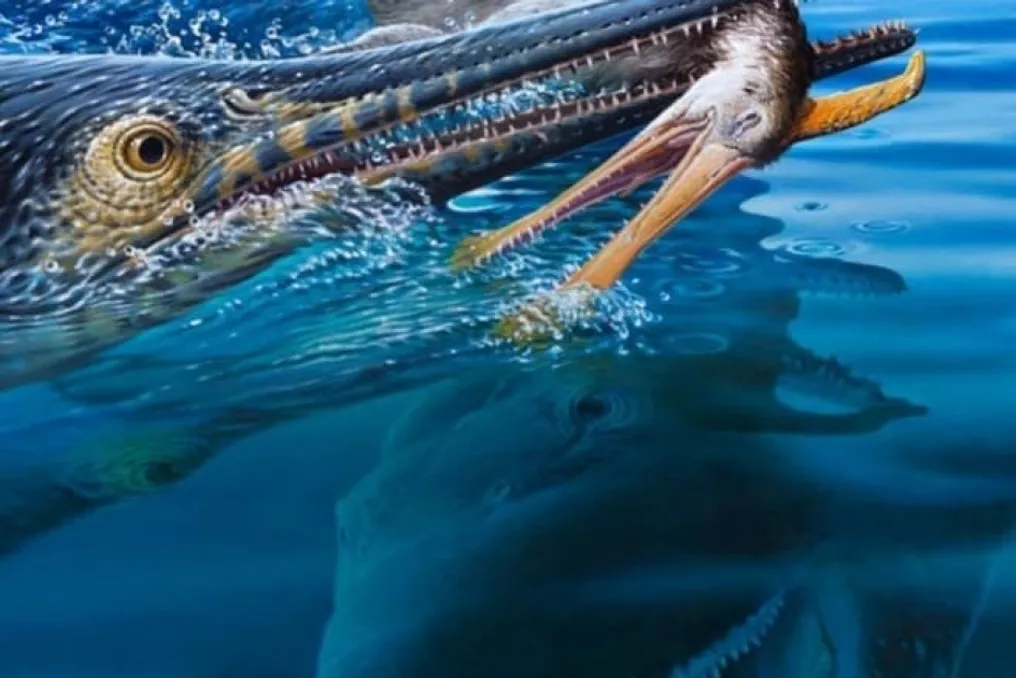
Researchers described the fossil of a six-to-seven-meter ichthyosaur, Platypterygius australis, which inhabited the inland Eromanga Sea in Australia during the Early Cretaceous period, approximately 105–106 million years ago. Among the scattered bones of this ancient reptile, fossilized remains of stomach contents were found. Analysis of this content showed that shortly before P. australis died, it had swallowed a pterosaur. There are two versions: either the ichthyosaur caught the winged reptile on its own, or it fed on its carcass. This marks the first documented case of an ichthyosaur feeding on a pterosaur.
Furthermore, based on tooth marks on the vertebrae, it is suggested that P. australis itself might have been killed and eaten by an even larger marine animal—the pliosaaur Kronosaurus queenslandicus. These research findings were published in the scientific journal Gondwana Research.
Periodically, paleontologists come across fossil remains of ancient animals containing coprolites—that is, preserved parts of stomach and intestinal contents. Such finds allow for the direct study of the diet and feeding behavior of long-extinct species. For example, previously, a coprolite was discovered belonging to a sauropod, young specimens of Diamantinasaurus matildae, which lived in Australia about 100 million years ago. Analysis of this sample confirmed that sauropods were herbivores and ingested food without much chewing.
A team of paleontologists led by Matt Andrew White from Northeastern University presented data on another discovery of a fossil animal with preserved gastrointestinal tract contents. The focus was on remains under identification number KK F1435, which were found in the Tulubook formation in Queensland, Australia. The age of this specimen is estimated at 105–106 million years. During that era, most of Australia was covered by the shallow inland Eromanga Sea.
Specimen KK F1435 consists of the remains of a large reptile, including a nearly complete skull with teeth and fragments of the postcranial skeleton, such as vertebrae, ribs, and limb bones. By studying this specimen, White and his colleagues classified the remains as belonging to the ichthyosaur Platypterygius australis of the family Ophthalmosauridae, which is well known to paleontologists and was described in 1972. It was established that this individual could reach a length of six to seven meters when alive.
About half a meter from the skull of KK F1435, White and his co-authors discovered a spherical mass, which they interpreted as fossilized stomach content that had fallen out of the abdominal cavity. From this structure, two fragments of pterosaur tooth bone from the family Anhangueridae were extracted, whose wingspan was presumably about four meters. The most likely scenario is that P. australis caught the pterosaur while it was flying over the sea and ate it. An alternative version suggests that the ichthyosaur fed on the carcass of a winged reptile that fell into the water.
According to researchers, this is the first known example of an ichthyosaur feeding on a pterosaur. Nevertheless, coprolites also contained (using neutron tomography) remains of more typical ichthyosaur food: several belemnites, as well as fish vertebrae and ribs and shell fragments. The stomach contents of P. australis indicate that members of this species, and possibly other Cretaceous ichthyosaurs, were generalist predators consuming a wide range of prey.
Notably, deep tooth marks were observed on the vertebrae of KK F1435, and some vertebrae were broken or missing. Judging by the size and shape of these marks, they were left by the pliosaaur Kronosaurus queenslandicus—an even larger marine reptile that reached over ten meters in length and occupied the position of apex predator in the Eromanga Sea. According to the most plausible version, the pliosaaur hunted the ichthyosaur, killed it, after which it fell to the seabed, damaging its skull from the impact. Then this same pliosaaur consumed the body of the victim, scattering the remains across the seabed over a distance of more than ten meters (possibly its relatives later acted as scavengers).
The research results demonstrate the presence of a complete food chain in the Eromanga Sea: large ichthyosaurs consumed mollusks, fish, and pterosaurs, and in turn became prey for more massive pliosaurs. Several years ago, paleontologists found a fragment of a lower jaw of an unknown pterosaur on the Tulubook formation, based on which a new genus and species—Thapunngaka shawi—was described. Scientists estimated the wingspan of this reptile to be six to seven meters, making it the largest pterosaur in Australia. There is a possibility that the bone found in P. australis's stomach belonged to T. shawi.