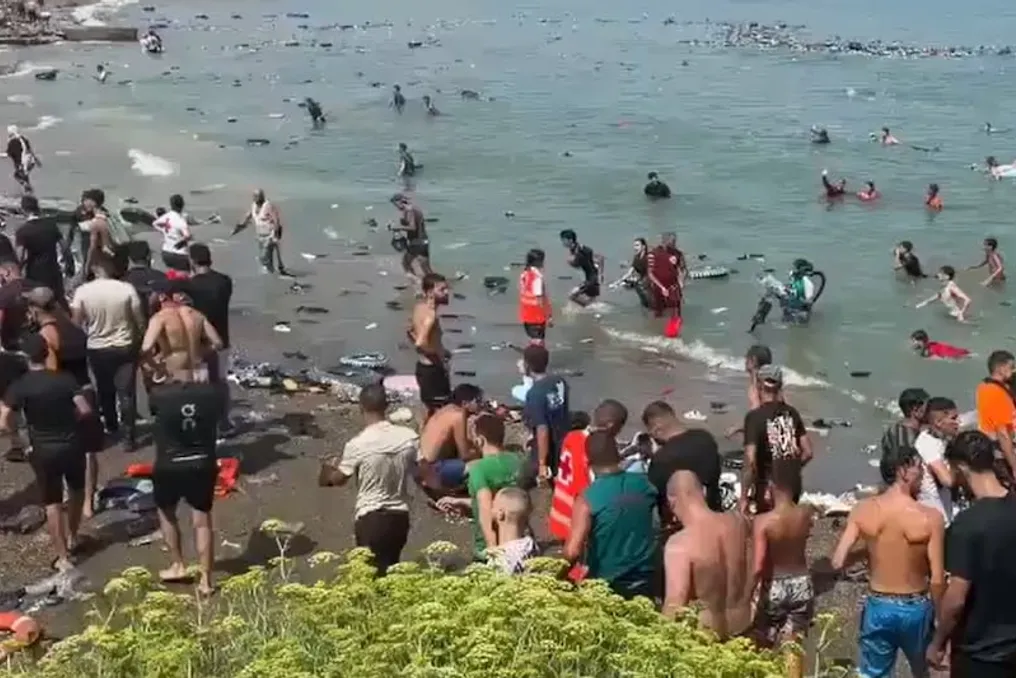
Thousands of Moroccan residents illegally enter Spain by crossing the sea border, leading to an unusual situation in the city of Ceuta. People from Morocco arrive in Spain chanting slogans in support of Spain and enter via the sea, while Spanish border guards are unable to take countermeasures other than demanding they leave.
Due to thousands of migrants entering this small Spanish region, Spain has announced the deployment of its military forces in Ceuta to restore order. Nine people died during these events. The question arises as to why this happens every year, and why thousands of people from Morocco, including youth, children, and women, seek to enter a European country.
To understand this situation, it is necessary to examine the unique geographical position of Spain and Morocco. Spain is a European country, whereas Morocco is located on the African continent, separated by the sea. Nevertheless, Moroccans reach Spain. The answer lies in the historical and geographical position of these two countries.
The city of Ceuta, located on the northern coast of Africa in Morocco, is near the Strait of Gibraltar, between Europe and Africa. History shows that Ceuta has been under Spanish control since 1580; previously, this area was controlled by Portugal. After the unification of Portugal and Spain, Ceuta became a Spanish enclave and remains so to this day.
This city, under Spanish jurisdiction, borders Morocco by land. However, due to strict land border security, people cannot enter this area. Where the border between Morocco and Ceuta runs by land, the sea begins, and passages into Ceuta open up across the sea.
Ceuta's geographical location is isolated from mainland Spain, but due to its location in Africa, it is connected to Morocco by land. This has made it an entry point for migrants who have long tried to reach Europe.
If you look at a map of Ceuta, you can see entry points from Morocco by sea. These include Tarajal beach, located at the southern end of Ceuta, and Benchouica beach, through which one can also enter the Spanish region.
The crowd that arrived in Ceuta on Thursday entered specifically through Tarajal beach. Videos show a gathering of people around embankments at Tarajal beach, most of whom were Moroccans. Although young men predominated among them, families with women and small children were also present.
Representatives of the Spanish government reported that at least nine people died as a result of the chaos on Thursday. It is not yet clear what caused such a large number of migrants heading to Ceuta. However, this is not the first case. Local authorities note that dozens of people have died this year trying to reach Ceuta.
According to a CNN report, official representatives of Morocco did not publicly comment on these border crossing incidents, and the Ministry of the Interior did not respond to requests for comment.
The Spanish Ministry of the Interior stated that the Moroccan government is cooperating with Spain to solve this problem, and Moroccan police stop many people attempting to cross the border.
Ceuta officials link this wave of migrants to a ruling by the Supreme Court of Spain made at the beginning of this month. It stated that migrants arriving by sea cannot be immediately deported across the border without proper legal procedure. In contrast, people entering by land, for example, by climbing over the border fence, are immediately sent back.
Some Moroccan human rights activists have expressed doubt that the Spanish court ruling caused a sudden increase in the number of migrants. They argue that most migrants are unaware of such legal decisions.
Another reason is the Schengen system of Europe. The Schengen area is a system of open borders covering 29 European countries. These countries have officially abolished their internal borders. Thus, Spain becomes the first gateway to Europe for these migrants. Residents of Morocco arrive in Ceuta seeking better economic opportunities or to escape violence in their home countries, and then continue their journey to other European countries in search of a better life.
How do migrants reach Ceuta?
To reach Ceuta, located on the northern African coast, migrants often swim about 5 kilometers from the town of Fnideq in Morocco and reach Spanish territory. Some other people try to cross the border from the nearby town of Melilla, where the distance is shorter.
Scenes of crowds at the border resemble the crisis of 2021, when more than 8,000 migrants arrived in Ceuta in just two days. At that time, accusations were made that Morocco had weakened border control and allowed migrants to enter Ceuta.
This happened because Spain allowed Brahim Ghali, the leader of the Polisario Front, to receive treatment in a Spanish hospital, which caused a diplomatic crisis between Rabat and Madrid. For decades, the Polisario Front, advocating for independence, has presented itself as the legitimate representative of the Sahrawi people, a disputed region of Morocco. Thus, the Moroccan government sometimes unofficially allows its citizens to enter Europe, while suffering people from Africa rush into the sea in search of entry into Spain for a better life.