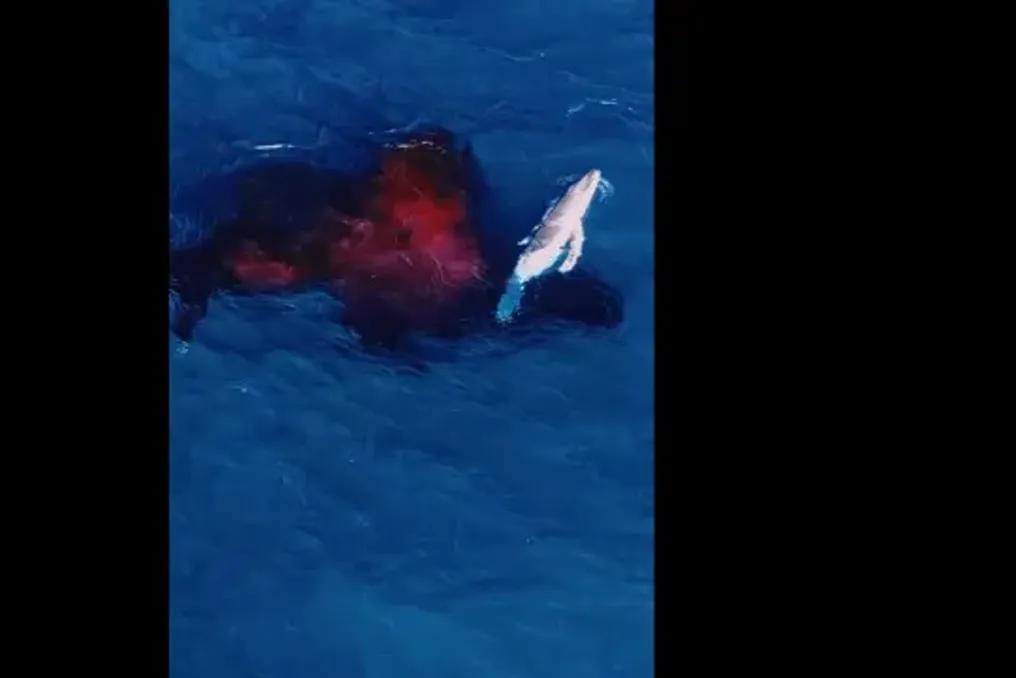
The Oceanic Research and Rescue Centre of Australia (ORRCA) has published video footage that, according to their description, represents the fourth complete humpback birth recorded on video worldwide and the first captured using a drone.
This birth occurred the day before off the coast of New South Wales, but the exact location will not be disclosed to ensure the welfare of the mother and calf.
On July 28, ORRCA drone operator Alexander Forrest witnessed and documented what is presumed to be the fourth complete humpback birth recorded on video anywhere in the world, as well as the first such birth filmed by a drone. After noticing an adult female exhibiting unusual behavior during a northward migration, Alexander observed the birth of the newborn calf and its first breath.
His colleague at ORRCA, drone pilot Tanya Snowden, and friend, wildlife photographer Dominic Cotter-DeFoeff, continued to document the mother and calf for several hours, gathering valuable behavioral observations during the critical first hours of the calf's life.
ORRCA noted that although humpback whales give birth annually, witnessing and documenting the entire birthing sequence is an exceptionally rare event. Such observations can expand the understanding of humpback whale reproduction, maternal behavior, and the earliest stages of calf life.
The ORRCA research team will conduct a comprehensive scientific analysis of the images and associated field observations, the results of which will be prepared for publication as a peer-reviewed scientific note. The organization expressed hope that this remarkable event will contribute valuable insight into the international understanding of these amazing animals, while emphasizing that the location will not be disclosed to protect the welfare of the mother and calf.
The photographer recounted that the ocean seemed full of activity that day. Among the whales migrating south and north, one solitary adult specimen stood out, swimming very slowly in the shallow water. His initial thought was that the animal might be sleeping, but he did not suspect the rarity of what he was about to document. The whale suddenly surfaced, so he activated the recording button—every breath is an opportunity to capture unique behavior. In this case, the whale surfaced not to breathe, but to give birth to its new calf. He described it as something extraordinary that caused a sharp rush of adrenaline.
Forrest emphasized that it was a privilege to witness such a significant moment, and even more rewarding to know that it could contribute to marine mammal science in the coming years, noting that at that moment, he was not just a cinematographer or photographer, but an observer.
It is worth noting that in the 1970s, the US classified humpback whales as endangered due to commercial hunting. According to the National Oceanic and Atmospheric Administration (NOAA), the final moratorium on commercial whaling was established in 1985, and currently, four of the 14 different population segments remain protected as endangered species, while only one is classified as threatened. Nevertheless, according to the International Union for Conservation of Nature (IUCN), the conservation status of this species is assessed as 'least concern.'