In the 19th century, photography began to become financially accessible, but it was still a relatively new technology, making the idea of permanently recording someone's image seem unusual. The first documented photograph appeared in 1826, but it was in 1839 that Louis Daguerre introduced the daguerreotype, the first commercially successful photographic method, which recorded images on small metal plates.
With the rapid improvement of the process, photography gained popularity, and a habit established itself in many British families: taking pictures of deceased relatives as an eternal memory. Although documenting the dead was not unprecedented, before the 19th century, this was restricted to the wealthy, who hired artists to paint portraits. Photography, being much more economical, allowed families of lower income to also have access to this memory, especially from the 1850s.
The high mortality rate in Europe, which hovered around 40 years due to childhood vulnerability in an era without antibiotics, generated a large demand. During mourning, families sought out photographers to create a record, an act known as 'memento mori,' which means 'remember that you will die' in Latin.
Although these images were known as 'Victorian death photos' in English, the practice expanded throughout Europe, as well as to other places such as the United States and Australia. Historian Stanley Burns calculated that about 30 million daguerreotypes of deceased people were produced in the US between 1841 and 1860.
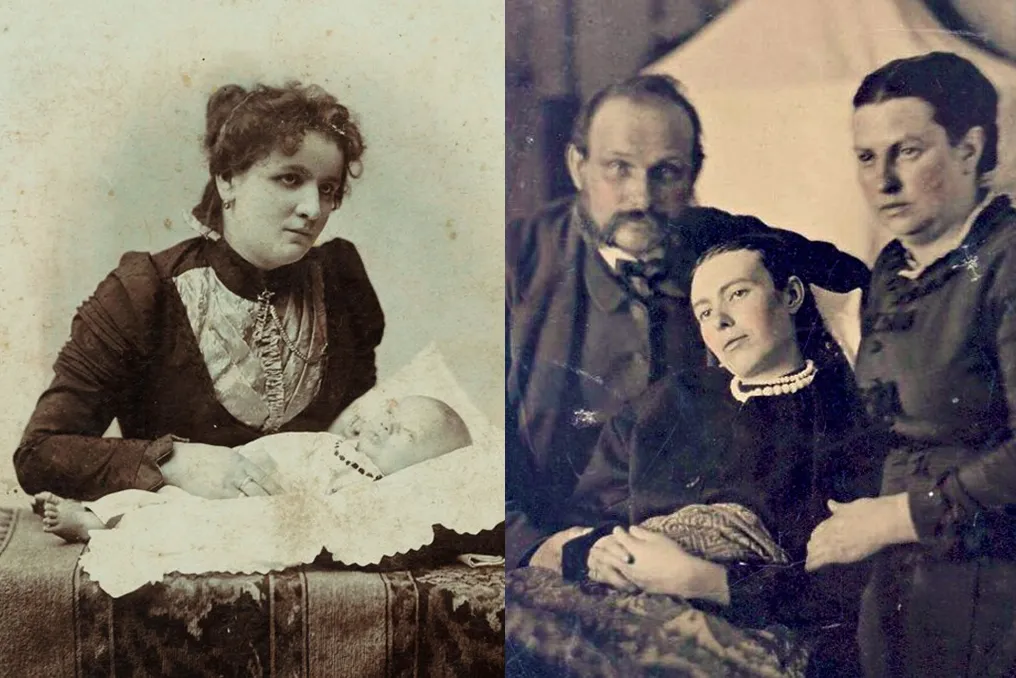
These photographs required careful posing: mothers holding children, couples embracing, or babies sleeping. Frequently, the models were placed in coffins or beds. Unlike portraits of living people, which were taken in studios, photos of the dead were generally taken in domestic settings. Families cared for the loved one, dressing them in nice clothes and arranging special hairstyles. Some photographers had the technique of opening the eyes of the corpses or even painting the eyes in the photos to simulate them being open.
Many Victorian photographers were skilled at posing deceased babies to look like they were sleeping, applying even a slight pink tone to the cheeks to suggest vitality. The setting was also planned, decorated with flowers and items reminiscent of time, such as clocks and hourglasses, indicating that it was a post-mortem image. There were also photos where the living posed next to the deceased. In these cases, a notable effect occurred: the dead appeared sharper in the final image because they remained still during the capture (which lasted a few minutes), while the living appeared slightly blurred. Some children were photographed with their deceased dogs.
Later examples show the deceased inside a coffin, accompanied by a large group of people at the funeral. This type of record was more popular in Europe than in the US.
There were practical challenges in dealing with a body. In a 1873 edition of the magazine Philadelphia Photographer, photographer Albert Southworth reported: 'If a person has died and friends fear there will be liquid expulsion from the mouth, it is possible to turn them carefully, as if under the effect of an emetic. This can be done in less than a minute; all contents will be expelled, and then it is possible to clean the mouth, wash the face, and handle the body as well as if the person were alive.'
However, the general rule was to treat the deceased with the utmost respect. Post-mortem photos were not a pastime but a sincere attempt to keep the relative alive in memory. The poses were designed to convey solemnity, and the bodies were not subjected to disrespectful manipulations. Claims that corpses were hung or supported upright to look alive lack historical basis.
These photographs were preserved as memories, displayed in homes, sent to family and friends, or kept in lockets and pockets. The practice of post-mortem photos declined in the early 20th century due to medical advancements, the reduction in infant mortality, and the implementation of stricter sanitary standards in body treatment. Additionally, progress in photographic technology and the emergence of home cameras allowed people to maintain extensive records of their loved ones while alive, making post-mortem photography unnecessary.