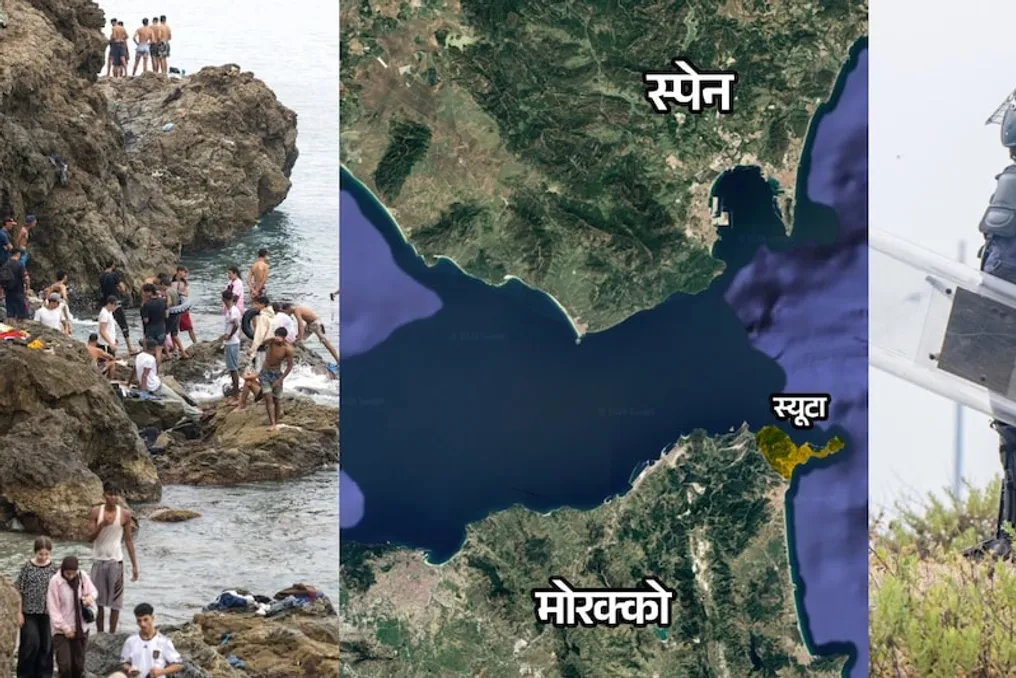
In the city of Ceuta, considered a gateway to Europe, sounds of gunfire are heard. Thousands of migrants from North Africa cross the border, striving to reach this small city in search of a better life, but they encounter harsh actions from the police and security forces.
As a result of these clashes, 32 people have died, raising serious questions about human rights observance worldwide. Notably, the city that has become the center of this conflict is surrounded by Moroccan territory but is under Spanish administration. Questions arise regarding the ancient history that made Ceuta part of Europe, and why Morocco considers it its territory.
Over the past week, thousands of migrants from Morocco have arrived in the Spanish enclave of Ceuta, located in North Africa. The President of Ceuta reported that about 60,000 migrants from Morocco entered Ceuta, which accounts for 70 percent of the city's total population. The President of Ceuta, Juan Jesús Vivás, noted that the current situation is unprecedented. During the riots, drownings, and actions of security forces, 34 people died.
Spain has deployed the army and additional police forces to stabilize the situation. According to media reports, attempts by thousands of migrants to cross the border in one day have become the largest crisis since 2021. Ceuta is the closest route to reaching Spain; people can get there by swimming, climbing fences, or breaking through checkpoints.
Photos and videos from Ceuta are shocking: when checkpoints open, crowds of people run, ignoring all security measures and crossing the border. Young people predominate among them. Hundreds of people swimming towards Spain were spotted in Reuters posts.
The minimum sea distance between Spain and Morocco is about 14 kilometers, between Punta de Tarifa in Spain and Punta Sireas in Morocco in the Strait of Gibraltar. However, the situation is different when talking about Ceuta. Ceuta borders Morocco directly, having a land border of about 8.2 kilometers. Therefore, migrants often try to enter Ceuta by jumping over fences or across the seashore.
The main reason is that Spain is a wealthy European country with job opportunities and a better future, whereas Morocco is a poor country from which young people leave in search of employment.
A recent decision by the Spanish Supreme Court is explained by the court ruling that migrants detained at sea near Ceuta cannot be immediately deported under old rules, unlike the former 'border refusal' practice. This gave migrants hope of settling in Spain, prompting them to enter the country by any means.
Furthermore, Spain is working on a plan to grant legal status to approximately 500,000 undocumented migrants. Spanish Prime Minister Pedro Sánchez maintains a relatively liberal policy towards migrants, supporting legal immigration, refugee reintegration, and granting permanent status to long-term undocumented residents.
After the incident, Prime Minister Pedro Sánchez stated on X that the government guarantees the safety of Ceuta's residents and will increase the presence of security forces and the Corps in the city streets. He also announced that a physical barrier would be established in the sea to facilitate the deportation of people in accordance with the Supreme Court's ruling. Additionally, cases for the return of migrants who arrived without permits will be expedited, and cooperation with Moroccan authorities in combating human trafficking will continue.
Geographically, Ceuta is located on the northern coast of Morocco in Africa, but politically it is an autonomous city of Spain. The history of this place spans about 600 years. In 1415, Portugal captured Ceuta. Later, in 1580, Portugal and Spain entered into a union monarchy. When Portugal separated in 1640, the local rulers of Ceuta decided to remain with Spain. After the 1688 treaty, Ceuta officially became part of Spain. Today, it is also part of the European Union, although located on the African continent.
Morocco claims that Ceuta and Melilla are colonial remnants on its territory that were seized by Spain and should be returned. Spain, in turn, insists that Ceuta is an integral part of it for centuries, and most residents there also wish to live with Spain. Because of this, the issue remains a source of constant diplomatic tension between the two countries.
Ceuta is not just a border city of Spain; it is the external border of the European Union, its gateway. Consequently, any major wave of illegal migration here affects the immigration policy, border security, and asylum system of the entire European continent.