
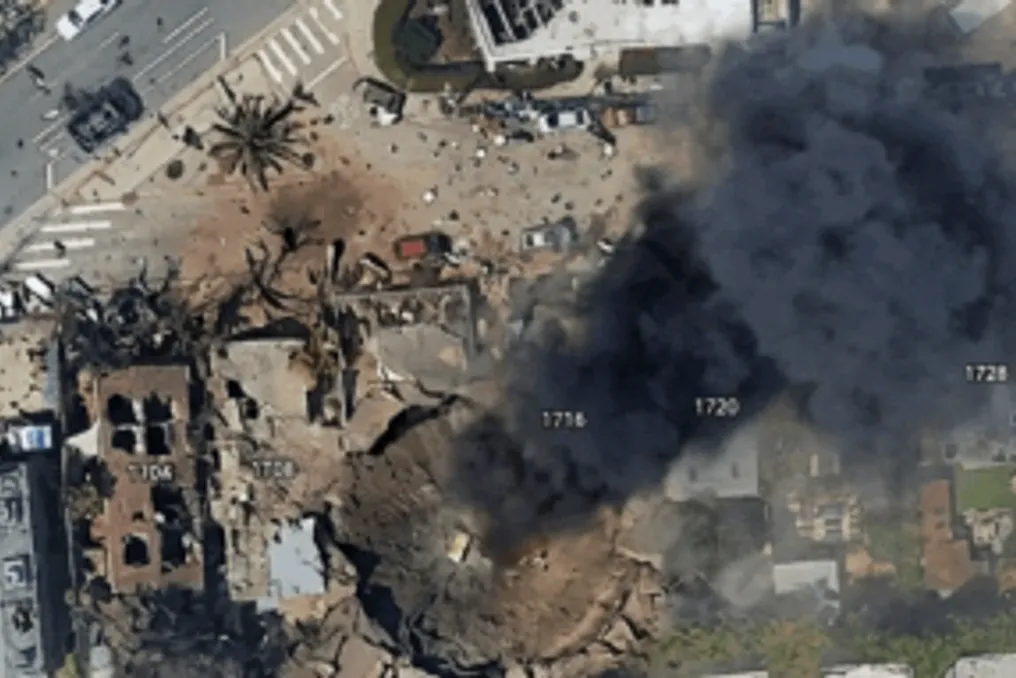
Google decided to disable the artificial intelligence image creation feature in Google Earth last Friday, July 31st. This functionality, which allowed for the generation of photorealistic representations of global locations from satellite data, had only been introduced one day earlier, on Thursday, July 30th, but faced severe criticism.
In less than twenty-four hours, users and experts demonstrated how easily it was possible to produce realistic images simulating disasters and attacks, which opened the door for use in disinformation campaigns. Google acknowledged this concern, stating on its X account (formerly Twitter) that while it saw useful uses by geospatial professionals, it also observed shared screenshots that seemed to violate its guidelines.
As a result, the company opted to remove the AI from Google Earth while working on developing more robust restrictions to prevent such occurrences. The company also reinforced that the generated images were not visible to all users and contained digital watermarks for identification purposes.
The tool was criticized for facilitating fake news
The simplicity with which realistic images could be generated, capable of being used in fake news and disinformation efforts, generated a wave of criticism directed at Google. Several experts and users pointed out the extreme ease of using the tool for illicit purposes.
For example, the team at 404 Media managed to fabricate fake images of a homeless encampment in Los Angeles, as well as position protesters in front of Google's headquarters. Information security researcher Henk van Ess achieved similar results, reporting having created images of refugees on the border with Mexico, a nuclear power plant in Iran, and a fatal accident on a street in Amsterdam, using Google's own satellite imagery as a basis.
Negative examples continued, with the BBC generating images of a collapsed Eiffel Tower, a hole swallowing the Great Pyramid of Giza, and Russian tanks in the capital of Ukraine. On Thursday, July 30th, Google had assured that it took the issue of disinformation seriously, informing that all generated images possessed the SynthID digital watermark, identifiable through Gemini or Lens; however, this measure proved insufficient to keep the feature active.