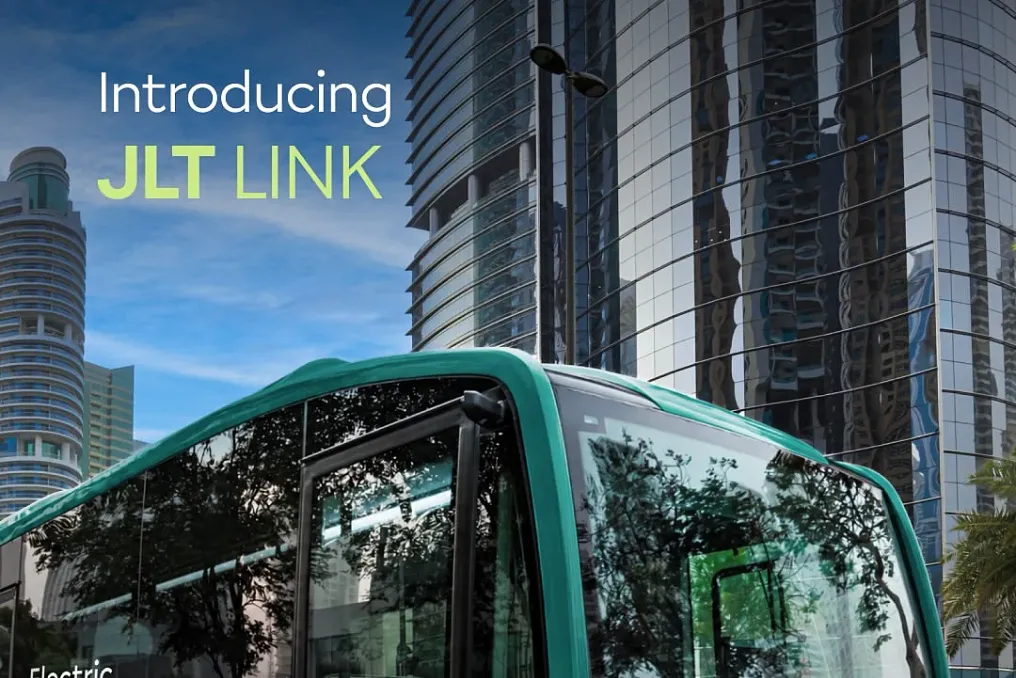
Residents, employees, and visitors of the Jumeirah Lakes Towers (JLT) area in Dubai will be able to travel around the area using a new fully electric bus service starting on August 1st. This service is named JLT Link.
Residents, employees, and visitors of the Jumeirah Lakes Towers (JLT) area in Dubai will be able to travel around the area using a new fully electric bus service starting on August 1st. This service is named JLT Link.
The service will operate on two routes, covering clusters from A to Z, and will provide connectivity between different parts of JLT and the DMCC Metro Station and Sobha Realty Metro Station. The cost of each trip will be 3 dirhams, and passengers can track routes, view real-time schedules, top up balances, and pay for travel through the JLT Link application.
The new service will replace the existing bus line in the area and will utilize four fully electric buses.
JLT Link will operate on two circuits, with each route serving opposite sides of the area. Circuit 1 will cover the western part of JLT and connect passengers to the DMCC Metro Station. According to the route map, it will serve clusters from A to N and pass through key points on this side of JLT. Buses on Circuit 1 will arrive every 30 minutes.
Circuit 2 will cover the eastern part of JLT and link passengers to the Sobha Realty Metro Station. It will serve clusters from O to Z, including residential and commercial areas near JLT Park. According to the detailed schedule published on the JLT Link website, buses on this route will arrive every 20 minutes. In total, the two routes include 13 stops throughout JLT.
This service is designed to simplify movement for people between homes, offices, and the Dubai Metro, eliminating the need to use a car for short trips or long walks in the heat.
Both routes will operate from 6:30 AM to 9:30 PM from Monday to Saturday. On Sunday, the schedule indicated on the JLT Link website provides operation from 9:30 AM to 12:30 AM. Passengers can check the full schedule and real-time arrival information through the app before traveling.
The fare for each trip will be 3 dirhams. Passengers will need to open the JLT Link application, top up their balance, and use a QR pass to pay for the trip. Information posted on the service's website also asks passengers to scan the QR code at the bus stop before boarding. Advance booking is not required; passengers can find the nearest stop, get there, and board the next available bus.
The service information does not mention the use of Nol cards. Payment data provided by JLT Link relates to its own application and QR system.
The JLT Link fleet will consist of four fully electric buses, each with 23 seats. The buses have low entry, which facilitates passenger boarding. Each vehicle will also be equipped with a dedicated space for wheelchair users. DMCC stated that the buses are designed with comfort, accessibility, and daily reliability in mind.
All journeys on JLT Link will be made using electric buses. DMCC noted that the zero-emission fleet will support cleaner and quieter streets in the area while reducing emissions from local transport. For many JLT residents and employees, the main advantage will be direct connectivity to the metro. People living or working in the western part of JLT can use Circuit 1 to reach the DMCC Metro Station, while residents of the eastern part of JLT can use Circuit 2 to access the Sobha Realty Metro Station.
Thanks to the 3 dirham fare, 13 stops, and operation throughout the week, JLT Link is expected to provide a new option
Shree Cement Ltd announced on Friday a 17.48% decline in consolidated net profit for the June quarter of fiscal year 27. This decrease was attributed to increased raw material costs. According to regulatory filings, the company, promoted by the Bangur family, reported a net profit of 643.66 crore rupees for the period from April to June last year.
The country's third-largest cement group demonstrated an 18% growth in operating revenue for the June quarter of FY27, reaching 6233.13 crore rupees, compared to 5280.88 crore rupees in the same quarter of the previous fiscal year.
The company's operating profit decreased due to rising fuel and raw material expenses caused by the Middle East crisis, as stated in the earnings report. Cement sales volume increased by 17% year-on-year, totaling 10.23 million tonnes (MT) in Q1 FY27, compared to 8.74 MT in Q1 FY26. Total sales volume, including clinker, grew by 17.2% to 10.49 MT from 8.95 MT.
Furthermore, the Ready Mix Concrete (RMC) business showed significant growth during the quarter: volumes increased by 156% year-on-year, reaching 2.36 lakh cubic meters compared to 0.92 lakh cubic meters in the corresponding quarter last year, according to the earnings report.
The company's total expenses rose by 22.7% to 5703.75 crore rupees in the June quarter of FY27. According to SCL, premium product sales increased to 23.3% of total turnover compared to 17.7% in the same quarter last year. Meanwhile, total revenue grew by 16.83% to 6444.84 crore rupees in the reporting quarter.
Commenting on the results, Shree Cement Managing Director, Niraj Ahoury, noted that the quarter was characterized by strong demand momentum, confident volume growth, and continuous progress in the premiumization strategy implementation. The company continued to focus on increasing sales volumes and value proposition, which was supported by the expansion of the RMC business.
Regarding capital expenditure, SCL reported that work on the planned new integrated plant in Meghalaya is progressing satisfactorily. Necessary permits have been obtained, and orders have been placed for major plant equipment. The project is expected to be completed by the quarter ending March 31, 2028.
Concerning growth forecasts, SCL maintains a positive outlook, supported by consumption growth, government infrastructure spending, stable inflation, and favorable policy measures. However, the company warned that geopolitical tensions in the Middle East and the possibility of a moderate monsoon could create short-term challenges to growth rates.
On Friday, Shree Cement Ltd shares closed at BSE at ₹26146 per share, declining by 1.12%.
Social media users have been targeted by scams orchestrated through fake advertisements posing as the Desenrola Brasil program. These fraudulent pages promise to simplify debt negotiation, but their real goal is to collect victims' personal data or redirect them to contacts controlled by criminals.
According to a survey conducted by Agência Brasil, based on data from UFRJ's Netlab, 544 fraudulent ads were identified across Meta platforms between April and June, including Facebook, Instagram, WhatsApp, Threads, and Messenger.
The study conducted by the Laboratory of Internet and Social Network Studies (Netlab), affiliated with the Federal University of Rio de Janeiro (UFRJ), found that 48 pages were responsible for disseminating these deceptive campaigns. Of this total, 278 ads mentioned the official name of Desenrola Brasil, while another 264 promoted a fictitious program called Libera Brasil. In some cases, a page combined both names to simulate authentic communication.
Desenrola Brasil, established in 2023, was created to help consumers renegotiate their debts. Netlab observed that the circulation of these fake ads increased after the launch of the program's new version in May.
The methods employed by scammers include the improper use of government or recognized brand visual identity and names, the use of links mimicking official websites for information theft, the promise of immediate financial resolutions, sending messages that induce urgency, and creating content using artificial intelligence.
Marie Santini, director of Netlab, told Agência Brasil that the difficulty lies in the fact that genuine and fake ads are displayed side-by-side on the same social media platforms, without adequate filters or security systems.
When users interact with these ads, they may be redirected to pages set up by the scammers. In these environments, the intention is to obtain confidential and personal data or direct the victim to conversations via WhatsApp.
The survey revealed that 72% of the analyzed ads improperly used names or images belonging to the government and private brands. Additionally, 19.1% led to URLs imitating official channels, and 38.1% contained AI-generated material. Researchers indicate that these tactics make the scams more believable and complicate fraud detection.
In response, Meta communicated that it implements actions to combat digital fraud, employing artificial intelligence, large language models (LLMs), facial recognition, and human analysis. The company also assured the removal of any content that violates its guidelines, stating: 'We use a combination of technology and human review to identify and remove violating content.'
The study demonstrates that criminals persist in exploiting established programs to mislead users. Therefore, before sharing data or accessing any link received through ads, it is essential to verify whether the communication comes from an official channel.
The National Bank of Angola (BNA) held a press conference to announce the formal integration of the kwanza into the South African Development Community's (SADC) Real-Time Gross Settlement (RTGS) System, a move considered by the governor of the Angolan central bank as crucial for both the domestic financial system and the country's financial inclusion in the southern region.
Tiago Dias, Governor of the BNA, stated that the inclusion of the kwanza in the RTGS, which functions as the main regional payment system, will enable transactions with greater security, efficiency, speed, and lower cost.
According to the governor, the adoption of the kwanza as the settlement currency in SADC constitutes a major advance for Angola, as it is the second currency, after the South African rand, to reach this milestone.
By presenting this initiative, the BNA reinforces its commitment to modernizing the payment system, maintaining financial stability, and offering solutions that boost national trade, investment, and economic growth. The governor also highlighted that the local economy is more diversified and trade exchanges with SADC members are more balanced, allowing for a tranquil outlook on the future.
He predicted that there will be better business opportunities for the Angolan business class, enabling them to produce and export goods and services to the economies of other participating countries.
Meanwhile, Cristina Caniço, Director of Payment Systems at the BNA, communicated that the next integrations of Mozambique's metical and Botswana's pula into the RTGS are planned. She clarified that the SADC RTGS is a regional real-time gross settlement mechanism designed to process cross-border payments between member states of the southern region.
The official emphasized that individuals, companies, and the State can use this system to make payments for goods and services by requesting international transfers through one of the five accredited commercial banks. Cristina Caniço detailed that the client does not interact directly with the system; they must contact their commercial bank, present the invoice for the good or service for the external transfer, with the bank being responsible for validating the operation.
Among the advantages pointed out by the director is the elimination of the need for correspondent banks. Settlement becomes more agile regionally, reducing dependence on intermediary banks, increasing the effectiveness of transaction processing, potentially decreasing international payment costs, and promoting greater use of the kwanza in regional operations.