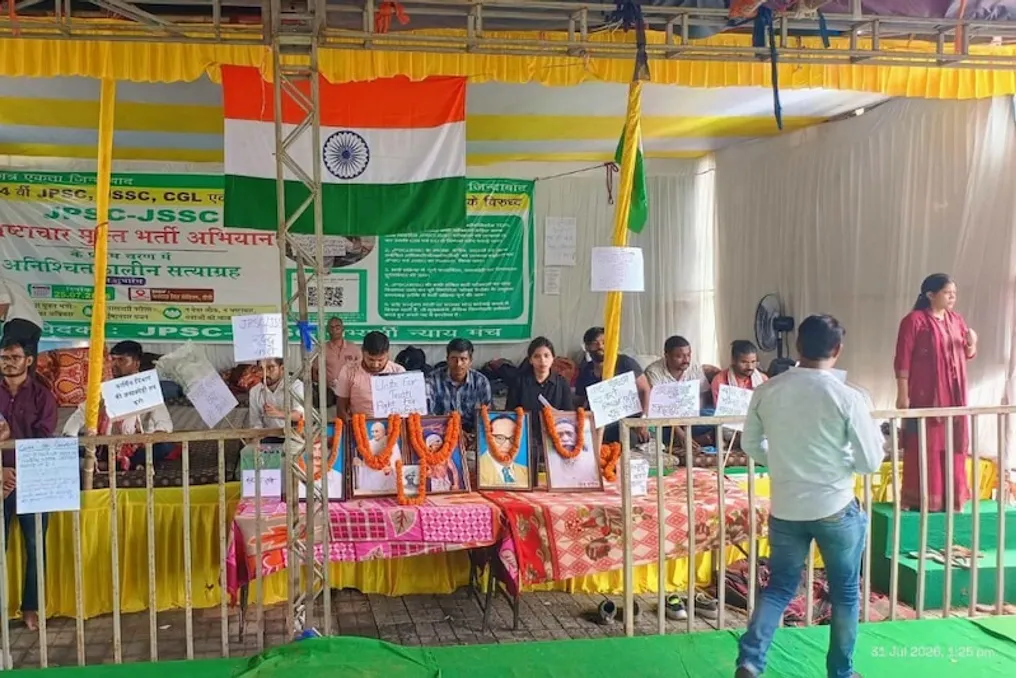
The student movement continues in Ranchi, which resembles the rallies held in Delhi at Jantar Mantar. Students are conducting an indefinite Satyagraha against corruption present in the JPSC and JSSC examinations. A tent camp has been set up at the protest site with beds to fight until the end. Photographs of figures such as Bhagat Singh, Birsa Munda, and Baba Saheb are displayed in the tents, and the main content of the Constitution is reflected on the stage. Flags are also flying on the stage, symbolizing pride and honor.
Some protesters discussed among themselves on the stage. After visiting the toilet in the morning, many male and female students came to the demonstration venue with great enthusiasm. Electricity supply and fans have been organized in the tents. A large stage has been created, and a platform has been prepared beneath it where protesters can sit and sleep. Additionally, a large waterproof tent has been installed.
These students are participating in an indefinite Satyagraha, opposing the deep-rooted system of corruption existing in the JPSC and JSSC examinations. Although the students chant slogans, they began their demonstration by performing the national anthem. They sang the anthem in unison, followed by a loud placard against the government. Some students also boosted each other's morale by performing works by famous poets.
Protesters assert that they have no other options left. Regardless of whether the posts belong to JPSC or JSSC, they accuse the system of selling positions since its inception. Their view is that the only way to change the system is to fight it. The students state directly that government jobs have become an unattainable dream for them because disputes arise after every examination. This results in children from middle-class families who have been preparing in Ranchi, Hajharibagh, or Ramgarh for years facing only disappointment. They believe that the demonstration at Jantar Mantar in Delhi raised their morale, and they are confident that the government will eventually yield to them.
After the Jantar Mantar protests, one female student participating in the protest told a correspondent from Palamu that her parents did not prevent her from coming to the demonstration site, despite her being a girl. She emphasized that this is a fight for the future and existence of all students.
Students arriving from Hajharibagh and Ramgarh reported that their relatives provided financial assistance for participation in the demonstration. During a conversation, a social activist brought two sacks of rice flakes, bread, biscuits, and other snacks to be distributed among the students. Similarly, the students engaged in Satyagraha constantly receive support from various segments of society.
Some of the students' families are farmers, while others do not have mothers. These families rely solely on their children's government jobs to change their situation. However, due to constant disputes, this job now seems unattainable to them. The students are also outraged that the government has not contacted them yet. Young men and women from different areas stand firm, concerned about their own future and that of coming generations.
Students note that various sections of society are taking the initiative to help with setting up tents, shelters, and providing food. They claim that this movement is gaining momentum. Similar to Jantar Mantar in Delhi, aspirants have taken positions in Jai Pal Singh Stadium in Ranchi, setting up tents and beds to conduct an indefinite protest against corruption in JPSC and JSSC. Jai Pal Singh Stadium has organized beds and furnished pavilions for participants of the JPSC and JSSC competitions. Dishes and bowls for food have also been delivered, indicating that the protest and indefinite Satyagraha will last a long time.
Students arriving from distant areas demonstrate determination to fight until the end. Some came from Ramgarh, some from Bokaro, and some from Hajharibagh. They do not care at all how they will eat or how their daily life will proceed. Some came with permission from their brother and money for accommodation, while others received help from their father. The number of girls participating in the protest is also large. They are all unanimously determined: they will only leave after JPSC and JSSC are free from corruption.