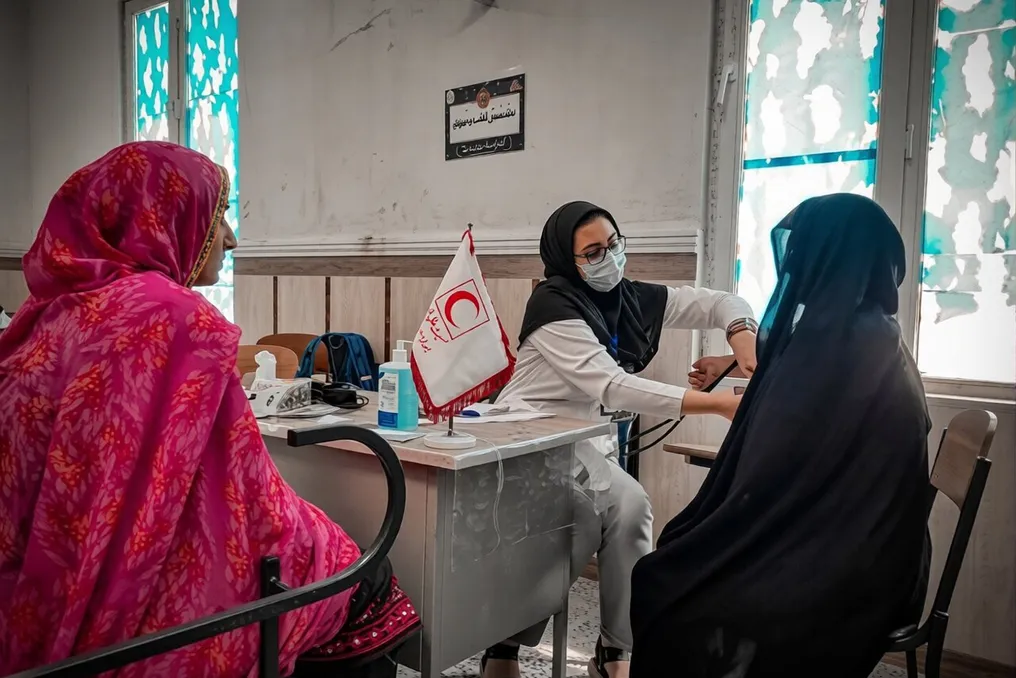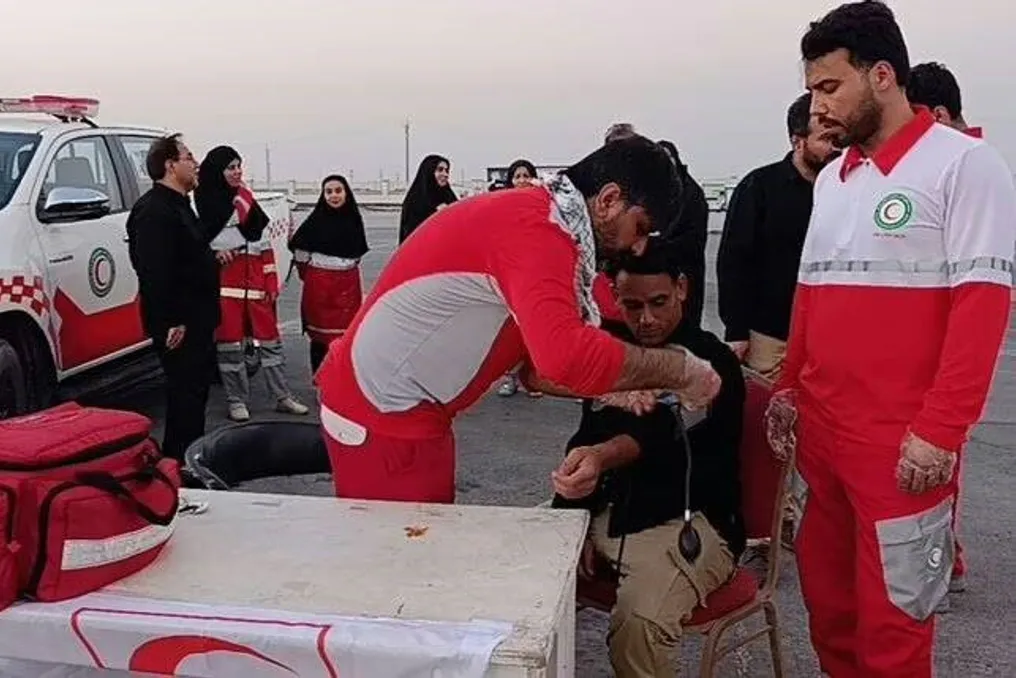
The head of the Iranian Red Crescent Society (IRCS), Pirhossein Kolivanand, presented a wide range of services that IRCS staff provide to people participating in the Arbaeen pilgrimage.
The head of the Iranian Red Crescent Society (IRCS), Pirhossein Kolivanand, presented a wide range of services that IRCS staff provide to people participating in the Arbaeen pilgrimage.
According to an ISNA report, approximately 120,000 operational teams, along with 8,500 workers and volunteers providing medical, rescue, and humanitarian services to pilgrims, were dispatched to Iraq. These statements were made by an official during an inspection of IRCS services in Huzestan province on Thursday.
To support the Arbaeen pilgrimage, IRCS utilizes rescue equipment, including ambulances, ambulance buses, rescue vehicles, command vehicles, and helicopters. Furthermore, the society has established four hospitals and numerous clinics to serve pilgrims along the route from Najaf to Karbala.
Kolivanand noted that mobile medical teams, equipped with medical backpacks, provide healthcare between clinics and hospitals. He also stated that IRCS, in collaboration with the Iraqi Ministry of Health, the Iraqi Red Crescent, and other medical institutions, continuously monitors the health status of pilgrims, tracks infectious diseases, and oversees the preparation and distribution of food in makabas.
If necessary, patients can be transported to the border by ambulance or helicopter for treatment within the country. According to IRCS, over 36,000 pilgrims received assistance from IRCS in the last ten days. IRNA reported that from July 21 to July 31, 184 operational teams, comprising 621 rescuers, provided medical aid to 36,609 people.
IRCS humanitarian teams transported 98 people to medical centers, provided emergency shelter for 36,284 people, and assisted 227 others on site.
Hossam Elsharkavi, Regional Director of the International Federation of Red Cross and Red Crescent Societies (IFRC) for the Middle East and North Africa (MENA), emphasized the value of Iran's experience in organizing the Arbaeen pilgrimage. He stated that the country can serve as a regional center for training other nations and exchanging knowledge.
According to Elsharkavi, the mission of the Red Cross and Red Crescent worldwide is to support people and provide them with humanitarian services; Iran possesses significant experience in managing large crowds, which needs to be shared internationally.
These remarks were made by the official during the sixth International Congress on 'Health at Arbaeen', held in Tehran from July 19 to 20. Elsharkavi stressed that the international federation aims to create a platform for transferring knowledge, scientific documentation, and Iran's experience in managing mass events to other countries, as this experience is invaluable and unique globally.
He added that the IFRC is currently consulting and exchanging views with Iranian officials to establish a center for training in crowd management in the country. This center should provide continuous specialized training and preserve knowledge for future generations.
The congress featured 515 articles, 19 of which will be presented as lectures and 22 as posters. IRNA reported that this year's congress hosts 105 presenters from various sectors. The congress includes 25 scientific panels and eight workshops, demonstrating the idea that health at mass events depends on interdisciplinary research, multi-center studies, data analysis, and the use of modern technologies, including artificial intelligence and modeling.
Later, in a letter to Kolivanand, Elsharkavi noted that IRCS's extensive readiness to serve millions of Arbaeen pilgrims is an inspiring demonstration of noble humanitarian spirit. He highlighted that the high readiness of the rescue fleet, specialized vehicles, and rescue helicopters, the coordination of earthquake response drills, the capabilities of search and rescue teams, and the efficiency of communication and air support systems demonstrate IRCS's complete preparedness, experience, and operational capacity, which have developed over many years.
He also mentioned that the society's ability to produce medical supplies, equipment, and necessities is a testament to self-sufficiency, innovation, and sustainable humanitarian development. In Elsharkavi's view, these achievements serve as a model of excellence for all national societies within the International Red Cross and Red Crescent Movement. The official expressed hope for further expansion of cooperation between IFRC and IRCS to advance their common humanitarian mission.
Over the initial three months of the current Iranian calendar year, which commenced on March 21, volunteers associated with the Iranian Red Crescent Society (IRCS) offered a broad spectrum of assistance. These services ranged from organizing medical deployments and collecting blood to executing various community projects.
During this same period, the IRCS welcomed an additional 275,381 volunteers, elevating the total volunteer count to surpass 1.8 million individuals. According to Mohammad-Javad Ezzati, an official at the IRCS, more than 152,400 participants were involved in IRCS programs, delivering aid to over 1.65 million people.
Specifically, 481 volunteer medical teams dedicated more than 75,000 hours of unpaid labor to provide healthcare to 94,358 individuals residing in underserved regions. Furthermore, these volunteers distributed 9,876 food parcels to those communities. Separately, 4,544 volunteers collaborated on 1,098 projects, supported by benefactors who donated 514 billion rials, equivalent to approximately 268,000 dollars, benefiting around 90,000 people.
In joint efforts, 3,348 volunteers partnered with 218 non-governmental organizations to complete 369 shared projects, serving 94,471 people. Public donations for these initiatives surpassed 586 billion rials (roughly 300,000 dollars), as noted by Ezzati. Within the first quarter, 13,103 volunteer activities took place, involving 90,493 volunteers and accumulating over 1.233 million service hours, which aided nearly one million people. Additionally, over 11,206 tents and health stations were established, with public contributions reaching more than 3,329 billion Rials (nearly 170,000 dollars).
A separate group of 9,504 volunteers dedicated over 30,000 hours each to visit 704 centers and homes belonging to 5,603 elderly and needy individuals, offering support to 20,583 people. Their contributions totaled over 128 billion rials (approximately 65,000 dollars). During this timeframe, 28,712 volunteers also donated 31,642 units of blood, significantly contributing to blood supply reserves. Moreover, 6,179 medical supplies were loaned to patients with the assistance of 593 volunteers, helping 3,047 individuals. Finally, 3,744 beneficiaries received direct financial aid from the organization, amounting to over 273.778 billion rials (about 140,000 dollars), Ezzati concluded.
The Iranian Red Crescent Society has actively involved hundreds of thousands of adolescents and young adults in educational, relief, and volunteering endeavors through various social and educational programs over the preceding year. The IRCS aims to broaden its perspective beyond mere relief operations, focusing heavily on cultivating a generation equipped to handle crises effectively. This preparation starts in schools, introducing teenagers to fundamental concepts of first aid, social responsibility, and relief work.
This foundational knowledge progresses into the formation of student and youth volunteer teams via diverse projects. The ultimate objective is to establish a network of informed and ready personnel who contribute actively to society alongside the Red Crescent's core missions. Current statistics indicate that the IRCS has 4,974,111 volunteers, with 3,257,455 of them being young people under the age of 35. Last year, the 'Skilled Trainer' plan, which provided first aid instruction in schools, was a major undertaking, reaching 9,000 schools and training about 350,000 students. These trainings emphasize recognizing hazardous situations and implementing correct actions during accidents, ensuring students can make sound initial judgments when facing unexpected events.
Beyond technical training, the IRCS attracts young individuals under 35 to relief bases to serve as active volunteers alongside rescue and relief teams. Various social and cultural projects are also implemented for youth, designed not only for education but also to foster a sense of social duty and encourage collective volunteering. The Society has also prioritized psychological support, running projects during crises to offer spiritual and social aid to those affected. Culturally, events blend religious and ritualistic elements in collective programs, while blood donation remains a key component of voluntary efforts, with over 8,000 people participating in this humanitarian act last year. These activities demonstrate the Red Crescent's commitment not only to immediate crisis response but also to developing the next generation capable of playing a meaningful role in real-life scenarios.