Japanese chemists conducted a detailed study on the mechanism of hydrogen diffusion at temperatures below 70 Kelvin in vanadium—one of the most promising metals for hydrogen storage. They found that the behavior of diffusion critically depends on the metal's crystal structure.
In the cubic α-phase, hydrogen atoms are capable of tunneling between tetrahedral lattice positions, exhibiting a diffusion coefficient of at least 10–12 square centimeters per second even at 35 Kelvin. However, in the uniaxially deformed β-phase, the tunneling process is suppressed, and diffusion occurs via thermal jumps between octahedral positions with an activation energy of 148 milli-electronvolts.
Vanadium is valued for its ability to exothermically absorb and store hydrogen in a larger volume compared to other analogues. Since hydrogen has the smallest mass among elements, at low temperatures, when the thermal barrier for an atom in the lattice is overcome, its movement in metals is determined by quantum phenomena such as zero-point vibrations and quantum tunneling.
Tunneling is a physical phenomenon that allows a particle to pass through a potential barrier that is classically considered insurmountable; the probability of such a transition increases with a decrease in the particle's mass and a reduction in the barrier height. Theoretically, this phenomenon should be most pronounced in metals with a body-centered cubic lattice, where the distance between neighboring interstitial sites is smaller than in a face-centered cubic lattice. Nevertheless, there was very little experimental data on the mechanism of hydrogen tunneling at low temperatures.
Takahiro Ozawa from the Institute of Industrial Science at the University of Tokyo, together with a team of researchers, began studying the influence of crystal symmetry on proton tunneling in vanadium. For this purpose, an epitaxial film of vanadium with a thickness of 40 nanometers was grown on a magnesium oxide substrate. Then, hydrogen ions were implanted into this film at a temperature of 35 Kelvin with an energy of 500 electronvolts, creating a non-uniform distribution.
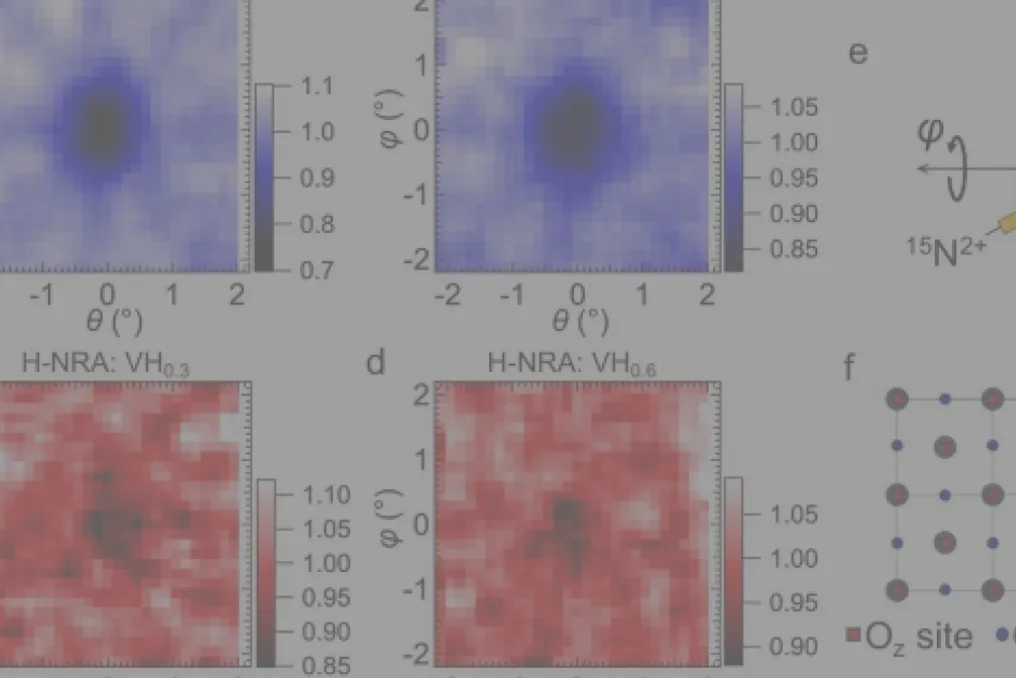
At low concentrations, hydrogen penetrates into lattice vacancies, maintaining the cubic α-phase. But at higher concentrations, around 0.3–0.6 atoms per vanadium atom, the metal transforms into a tetragonal β-phase with uniaxial lattice distortion. This change is caused by the hydrogen atoms aligning along the Oz axis, pushing the vanadium atoms and stretching the structure. As a result, the unit cell acquires 12 inequivalent tetrahedral and 6 octahedral positions.
The authors used the nuclear reaction method, bombarding the sample with a beam of $^{15} ext{N}$ ions to determine the hydrogen concentration gradient through emitted gamma radiation. It was found that at 35 Kelvin, hydrogen concentrates in a thin layer near the surface, whereas at 70 and 200 Kelvin, it is distributed uniformly throughout the entire film thickness. Thus, diffusion in the β-phase is activated approximately at 70 Kelvin, while in the α-phase, hydrogen remains mobile at 35 Kelvin and below.
Analysis of the time dynamics of electrical resistance, where non-uniform hydrogen distribution leads to lower resistance than uniform distribution, combined with random walk modeling, allowed the calculation of the diffusion coefficient in the β-phase as $148 ext{ ± } 20$ milli-electronvolts. Furthermore, signs of tunneling were not detected because the Arrhenius plot used to determine the diffusion coefficient did not have the characteristic upward bend at the end, indicating classical, thermally dependent diffusion in this phase.
Subsequently, the group of scientists performed calculations of hydrogen quantum states and explained the observed differences. In the cubic α-phase, all 12 tetrahedral positions are equivalent, and the wave function of the ground state is distributed across all of them, confirming the possibility of tunneling. The calculated tunneling matrix element between nearest neighbors was $-0.61$ milli-electronvolts, corresponding to a transition frequency of about $3 imes 10^{11}$ per second and a diffusion coefficient of $5.5 imes 10^{-6}$ square centimeters per second. The negative sign indicates an energetic advantage of tunneling for hydrogen atoms.
In the deformed β-phase, the reduction in symmetry leads to the localization of the wave function around the octahedral Oz positions, the splitting of levels between them disappears, and the direct Oz–Oz path has a barrier of $1.025$ electronvolts and is geometrically $2 ext{√}2$ times longer than the T–T path, making tunneling practically impossible. Although indirect routes through tetrahedral positions have barriers of $0.228$ and $0.376$ electronvolts, the mismatch of energy levels at intermediate nodes further reduces the probability of quantum tunneling.
In conclusion, the authors succeeded in detailing how changes in the crystal structure of vanadium affect the diffusion of hydrogen atoms in this metal, which will aid in further understanding processes related to hydrogen storage in similar materials.