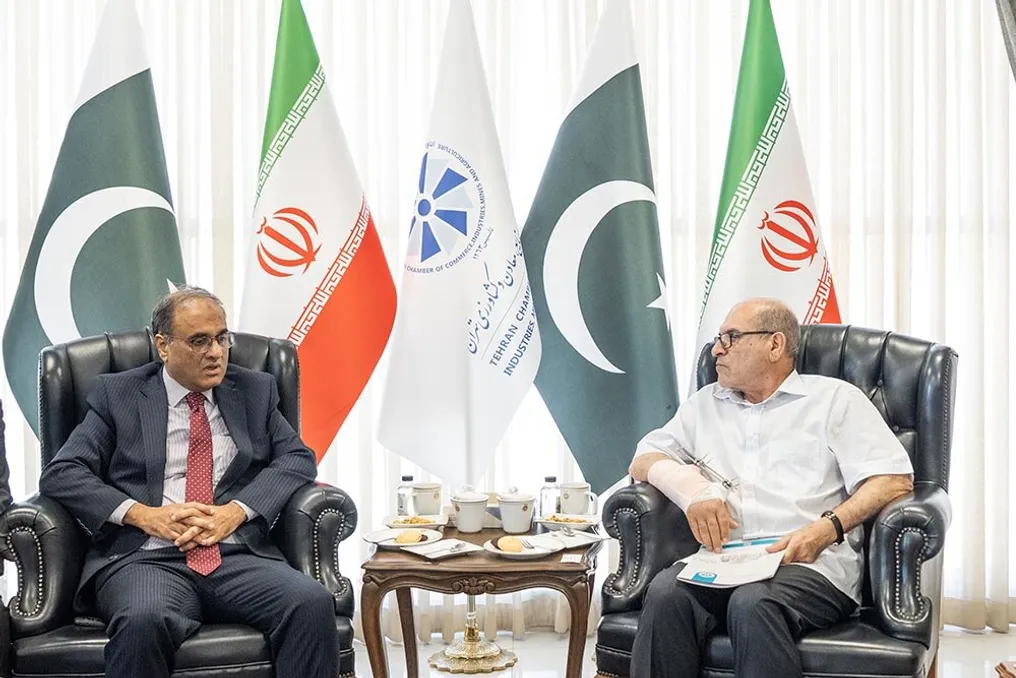
Representatives from Tehran and Islamabad held a joint meeting to discuss the development of economic cooperation between Iran and Pakistan, strengthening transport infrastructure, border trade, simplifying customs procedures, and increasing joint investments.
The meeting was attended by Imran Ahmed Siddiqui, the Pakistani ambassador to Iran, Mahmoud Najafi Arab, head of the Tehran Chamber of Commerce, as well as representatives of the Tehran Chamber of Commerce, including Hossemeddin Khalaj, Ayman Juwayri, and Peyman Sanandaji.
At the beginning of the session, Imran Ahmed Siddiqui, the Pakistani ambassador to Tehran, noted the potential for cooperation in areas such as the food industry, pharmaceuticals, and agriculture. He stated that some exchanges previously conducted through indirect channels could now occur directly between the two states, which would help reduce costs and promote economic partnership.
The ambassador also emphasized the importance of developing joint investments, holding trade delegations, active participation of Iranian companies in specialized Pakistani exhibitions, and strengthening interaction between the private sectors of both countries. He viewed the chambers of commerce as one of the most important platforms for building economic ties between Iran and Pakistan.
Siddiqui added that the presence of Iranian companies, members of the Tehran Chamber, at Pakistani exhibitions contributes to increasing joint cooperation and building trust. Furthermore, Iranian business figures at these events can expand contacts with their Pakistani counterparts and become familiar with local consumer preferences.
In another part of the meeting, Mahmoud Najafi Arab, head of the Tehran Chamber of Commerce, stated that despite long-standing cultural and trade ties between Iran and Pakistan, the volume of direct trade between them remains insufficient. He specifically highlighted the need to conduct trade directly across the extensive common border instead of using indirect routes, especially given restrictions in the country's southern ports.
The head of the Tehran Chamber also stressed the importance of border trade for the economic development of residents in border areas and called for more effective utilization of this potential. Najafi Arab noted that resolving current issues in border trade and ensuring necessary conditions on both sides of the border would lead to the economic prosperity of cities located near the borders.
He also announced the Tehran Chamber's readiness for continuous interaction with the Chambers of Karachi, Islamabad, and Lahore to improve trade activities and eliminate logistical difficulties. In his opinion, the chambers of commerce can play a more significant role in strengthening mutual trust, providing accurate information to traders, and presenting the economic opportunities of both countries.
Mahmoud Najafi Arab continued the discussion by addressing the topic of free trade and the necessity of promoting dialogue in this area. He stated that any agreement between the two countries on free trade would have a positive impact on the volume of exchanges, reduce trade costs, and promote economic cooperation.
Moreover, Najafi Arab pointed out the importance of providing customs and tariff benefits, as well as resolving banking and transport issues as prerequisites for expanding bilateral trade. He predicts that with the development of currency exchanges, provision of customs and tariff preferences, removal of border bottlenecks, and promotion of the idea of free trade, there will be an increase in imports and exports, which will improve the trade process between the countries.
Peyman Sanandaji, head of the Transport Committee of the Tehran Chamber of Commerce, also spoke at the meeting, raising issues related to the transportation and accumulation of Iranian cargo at the port of Karachi and other Pakistani ports. He reported that due to regional events, a large number of containers were delayed in Pakistani ports, and some of this cargo incurred additional costs.
Sanandaji added that certain obstacles needed to be removed and customs procedures eased to accelerate the land transport of these containers. The Pakistani ambassador also informed about the readiness of his country's embassy to hold regular meetings with the Tehran Chamber, monitor trade issues, and inform business figures about the latest trade rules and requirements.