According to the The Times Higher Education Sustainability Impact Ratings report (formerly THE Impact Rankings), no Iranian universities were included in the list for 2026 due to sanctions imposed on the country.
According to the The Times Higher Education Sustainability Impact Ratings report (formerly THE Impact Rankings), no Iranian universities were included in the list for 2026 due to sanctions imposed on the country.
According to Manuel Pedrosa, senior editor of the data, institutions based in jurisdictions or associated with organizations and individuals that may be subject to international sanctions cannot participate in sustainability rankings while these sanctions are in effect, which complies with company compliance requirements.
Pedrosa added that since participation in the Sustainability Network requires payment, sanctions prevent receiving payments from Iran. If an institution is not part of this network, it cannot participate in the sustainability rankings.
He also stated that this information was conveyed to all Iranian institutions interested in participating in the 2026 sustainability rankings. However, the official representative emphasized that Iranian universities can still participate in other THE rankings free of charge.
The THE Sustainability Impact Ratings is the only global ranking that assesses how institutions worldwide contribute to sustainable development in line with the United Nations Sustainable Development Goals (SDGs).
Previously, starting from the launch of THE Impact Rankings in 2019, Iranian universities participated in this ranking. In the THE Impact Ranking 2025, 34 universities from Iran were noted among the leaders in achieving sustainable development goals (SDGs).
In recent years, international sanctions have had a far-reaching impact on Iran's science, technology, and higher education systems. Problems arising from these illegal sanctions include limited access to laboratory equipment and materials, difficulties in conducting financial transactions for purchasing services and paying membership fees in international scientific organizations, reduced opportunities for scientific research collaboration, and participation of Iranian researchers in international conferences.
In the THE Asia University Rankings 2026, 90 Iranian universities ranked among the top Asian institutions, surpassing the figure of 85 universities in 2025. This ranking includes 929 universities from 36 territories. According to Borna news agency, Sharif University of Technology ranks first in the country with a world ranking of 76. Amkiran University of Technology (79) and Islamic Azad University of Science and Technology (87) are in second and third place, respectively.
The fourth to tenth places in the country are held by Tehran University of Medical Sciences (111), University of Tehran (120), Persian University of Medical Sciences in Kermanshah (131), Isfahan University of Technology (137), Tarbiat Modares University (162), Shiraz University of Technology (166), and Shahid Beheshti University of Medical Sciences (154).
Performance indicators are divided into five areas: Teaching (learning environment) - 24.5 percent, Research Environment (volume, income, and reputation) - 28 percent, Research Quality (cited impact, research power, excellence, and influence) - 30 percent, International Outlook (staff, students, and research) - 7.5 percent, and Industry (income and patents) - 10 percent.
In the THE World University Rankings (WUR) by Subject 2026, 101 Iranian universities were included among the leading global universities. Amkiran University of Technology, Persian University of Medical Sciences in Kermanshah, and Sharif University of Technology ranked first in the country with a world ranking of 351–400. Islamic Azad University of Science and Technology and University of Tehran ranked second, with a world ranking of 401–500. Shiraz University of Technology and Tehran University of Medical Sciences ranked third in the country, in the world ranking of 501–600.
In subject rankings, Iranian universities are among the world leaders in 11 fields. The best national ranking is in Engineering. The Engineering Ranking 2026 evaluates universities across five main disciplines: general engineering, electrical and electronic engineering, mechanical and aerospace engineering, civil engineering, and chemical engineering. Sharif University of Technology (126–150), University of Tehran (151–175), Amkiran University of Technology (251–300), Islamic Azad University of Science and Technology (251–300), Tabriz University (301–400), Isfahan University of Technology (401–500), and Tarbiat Modares University (401-500) took the first to fifth places, respectively.
The Business and Economics Ranking assesses results across three main areas: business and management; accounting and finance; and economics and econometrics. University of Tehran (201–250), Islamic Azad University of Science and Technology and Sharif University of Technology (301–400), Ferdowsi University of Mashhad (401–500), Shahid Beheshti University (501–600), and Yazd University (601–800) took the first to fifth places.
The Medicine and Healthcare Ranking 2026 assesses universities in medicine, dentistry, nursing, and other healthcare disciplines. Tehran University of Medical Sciences (251–300) ranks first in the country. Persian University of Medical Sciences in Kermanshah (301–400), Shahid Beheshti University, Tabriz University of Medical Sciences, and Tarbiat Modares University (401–500) are in second and third place.
The Arts and Humanities Ranking 2026 covers a wide range of disciplines, including languages, literature, and linguistics; history; philosophy; theology; architecture; archaeology; as well as fine arts, performing arts, and design. Islamic Azad University of Science and Technology and University of Tehran (401–500) ranked first in the country. Following them are Ferdowsi University of Mashhad, Shahid Beheshti University, Shiraz University, and Tarbiat Modares University, which ranked 501 to 600 in the world ranking.
The Life Sciences Ranking 2026 assesses universities across four main areas: veterinary medicine, biological sciences (including biology and biochemistry), agriculture and forestry, and sports science. University of Tehran ranks first with a world ranking of 401–500. Second place (501–600) is held by Gorgan University of Agricultural Sciences and Natural Resources, Isfahan University of Technology, Persian University of Medical Sciences in Kermanshah, Maragheh University, Tabriz University, and Urmia University.
The Natural Sciences Ranking 2026 assesses universities across several core disciplines: physics, chemistry, mathematics, statistics, astronomy, geology, and ecology, earth and marine sciences. Islamic Azad University of Science and Technology and University of Tehran ranked first, with a world ranking of 301–400. Amkiran University of Technology, Sharif University of Technology, and Tarbiat Modares University ranked second with a world ranking of 401–500.
The Psychology Ranking 2026 assesses universities across several more specialized disciplines: clinical psychology, educational psychology, sports psychology, business psychology, and zoopsychology. Islamic University of Medicine, Kharazmi University, and University of Tehran ranked from 501 to 600. Allameh Tabataba'i University, Ferdowsi University of Mashhad, Shahid Beheshti University, Tarbiat Modares University, Isfahan University, and University of Social Welfare and Rehabilitation Sciences ranked 601 and below.
The Law Ranking assesses excellence in areas such as constitutional and administrative law; international law; commercial and corporate law; criminal law and justice; and legal theory and jurisprudence. Only the University of Tehran, ranked 301–400 in the world ranking, is an Iranian university included in this subject area.
The Social Sciences Ranking 2026 covers diverse subjects, including communications and media studies, politics and international relations (including development studies), sociology, geography, and anthropology. Tarbiat Modares University, Tabriz University, and University of Tehran shared first place with a world ranking of 401–500. Ferdowsi University of Mashhad ranked second (501–600), while Shiraz University, Isfahan University, and Yazd University ranked third with a world ranking of 601–800.
Sai Nadezhda Vadimovna is preparing to defend her dissertation in pedagogical sciences, dedicated to the topic 'Improving mechanisms for the development of professional and personal qualities of leaders of preschool and school education systems.'
The dissertation was written under specialty 13.00.07 – 'Education Management' and aims to obtain the academic degree of Doctor of Philosophy (PhD).
The defense will take place on August 19, 2026, at 09:00 as part of the meeting of the Scientific Council PhD.01/2025.27.12.Ped.03.05 at the Nizomiy National Pedagogical University of Uzbekistan.
The event will be held at the National Pedagogical University of Uzbekistan, located at: Tashkent city, Chilonzor district, Bunyodkor street, house 27, postal code 100185.
Atajanov Azizbek Abdimalikovich will defend his dissertation to obtain the degree of Doctor of Legal Sciences (DSc).
The dissertation topic is titled 'Theoretical and practical issues of guaranteeing the independence of judges in ensuring fair justice.' The dissertation was written under the specialty '12.00.07 – Judicial power. Prosecutor's supervision. Organization of rights protection activities. Advocacy.'
The defense will take place at the meeting of the Scientific Council No. DSc.24/2025.27.12.Yu.01.01 at the Academy for the Protection of Rights of the Republic of Uzbekistan on August 12, 2026, at 10:00 AM.
The venue for the defense is: Tashkent city, Yunusobod district, Rikhsiliy street, house 9, postal code 100190.
For millions of children and youth in situations of forced displacement, education develops against a backdrop of compulsory mobility, administrative uncertainty, and prolonged instability. Schools located in border areas, refugee settlements, and places where people move due to climatic reasons function not merely as educational institutions. They become spatial structures that balance the contradictory demands of emergencies and the need for continuity, offering an environment where learning persists despite the instability of legal status, living conditions, and sense of home.
According to the UN Refugee Agency (UNHCR), as of the end of 2025, approximately 45 million out of 117.8 million forcibly displaced people worldwide were under the age of eighteen. Since displacement is increasingly linked to armed conflicts, political persecution, ecological crises, and economic instability, humanitarian architecture faces a growing challenge: the task is not only to quickly build more schools but also to create educational environments capable of ensuring continuity, safety, and a sense of belonging amidst an uncertain future.
The work of Jasmin Lari, in collaboration with the Pakistan Heritage Fund, proposes a community-based model relying on local building materials and self-construction for vulnerable and landless communities. This approach views architecture as a process of shared empowerment rather than adherence to paternalistic models of humanitarian intervention. Simultaneously, Sigeru Ban has long utilized emergency paper tube structures for communities affected by earthquakes and conflicts—from Japan and Rwanda to Ukraine—demonstrating how lightweight and rapidly deployable systems can restore educational and civic functions during acute crises. These projects embody diverse approaches to technical specialization, temporality, materiality, and participation.
The choice of materials, construction methods, and design processes are not just technical decisions; they determine who builds, who maintains, and who claims ownership of the educational space. The question is how border educational architecture resolves the tension between permanence and transience, between mobility and settlement, and between architectural technical knowledge and local, community knowledge.
Following the military coup in Myanmar, the border town of Mae Sot in Thailand became a key destination for displaced Myanmar populations. In response, architectural firms collaborate with local and international humanitarian organizations to build classrooms for migrants, addressing shortages of school places, sanitary facilities, and basic infrastructure due to limited financial resources.
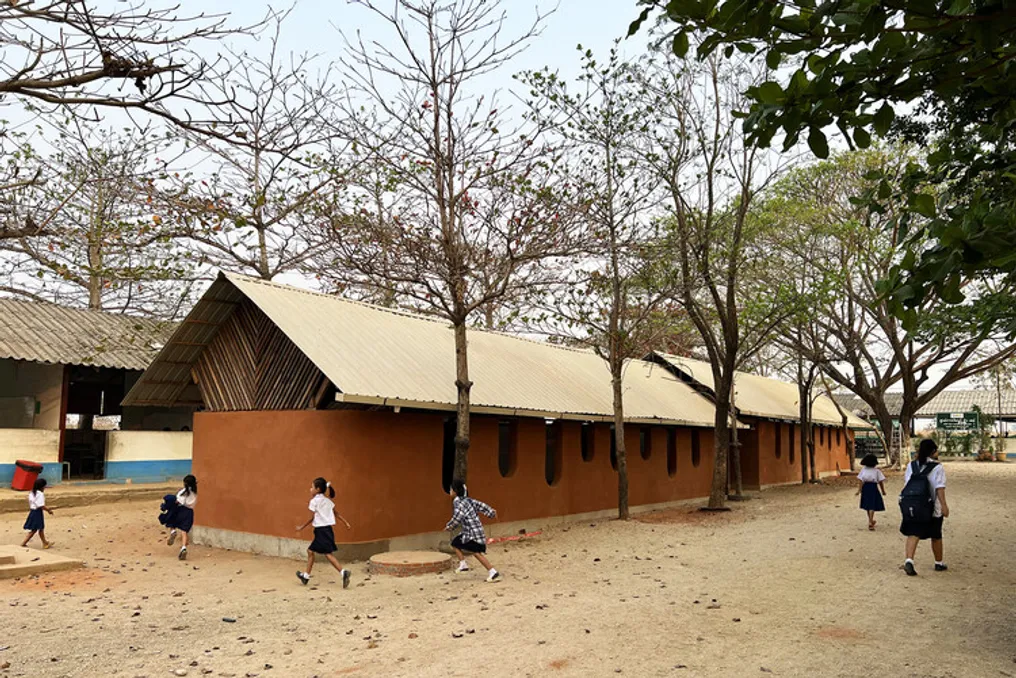
A series of school projects by the firm Simple Architecture, intended for young people in Myanmar facing displacement, simultaneously addresses ecological, spatial, and social constraints. One recent project, New Day School, developed in close collaboration between architects, students, school administration, and local builders, occupies a narrow plot surrounded by existing classrooms and rows of mature trees. Four classrooms were neatly placed among the trees, preserving the landscape and providing protection from seasonal flooding by keeping the ground floor as an open area for socializing and football.
The project emphasizes local, low-carbon materials and community building. Adobe bricks were made on-site using clay soil mixed with rice husks, and local reclaimed wood forms the structure. Waterproof earth plaster, prepared from tapioca glue, sand, and local earth, increased the durability of the walls. Equally important is the construction process itself: the simple adobe brick-making methods are intentionally replicable, with local architecture students and high schoolers participating annually in workshops that transfer building knowledge and strengthen local technical capacity.
From a different approach, the Min Tu Won school in the same region features a light bamboo shell surrounding mud-plastered classrooms. Designed by Orbe Architecture, Estudio Cavernas, INDA, W.E. Wattanachote, and Lasavanich, the permeable bamboo envelope filters sunlight, protects the earth walls from heavy rains and direct heat, and promotes natural ventilation, creating comfortable and naturally lit interiors without reliance on mechanical systems. Light wells further improve the quality of natural light, while the overlaid bamboo structure creates sheltered circulation zones that encourage informal meetings and play.
These projects are based on simple, low-tech construction methods, utilizing local materials and knowledge, which allows local workers and community members to be involved in the entire design and construction process. This collaborative approach not only reduces costs but also fosters a sense of local ownership, ensuring that the school can be maintained, adapted, and expanded as educational needs evolve.
Displacement often blurs the line between temporary and permanent settlement. Camps can exist for decades, while climate-induced migration generates forms of temporary mobility whose duration remains undefined. Thus, border educational architecture must account for both permanence and mobility.
Internationally, the non-profit organization Building Trust International creates educational facilities for marginalized communities in various regions, including Thailand, Cambodia, and Laos. Its initial prototype, Moving Schools, near the border between Myanmar and Thailand, was conceived as a mobile classroom that could be dismantled and relocated in case of forced community displacement or when they regain access to their lands in the future. The lightweight structure consists of a steel prefabricated frame, raised off the ground to mitigate flood risk. Wrapped in an impermeable membrane and clad with local woven bamboo panels, the building combines durability with passive ecological efficiency, providing filtered light and natural ventilation while valuing local craftsmanship.
These border structures are not necessarily 'handed over' to displaced communities; they can emerge from processes that recognize children, teachers, and caregivers as active participants. The work of CatalyticAction in Lebanon focuses on co-design involving children. Initial projects, such as the Jarahieh school in Al-Marj and the IBTASEM playground for Syrian children, were developed through participatory design processes that placed children at the center of decision-making.
Existing structures were adapted using local materials, while modular playgrounds utilized recycled crates, tires, ropes, and wood that could be assembled, disassembled, and used as needed by the community. In this context, the co-design and construction process itself transforms into a pedagogical process through which youth and their communities acquire practical skills, align common priorities, and develop the collective ability to shape their own built environments.
Material practices, adaptive design, and collaborative processes redistribute knowledge and a sense of belonging, allowing youth in displacement and their communities to gain control over built environments that remain inherently uncertain. Educational architecture transforms into a form of border pedagogy. Learning occurs not only inside classrooms but also through collective processes of design, construction, repair, and inhabiting space, constantly challenging conditions of temporality and belonging.