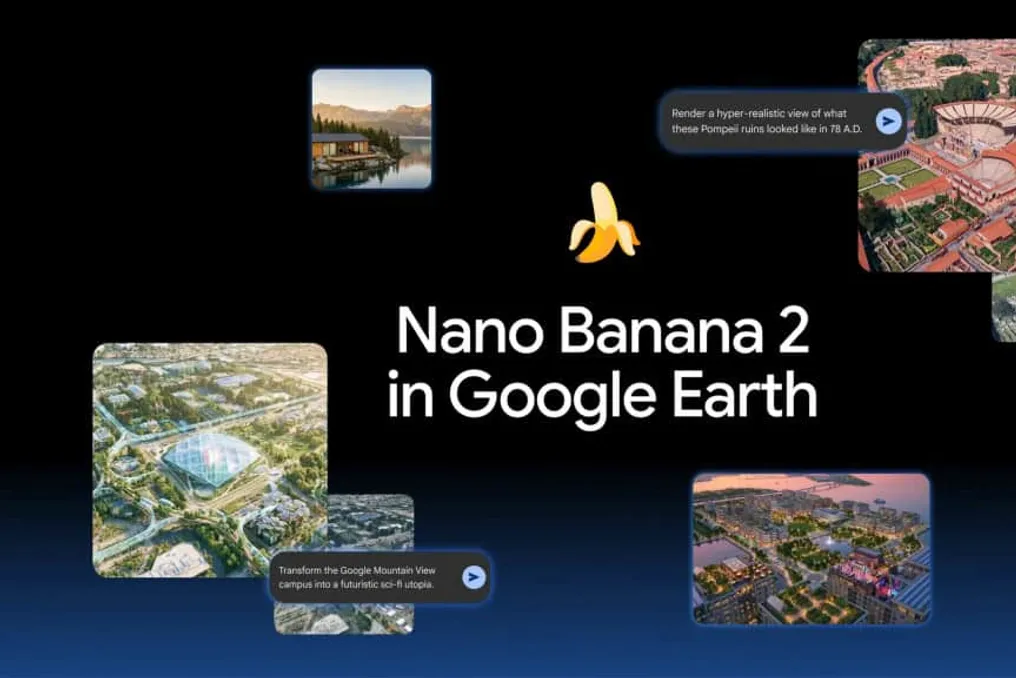
Google decided to roll back the launch of a new artificial intelligence feature in Google Earth, disabling it just one day after its introduction. This tool, which was presented on Thursday (30), had the capability to generate AI images that could be overlaid onto real images available on the platform, whether they were satellite, aerial, or 3D, all through text commands.
The suspension was communicated on Friday, following the emergence of content shared by users that, according to the company itself, appeared to infringe upon its established guidelines.
Google states it will strengthen protection mechanisms
In an official statement, Google mentioned noticing that geospatial professionals were using the functionality for various considered beneficial applications. However, the company also found that there were users disseminating screenshots of generated images that seemed to be in disagreement with its policies.
Given this situation, the company announced that it is pausing the availability of the feature while working on implementing stronger protections. Google clarified that this interruption is temporary and aims to reinforce the tool's safeguards. The company did not specify what types of images violated the rules, but guaranteed that the AI-created material did not appear in the main Google Earth experience and that such images were marked with an indicator that they had been generated by artificial intelligence.
The functionality allowed anyone to type a text command to create photorealistic representations at any point on the globe, using Google Earth images as a base. In practice, this meant the possibility of adding fictional elements onto monuments, cities, and other authentic locations.
Shortly after the launch, the feature began receiving criticism due to its potential to aid in the creation and dissemination of fake news. Experts and users warned that, by allowing the overlay of AI-generated images onto real Google Earth locations, it would be feasible to fabricate false scenarios involving tourist attractions, monuments, and other geographical areas.
Tech companies are adjusting AI features
This incident occurs within a broader context of the expansion of generative AI tools in the products of large technology corporations. While these new functionalities are being integrated into various services, companies have also opted to restrict or suspend features after incidents of misuse, concerns about internal policies, or risks related to disinformation.
As an example, Meta paused Muse Image, a tool that allowed image generation using public Instagram accounts. This measure was taken following criticism related to privacy issues, including statements from a Hollywood union.