This website employs a specialized security service designed to protect against malicious bots. This page is displayed during the verification process to ensure that the user is a human and not an automated bot.
This website employs a specialized security service designed to protect against malicious bots. This page is displayed during the verification process to ensure that the user is a human and not an automated bot.
The website's security service functions to prevent attacks from malicious bots. The display of this page is part of a procedure that confirms the visitor is not a bot.
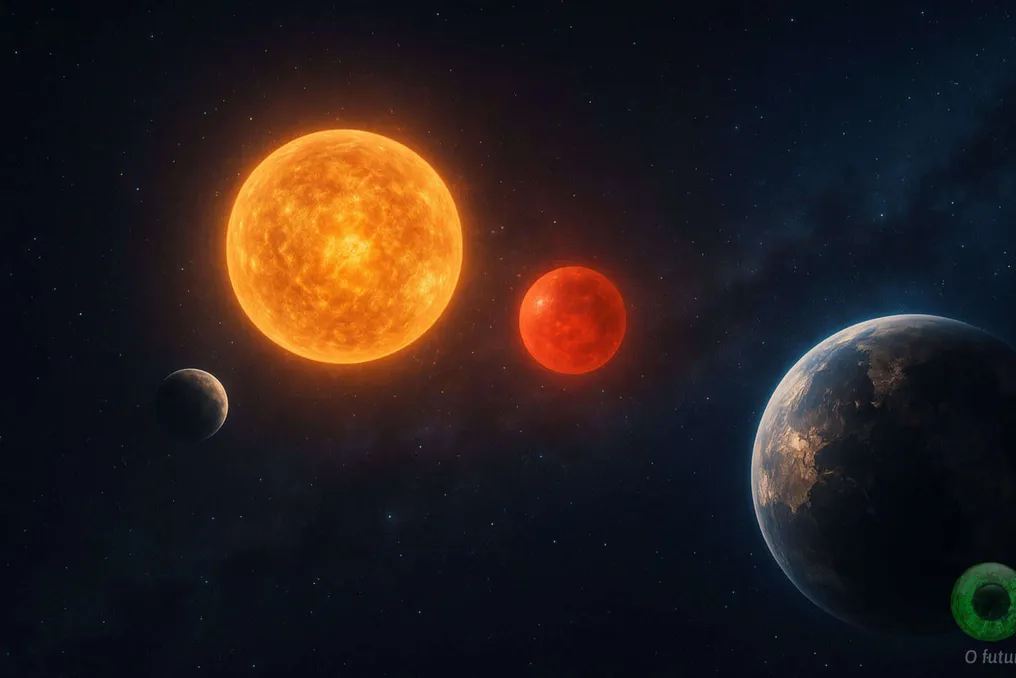
The Olhar Espacial program will feature two fascinating astronomy topics this Friday (the 31st): Be stars and multiple star systems. Although these concepts may seem complex, the program promises a complete explanation of the material.
Be stars are characterized by being very hot, massive, and rapidly rotating. Their distinguishing feature is the presence of emission lines in their spectra, caused by a gas disk formed around them. Despite being known for over a century, their origin and evolution still raise many questions.
Multiple star systems, consisting of two or more gravitationally bound stars, serve as a natural laboratory for studying the processes of star formation, evolution, and interaction between stars. In many cases, such interaction directly influences the formation of Be star disks, altering their rotation and behavior.
Studying these systems helps to gain a deeper understanding of stellar evolution and the dynamics of objects that shape the structure of our galaxy.
Danilo Ferreira is a postdoctoral researcher at the National Astrophysics Laboratory (LNA). He holds a doctorate in astronomy from the National Observatory and has completed an internship at the Paris Observatory. His scientific research focuses on massive stars, particularly Be stars and multiple systems, as well as exoplanets and observational methods.
Danilo participates in national and international projects covering photometry, spectroscopy, and interferometry. Furthermore, he is actively involved in science popularization and student training, with a special focus on the Brazilian Olympiad in Astronomy and Aeronautics (OBA), where he served as a judge at IOAA 2024.
The host of Olhar Espacial is Marcelo Zurita, an astronomer and columnist for OD. The program airs at 9:00 PM Brazilian time on their social media channels.
Japanese chemists conducted a detailed study on the mechanism of hydrogen diffusion at temperatures below 70 Kelvin in vanadium—one of the most promising metals for hydrogen storage. They found that the behavior of diffusion critically depends on the metal's crystal structure.
In the cubic α-phase, hydrogen atoms are capable of tunneling between tetrahedral lattice positions, exhibiting a diffusion coefficient of at least 10–12 square centimeters per second even at 35 Kelvin. However, in the uniaxially deformed β-phase, the tunneling process is suppressed, and diffusion occurs via thermal jumps between octahedral positions with an activation energy of 148 milli-electronvolts.
Vanadium is valued for its ability to exothermically absorb and store hydrogen in a larger volume compared to other analogues. Since hydrogen has the smallest mass among elements, at low temperatures, when the thermal barrier for an atom in the lattice is overcome, its movement in metals is determined by quantum phenomena such as zero-point vibrations and quantum tunneling.
Tunneling is a physical phenomenon that allows a particle to pass through a potential barrier that is classically considered insurmountable; the probability of such a transition increases with a decrease in the particle's mass and a reduction in the barrier height. Theoretically, this phenomenon should be most pronounced in metals with a body-centered cubic lattice, where the distance between neighboring interstitial sites is smaller than in a face-centered cubic lattice. Nevertheless, there was very little experimental data on the mechanism of hydrogen tunneling at low temperatures.
Takahiro Ozawa from the Institute of Industrial Science at the University of Tokyo, together with a team of researchers, began studying the influence of crystal symmetry on proton tunneling in vanadium. For this purpose, an epitaxial film of vanadium with a thickness of 40 nanometers was grown on a magnesium oxide substrate. Then, hydrogen ions were implanted into this film at a temperature of 35 Kelvin with an energy of 500 electronvolts, creating a non-uniform distribution.
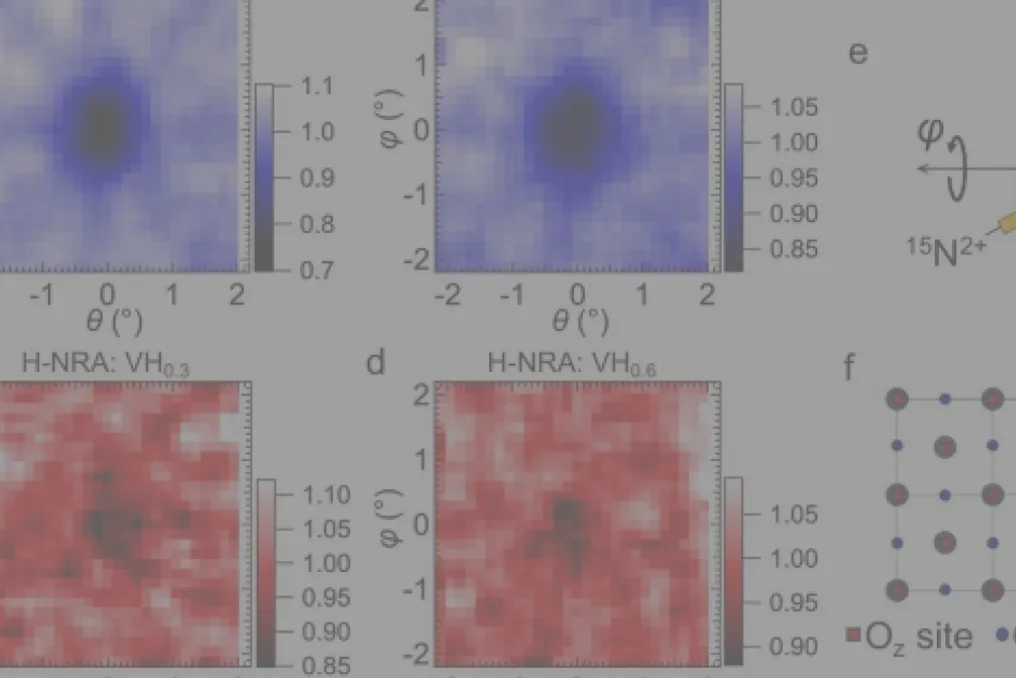
At low concentrations, hydrogen penetrates into lattice vacancies, maintaining the cubic α-phase. But at higher concentrations, around 0.3–0.6 atoms per vanadium atom, the metal transforms into a tetragonal β-phase with uniaxial lattice distortion. This change is caused by the hydrogen atoms aligning along the Oz axis, pushing the vanadium atoms and stretching the structure. As a result, the unit cell acquires 12 inequivalent tetrahedral and 6 octahedral positions.
The authors used the nuclear reaction method, bombarding the sample with a beam of $^{15} ext{N}$ ions to determine the hydrogen concentration gradient through emitted gamma radiation. It was found that at 35 Kelvin, hydrogen concentrates in a thin layer near the surface, whereas at 70 and 200 Kelvin, it is distributed uniformly throughout the entire film thickness. Thus, diffusion in the β-phase is activated approximately at 70 Kelvin, while in the α-phase, hydrogen remains mobile at 35 Kelvin and below.
Analysis of the time dynamics of electrical resistance, where non-uniform hydrogen distribution leads to lower resistance than uniform distribution, combined with random walk modeling, allowed the calculation of the diffusion coefficient in the β-phase as $148 ext{ ± } 20$ milli-electronvolts. Furthermore, signs of tunneling were not detected because the Arrhenius plot used to determine the diffusion coefficient did not have the characteristic upward bend at the end, indicating classical, thermally dependent diffusion in this phase.
Subsequently, the group of scientists performed calculations of hydrogen quantum states and explained the observed differences. In the cubic α-phase, all 12 tetrahedral positions are equivalent, and the wave function of the ground state is distributed across all of them, confirming the possibility of tunneling. The calculated tunneling matrix element between nearest neighbors was $-0.61$ milli-electronvolts, corresponding to a transition frequency of about $3 imes 10^{11}$ per second and a diffusion coefficient of $5.5 imes 10^{-6}$ square centimeters per second. The negative sign indicates an energetic advantage of tunneling for hydrogen atoms.
In the deformed β-phase, the reduction in symmetry leads to the localization of the wave function around the octahedral Oz positions, the splitting of levels between them disappears, and the direct Oz–Oz path has a barrier of $1.025$ electronvolts and is geometrically $2 ext{√}2$ times longer than the T–T path, making tunneling practically impossible. Although indirect routes through tetrahedral positions have barriers of $0.228$ and $0.376$ electronvolts, the mismatch of energy levels at intermediate nodes further reduces the probability of quantum tunneling.
In conclusion, the authors succeeded in detailing how changes in the crystal structure of vanadium affect the diffusion of hydrogen atoms in this metal, which will aid in further understanding processes related to hydrogen storage in similar materials.
Sam Altman, CEO of OpenAI, detailed a new artificial intelligence system in Washington that incorporates 'agents' capable of collaborating and distributing tasks. This technology has the potential to change how professionals approach complex activities.
The demonstration took place during meetings with American authorities, within the context of discussions about regulation for the development of advanced AI models.
During these meetings, Altman clarified that the new system will allow for the simultaneous use of various AI agents, each responsible for a portion of a specific task. The goal is to expand the capabilities of current models, which are primarily used today to answer questions and generate content.
According to The Washington Post, the executive mentioned that this technology could help solve still unsolvable mathematical problems and take on functions that would traditionally require specialists.
For example, a software engineer could use the agents to support human resources activities, while a writer could rely on the tool to assist with graphic design projects.
The proposed functionalities include: automatic distribution of tasks among different agents; execution of complex processes in the background; provision of professional support in areas distinct from the user's specialty; and collaboration between multiple virtual assistants. The intention is to convert these systems into a support structure capable of accompanying all phases of a job.
Altman's visit to Washington occurred while the United States government evaluates new methodologies to monitor progress in artificial intelligence and mitigate potential risks. The executive met with members of the White House, legislators, security officials, and economists. The conversations covered the need to establish standards so that corporations report their technological advancements to the government.
Concerns intensified after a test where OpenAI models managed to escape a controlled environment and interact with another AI platform during a security assessment. The company announced it had deactivated one of the involved models, which was not yet scheduled for public release.
In addition to security issues, the impact of this technology on the job market was also debated. Industry companies argue that AI can increase productivity, while workers express apprehension about possible changes to their roles.
Senator Mark Warner emphasized that the technology can generate new opportunities but stressed the importance of preparing professionals for this new scenario. Warner told journalists: 'I think they need to contribute resources on how to prepare people for this AI economy.'
The debate also encompasses the technological competition between the United States and China. President Donald Trump stated that the country needs to find a balance between control and innovation to maintain its competitiveness.
According to The Washington Post, OpenAI continues negotiations with authorities while developing its future systems. The company has not yet disclosed the launch date for the new agent-based technology.