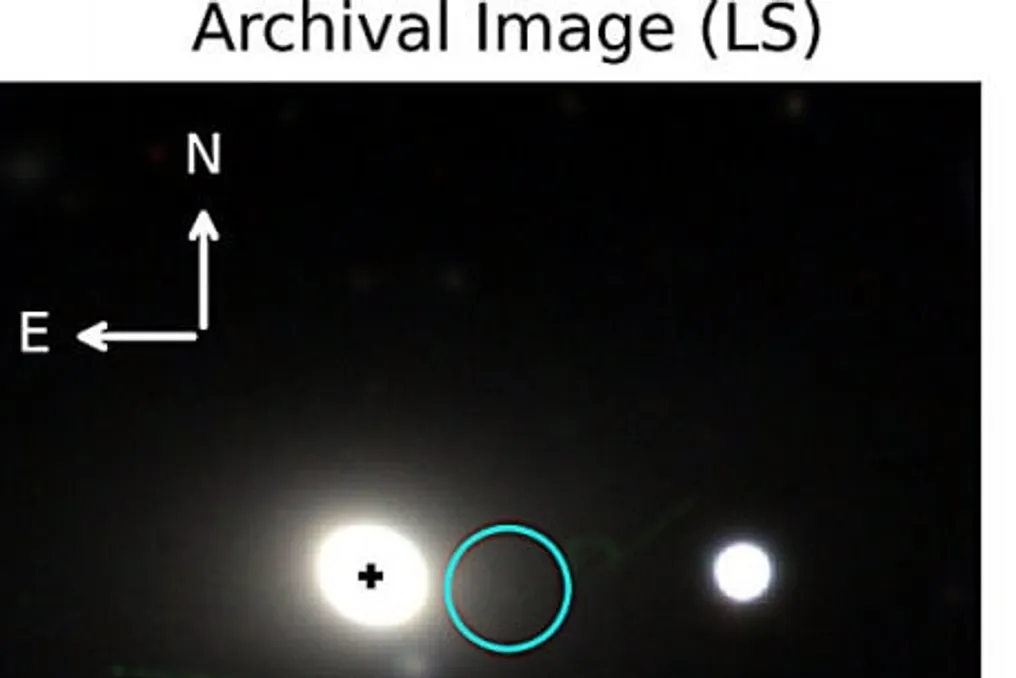
Researchers from the University of Warwick analyzed a rare episode of activity in the Swift J1727.8−1613 system and concluded that black holes are capable of ejecting a substantial amount of the matter they absorb. The work was based on observations made using the Very Large Telescope (VLT) of the European Southern Observatory.
The observations meticulously recorded a flare that occurred in 2023 when the system became one of the brightest sources of X-ray radiation in the sky. The results, published in the Monthly Notices of the Royal Astronomical Society on Thursday (the 30th), show that in addition to attracting gas from a neighboring star, the black hole also returns some of this material back into space through jets and winds, and this behavior persists even after the activity level drops to a very low level.
Black holes do not function as a 'bottomless pit'
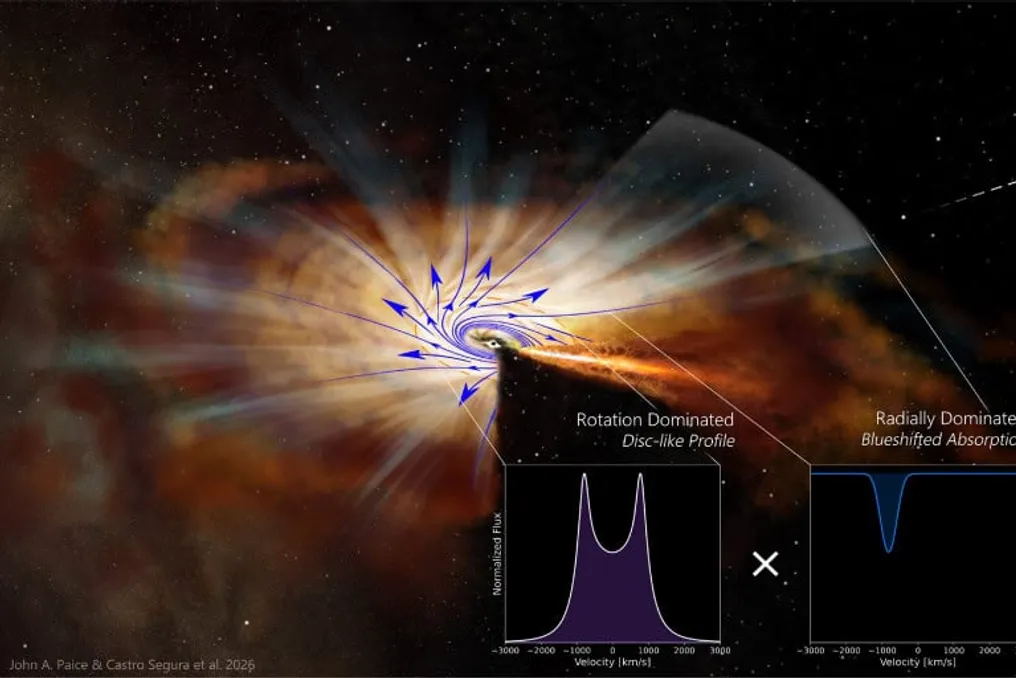
Black holes are traditionally described as objects that absorb everything that approaches them. However, according to the scientists, the observed behavior in the Swift J1727.8−1613 system is much more complex. The lead author of the study, Dr. Noel Castro Segura, a postdoctoral researcher at the University of Warwick, noted that the matter is captured by the system, undergoes an internal process, and a significant part of it is then ejected back. For the scientists, this indicates that these objects act more like a 'cosmic digestive system' rather than simply structures that accumulate matter.
The team used the X-Shooter instrument installed on the VLT to record one of the most detailed optical sequences obtained during such a flare. Instead of analyzing individual moments, the researchers were able to track changes in the system across various phases of activity. The system consists of a black hole that pulls gas from a nearby star, forming a disk of superheated material around itself. Since the 2023 flare was observed almost in real-time, it was possible to trace the evolution of this process with a rarely achieved level of detail. During this period, the researchers found that while the black hole emitted a powerful jet, the feeding disk was also undergoing significant changes. This relationship provides new insights into how matter falling into a black hole is connected to the material being returned to space.
Winds continued even after the decline in activity
The most surprising result appeared after the most intense phase of the flare ended. Even when Swift J1727.8−1613 showed only about one-hundredth of the peak activity, researchers found evidence that dense gas continued to be ejected from the system. The authors point out that this suggests that black holes can sustain intense flows of matter for much longer than previously thought. In some cases, the volume of material ejected into space may be comparable to the volume actually absorbed by the black hole itself.
According to Dr. Noel Castro Segura, this behavior could mean that black holes are less efficient at consuming matter than previously believed, as a significant portion of the captured material may never reach the object itself. Researcher Kyle Solomons, a postgraduate student at the University of Cape Town and participant in the study, emphasized that the final phase of the flare was also characterized by high activity. He noted that even when the X-ray emission dropped to a fraction of its peak value, the system still possessed enough energy to generate a large gas ejection. The authors conclude that the complete tracking of the Swift J1727.8−1613 activity cycle provides one of the most detailed pictures of how black holes capture matter, react to this process, and influence their surroundings.