Chinese material science specialists have developed a functional living fabric made from mycelium. This material possesses self-healing and self-cleaning properties. By using genetically modified yeast, the fabric can be dyed in various colors, and hyphae from another fungus provide protection against ultraviolet radiation. These findings were reported in the journal Science Advances.
Development of Mycelium Materials
Although mycelium-based materials have been used for the past decade to create furniture, packaging, footwear, clothing, and even eco-friendly coffins, mycelium is most often subjected to thermal treatment or prolonged drying. This results in a leather-like material that, while biodegradable, is significantly less durable. Although living mycelium materials and devices are more complex to produce and less common, this area of research is not entirely new.
Creation of Programmable Fabric
Under the guidance of Chao Zhun from the Shenzhen Institute of Advanced Technology, Chinese material scientists combined two different approaches to create wearable programmable fabric from living mycelium. The authors first grew granules of the fungus Cordyceps militaris mycelium, and then formed thin sheets from them. Initially, the material was too brittle, so glycerin was added to the composition before rolling. After testing various compositions, the team settled on a concentration of ten mass percent glycerin, which increased plasticity by about one and a half times without significantly reducing strength.
Functionality of the Living Material
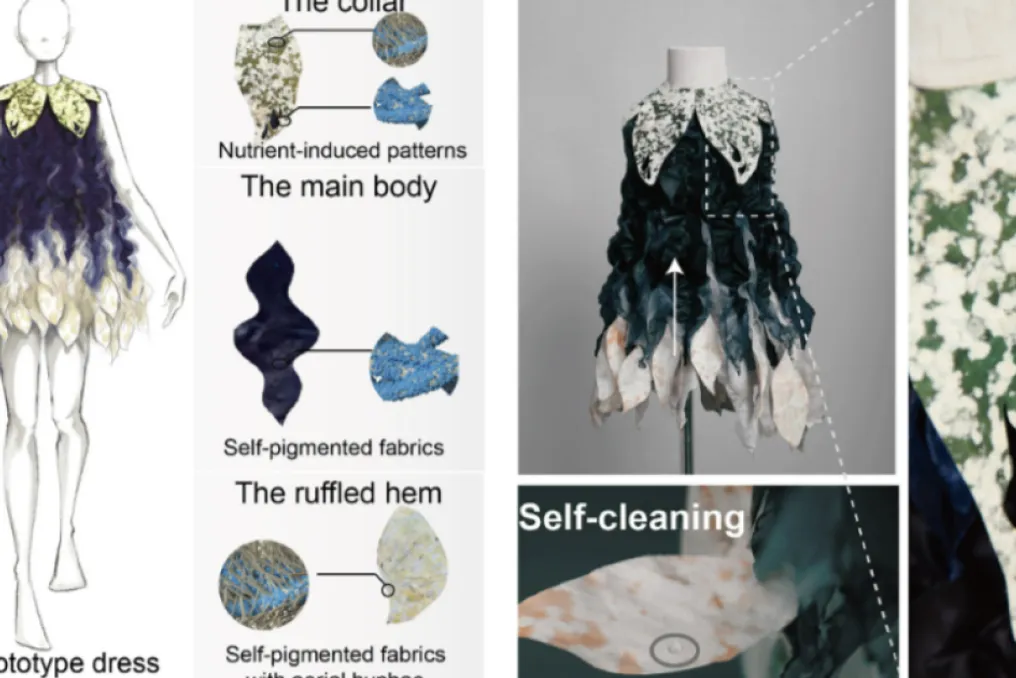
Since the fungal cells in the thin sheet remained viable, the fabric retained the potential for further growth. When nutrient medium was applied to specific areas, new aerial hyphae began to develop. Furthermore, the fabric has repair capabilities: holes can be closed by adding fresh mycelium granules, which securely fix to the original material upon drying via hydrogen bonds. Minor damage can heal itself simply by lightly spraying the material with water. The authors also noted that the resulting aerial hyphae give the surface hydrophobic properties, causing water droplets to form spheres and easily roll off, carrying away contaminants.
Dyeing and UV Protection
To change the color, researchers used genetically modified yeast, Saccharomyces cerevisiae. These yeasts attach to the mycelium surface and produce pigments of various shades. Different strains of yeast synthesize red, blue, purple, or orange pigments, allowing the fabric to take on the desired color without using traditional dyes. Protection against ultraviolet light was provided by another fungus, Aspergillus niger. Its melanin-rich hyphae form an additional living layer on the surface of the fabric that effectively absorbs ultraviolet radiation.
Application and Economics
The researchers manufactured a dress from the resulting sheets, whose parts were joined without the use of threads or glue; after wetting, they bonded strongly due to hydrogen bonds. The dress, dyed with yeast and containing no metal or plastic elements, is completely biodegradable and decomposes entirely in compost in just forty days. The authors assessed the potential for industrial implementation of the material. They predict that with an annual output of thousands of tons of fabric, the cost will be around $13 per square meter, with nearly 40% of the expenses attributed to the nutrient medium for fungal cultivation. The researchers believe this figure can be lowered by replacing some ingredients with inexpensive agricultural waste.