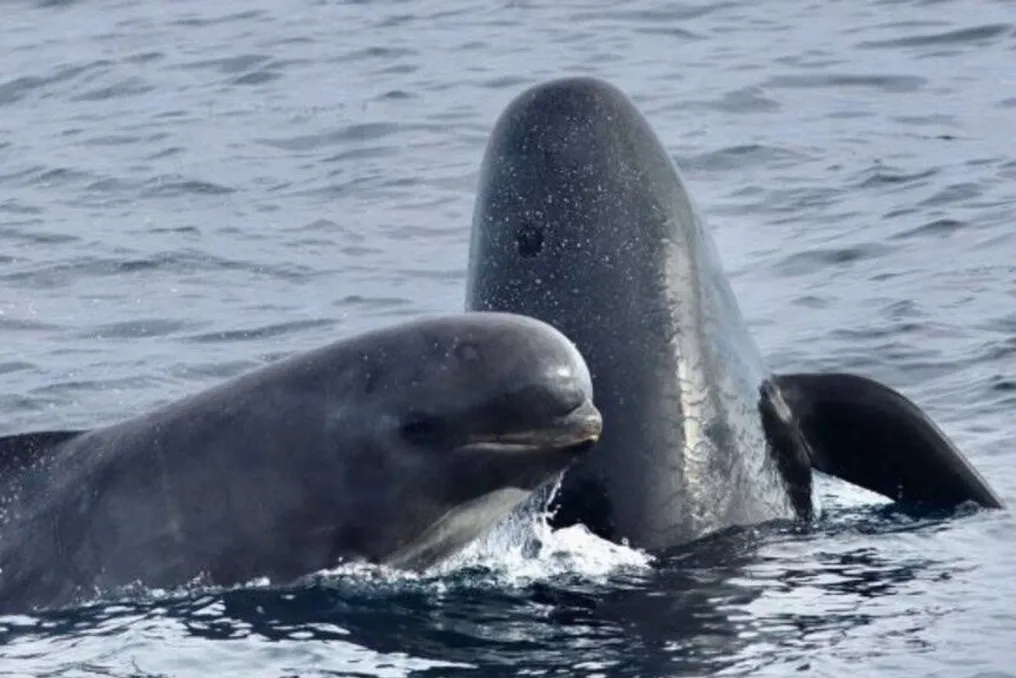
Researchers observed an unusual behavioral pattern over more than two decades between two species of cetaceans: orcas (Orcinus orca) tend to avoid encounters with long-finned pilot whales (Globicephala melas), even without records of direct attacks between them.
Study points to sonic influence
This discovery was examined by scientists from various institutions, including a team led by marine biologist Anna Selbmann, who works at the Sudurnes Center for Science and Learning in Iceland. A study published in Science Reports this January suggested that the noises produced by pilot whales are sufficient to modify the behavior of orcas.
The data was compiled in areas of Iceland and other locations where both species were sighted. The reason why a generally dominant predator retreats before a smaller animal still lacks a final explanation, although researchers have formulated several hypotheses.
History of observations
The interaction between the two species began to attract scientific interest after observations started in 2012. At that time, it was noted that orca sounds reproduced in the natural environment attracted pilot whales, signaling a strong reaction to the acoustic stimuli of another cetacean.
Two years later, an analysis conducted by scientists affiliated with the Spanish National Research Council revealed a surprising piece of data. By reviewing encounters that occurred between 2004 and that period, the team found that orcas moved away from the area as soon as the pilot whales appeared.
Detailed behavior analysis
This phenomenon generated curiosity among specialists, as there was no clear ecological justification for such distancing. The species did not share the same diet, there were no reports of mutual hunting, and the pilot whales were significantly smaller than the orcas.
One theory raised by the scientists was the possibility that past conflicts had established a defensive response transmitted through generations, but this view lacks robust proof for confirmation.
To investigate the behavior more rigorously, researchers analyzed information collected between 2007 and 2020 in six locations in Iceland, using data from scientific platforms and whale watching tours.
The results showed that, in 24 recorded encounters, orcas avoided contact 68% of the time, moving away before the pilot whales approached. In the remaining 28% of cases, the two species engaged in quick chases, reaching speeds of up to 13.5 knots, which is equivalent to about 25 km/h.
Direct response to calls
Subsequently, scientists tried to determine whether the orcas' reaction was motivated by the physical presence of the pilot whales or by other elements associated with the encounters. To do this, they played back recordings of the animals' sounds to orcas being monitored by tracking equipment.
The response obtained indicated a direct reaction to the pilot whales' calls. The orcas altered their group formation, modified their vocal patterns, changed direction, and increased their locomotion speed.
According to the researchers, sound signals play a crucial role in the interaction between the species. The team responsible for the study stated that acoustic responses work in both directions: pilot whales approach upon hearing orcas, while the latter exhibit avoidance behavior in response to the former's calls.
Final hypotheses on fear
There is still no definitive consensus on the reason for this fear. Among the considered explanations is the behavior known as 'mobbing', in which smaller animals unite to harass or drive away a potential predator. This mechanism is common in birds, but can occur in other groups.
Other possibilities remain under analysis, such as indirect competition for resources or offspring protection. Despite the lack of a final conclusion, this case illustrates that size and position in the food chain do not always define who dictates the dynamics of an interaction between wild animals.