The Kimi K3 technical report details infrastructure, including MoonEP, KDA, and AttnRes. However, the true differentiator remains the engineering expertise behind the implementation of MFU, expert parallelism, and shared experts.
The Kimi K3 technical report details infrastructure, including MoonEP, KDA, and AttnRes. However, the true differentiator remains the engineering expertise behind the implementation of MFU, expert parallelism, and shared experts.
Artificial intelligence infrastructure acts as an operating system connecting hardware and applications. When developers use proprietary models, costs are significantly lower than using third-party solutions, which is due to the gap in infrastructure experience. OpenAI engineer Weng Jiayi noted that the main problem in training is precisely related to infrastructure, and engineers are primarily engaged in debugging this area.
As architectures converge and distillation lowers reproduction barriers, it is infrastructure engineering that determines training cost, deployment efficiency, and stability. One hundred companies utilizing Kimi K3 can achieve one hundred different levels of efficiency. Infrastructure errors include both traditional flaws affecting correctness and stability, and systemic issues that do not violate mathematical accuracy but lead to GPU downtime, memory loss, communication blocking, and reduced throughput.
The model's FLOPs utilization rate measures training efficiency as the ratio of observed throughput to theoretical maximum. Publicly verifiable large-scale training cases demonstrate that ByteDance MegaScale achieved an MFU of 55.2%, which is one of the highest recorded results. As a counterargument, information is provided that xAI, using about 550,000 H100 GPUs, reported an MFU of only 11% according to internal memos, which is significantly below the industry standard of 35–45% and the figures from competitors Meta (43%) and Google (46%). Higher training efficiency directly leads to shorter training cycles, reduced costs, increased experimentation, and scaling of data or models.
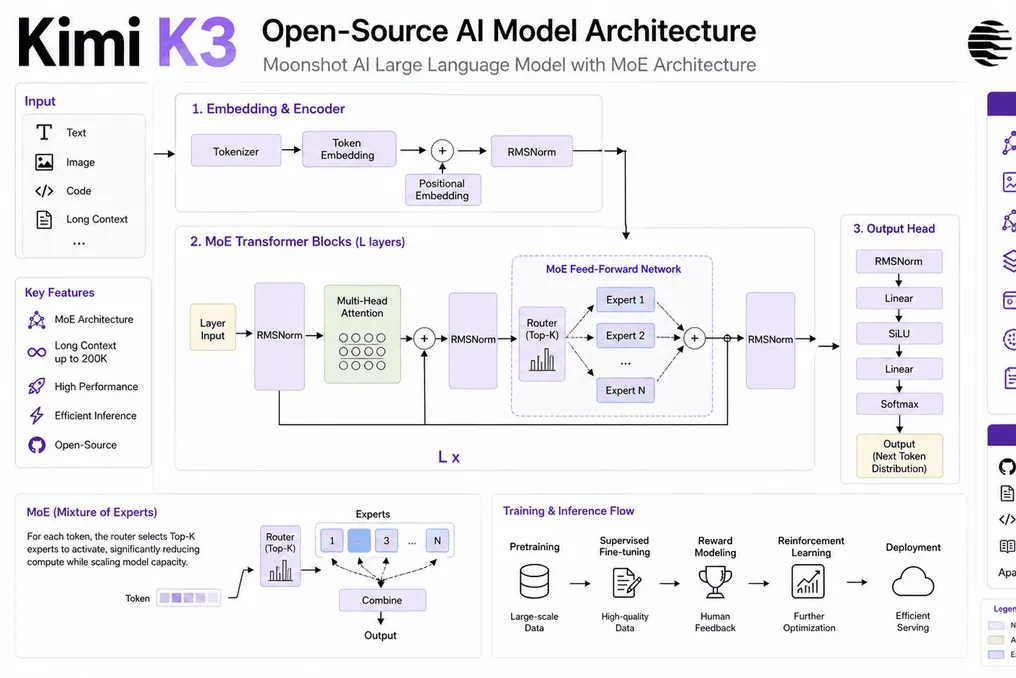
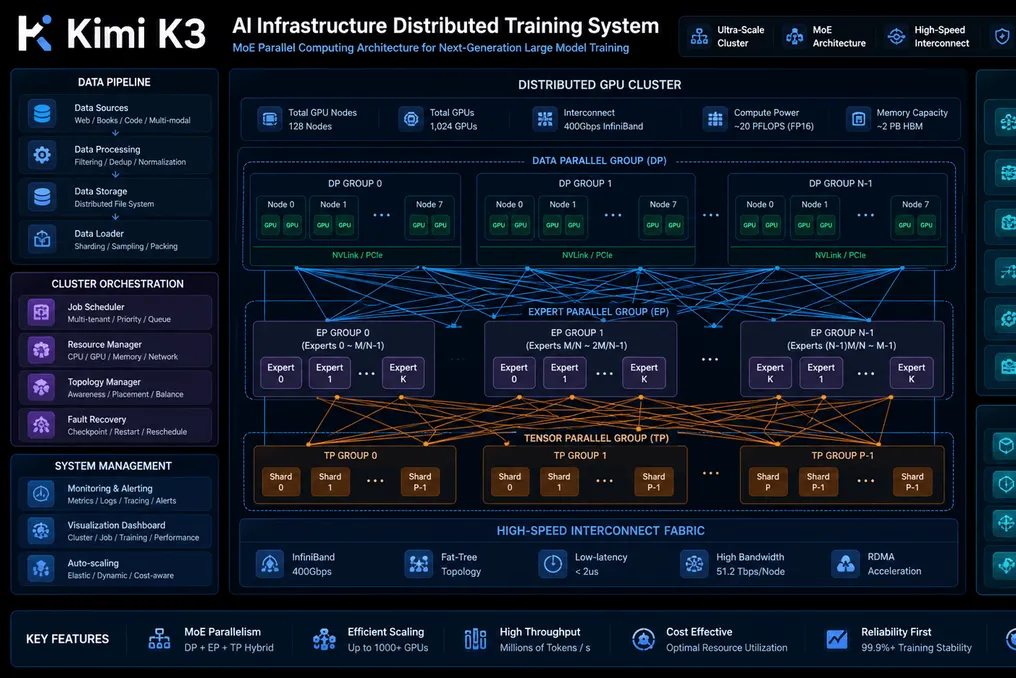
The Kimi K3 distributed system employs classic parallelization methods such as pipeline parallelism, expert parallelism, and ZeRO sharding. Pipeline parallelism distributes model layers across GPUs using micro-batch processing to reduce downtime caused by pipeline 'bubbles'. Tensor parallelism splits weight matrices and operations across GPUs, requiring high GPU interconnect bandwidth. A crucial detail is that MoE layers use shared experts replicated across EP ranks, meaning each GPU contains identical shared experts plus various routed experts, allowing shared experts to learn common features in the data. The KDA and AttnRes architectural mechanisms combine with corresponding infrastructure design, while MoonEP addresses unique challenges of expert parallelism in MoE architectures. When working with larger models, problems appear that are unnoticed in smaller models, as previously unrecognized computational processes or memory objects become significant relative to GPU capacity upon scaling.
Open access to weights democratizes model usage, but not infrastructure competence. Differences in deployment costs, amounting to several orders of magnitude, create a structural advantage for the developer in the training and inference economy. This report serves as both a knowledge exchange and a signal of competitive capabilities: the architecture can be studied, but engineering experience at a scale of 2.8 trillion cannot be conveyed through documentation. Model capabilities are increasingly becoming a commodity, while infrastructure perfection transforms into a long-term defensive advantage.
Moonshot AI has officially released the open-source Kimi K3 model. This model features 2.8 trillion MoE parameters, incorporates 896 routed experts, supports 16 active experts per token, and boasts a context window of 1 million tokens. Additionally, the infrastructure tools MoonEP, FlashKDA, and AgentEnv have been released.
The launch of Kimi K3 occurred on July 27th. The model has become the largest in the world among open-weight models. Compared to the previous generation K2.5, the parameter scale of K3 has increased by approximately three times, and computational efficiency has risen by 2.5 times due to the use of Kimi Delta Attention, Attention Residuals, and MoonEP technologies, enabling operation under limited computational resources.
The technical report reveals several architectural novelties. The hybrid KDA attention structure combined with Gated MLA merges linear attention for efficient long-context processing and gated multi-head latent attention for high-quality local representation. The Stable LatentMoE routing mechanism addresses the expert collapse problem often encountered when training large MoE models by stabilizing the router's gradient dynamics. Furthermore, the MoonViT-V2 vision encoder training scheme ensures native multimodal interpretation without the need for separate vision and language adapters. The model was trained and tested on universal reasoning, agent, and coding tasks, demonstrating K3's broad capabilities beyond purely linguistic tasks.
In addition to the model itself, three infrastructure tools were opened up. MoonEP is a high-performance communication library designed for large-scale MoE training, which eliminates the all-to-all communication bottleneck that limits MoE scalability. FlashKDA provides a high-performance computation kernel for Kimi Delta Attention; benchmarks show it achieves a prefill speed improvement from 1.72x to 2.22x on the H20 GPU compared to the baseline flash-linear-attention. AgentEnv is an agent sandbox system developed using KVCache.ai, supporting fast snapshot creation, restoration, and forking for large-scale agent training environments. These infrastructure releases lower the barrier for reproducing and further developing K3-class models.
The open-source release has significant implications for the ecosystem. K3 meets or surpasses closed state-of-the-art models such as GPT-5.6 and Claude Fable 5 across several specific tests, particularly in frontend code generation. Moreover, the cost of using K3 via API is 40% lower than Claude and 70% lower than Fable. The open-weight license allows for local deployment and the development of proprietary applications without API dependency. However, due to its 2.8 trillion parameter scale, even local implementation requires substantial hardware—at least 10 GB300 class GPUs just to load the model, making inference infrastructure costs the primary factor in deployment, rather than API fees.
This release triggered a chain reaction in the ecosystem. Alibaba Cloud's Qianwen AI platform announced K3 availability. Huawei announced the adaptation of Ascend 0-day for K3, marking the first instance of launching a 3-trillion-level model on domestic hardware. The open-source community gained access to model weights that previously required hundreds of millions in investment to reproduce. Moonshot AI stated that the open-source initiative aims to advance the open-weight model ecosystem, lowering barriers to development and deployment for the broader AI community. However, shortly thereafter, it was announced that K3 suspended new user subscriptions due to computational capacity constraints, highlighting the contradiction between open-source ideals and the reality of serving a 2.8 trillion parameter model at scale.
The Kimi K3 model from Moonshot AI has demonstrated significant technical progress, ranking third in the global artificial intelligence rating, yet its path to a breakthrough comparable to DeepSeek's is complicated by issues of pricing, computational limitations, and ecosystem maturity.
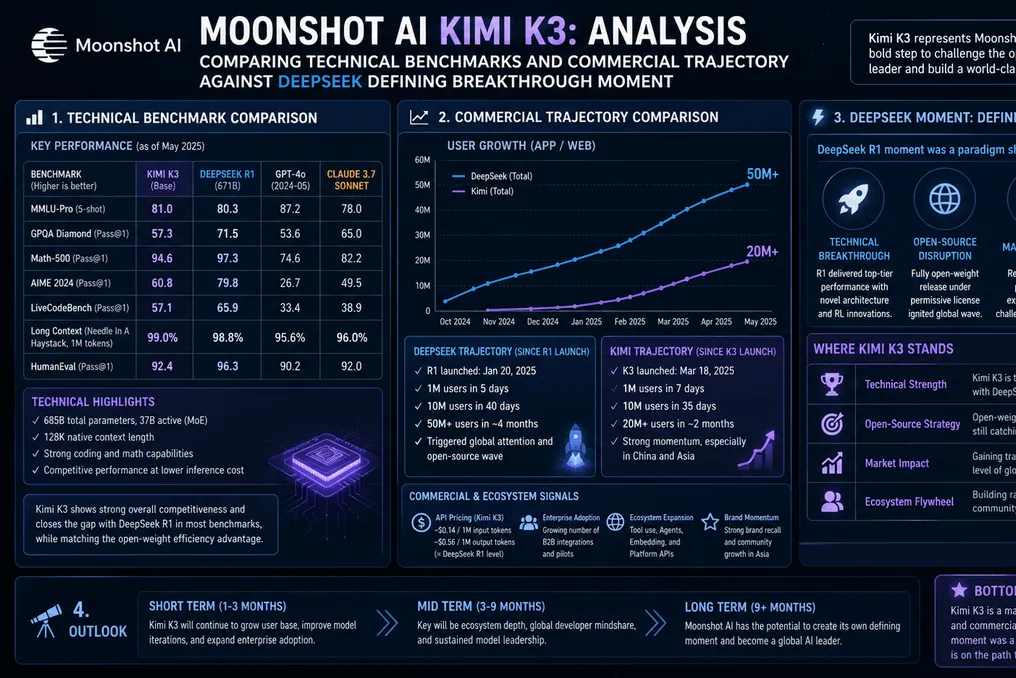
Kimi K3 leads global coding benchmarks and ranks third overall, trailing only Fable 5 and GPT-5.6. The model has reached a level previously unattainable by Chinese large models, securing third place in the AI rating and even surpassing Fable 5 in the Arena 2026 frontend coding benchmark. Elon Musk called this result impressive, and global media dubbed it the 'Second DeepSeek Shock.'
On the Artificial Analysis platform, Model K3 holds the third global position. It is built on a Mixture-of-Experts architecture with 896 experts, features 2.8 trillion parameters, supports a native context length of 1 million tokens, and utilizes the KDA attention mechanism. The model shows high efficiency in tasks related to coding, agent work, and long-context reasoning, which has direct commercial applications. Nevertheless, compared to leading closed-source models, K3 still exhibits measurable gaps in complex reasoning and multimodal tasks.
A significant obstacle is pricing: K3 costs 3 to 15 times more than DeepSeek per million tokens. While this confirms the ability of Chinese AI to command premium prices, it limits the viral growth of the ecosystem that DeepSeek achieved through ultra-low access costs and mass adoption.
The most critical bottleneck is computational constraints. Although K3 was trained with surprisingly efficient resource utilization, shortly after its release, Kimi was forced to suspend new consumer subscriptions due to enormous inference demand. A single K3 query requires approximately 1.4 TB of memory even after low-precision quantization. Moonshot AI is actively working to scale up computing power, but the gap between demand and available infrastructure remains the main factor separating K3 from sustained market influence. These limitations also hinder commercial deployment, as enterprise clients require guaranteed inference throughput that Moonshot AI cannot yet provide at scale.
The key difference in DeepSeek's breakthrough moment was not just the quality of the model itself, but the creation of a self-sustaining cycle: mass user adoption stimulated the growth of the developer ecosystem, which in turn improved the model's capabilities and led to further adoption growth. Kimi K3 has achieved the technical prerequisite but has not yet launched this 'ecosystem flywheel.' The coming weeks will determine whether Moonshot AI can overcome the computational barrier, transform technical admiration into stable commercial relationships, and build a developer ecosystem that turns an excellent model into a full-fledged platform. Engineering capabilities are proven, but the business model and infrastructure strategy are still under development.