Shen Hua, co-founder of LimX Dynamics, asserts that the motion control technology for humanoid robots is reaching a point of convergence, shifting industry focus from demonstrating capabilities to practical deployment in real-world scenarios.
Shen Hua, co-founder of LimX Dynamics, asserts that the motion control technology for humanoid robots is reaching a point of convergence, shifting industry focus from demonstrating capabilities to practical deployment in real-world scenarios.
According to Shen Hua, technological development in humanoid robot motion is nearing completion, and bottlenecks are narrowing. The main emphasis has shifted from hardware and motion control to generalization, which encompasses the coordination of the body, cerebellum, and brain. The WAIC 2026 exhibition marked a clear transition from showcasing technologies to exploring deployment possibilities, where integrators tested palletizing and machine servicing tasks, and guidance and performance applications confirmed commercial value. This shift is driven by both hardware improvements and progress in artificial intelligence models.
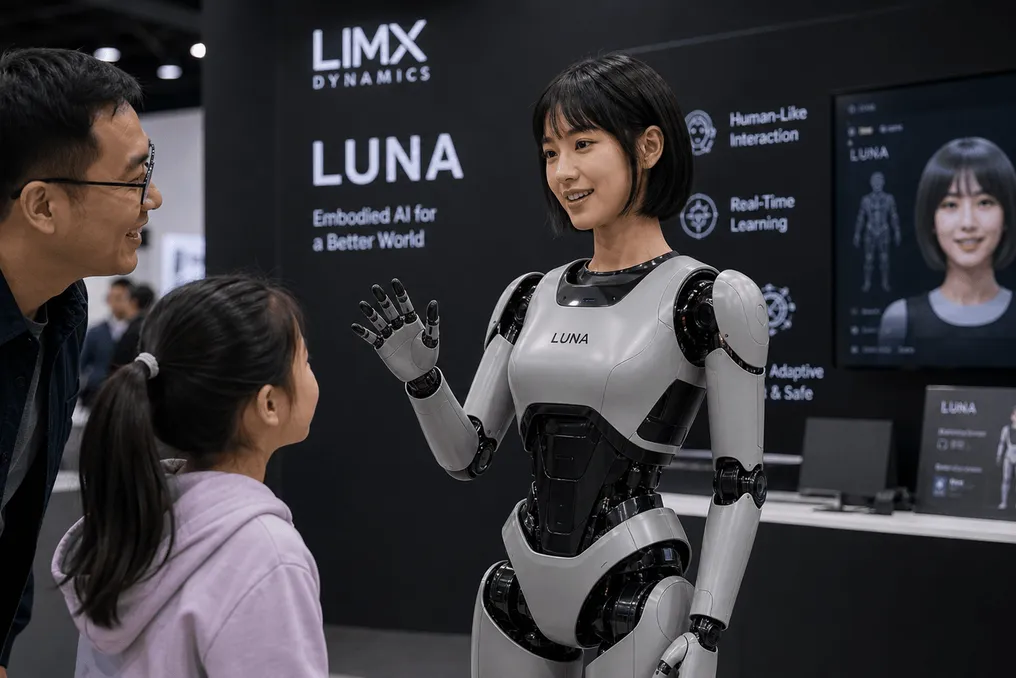
Founded in 2022 by Professor Zhang Wei of SUSTech in Shenzhen, LimX Dynamics has developed a three-pronged strategy. It includes Luna—a full-scale interactive humanoid robot; modular TRON 2 robots for task execution; and the LimX COSA 0.5 brain system for long-term complex operations. The FluxVLA Engine embodied intelligence infrastructure provides a standardized foundation for data, training, simulation, and deployment on real robots, allowing industries to develop VLA models without needing adaptation for each project.
Shen Hua refuted a common industry belief that the cerebellum lags behind the brain. He stated that in some aspects, the robot's ability to control motion, which is related to the cerebellum, has reached parity with the capabilities of the brain and the body hardware. The critical issue is no longer improving one module's capabilities but integrating the brain, cerebellum, and body: combining task understanding and decision-making, motion control, and robot hardware to achieve true embodied intelligence. The cerebellum remains closely tied to the physical body, requiring adaptation when motor selection or joint architecture changes, but the bottleneck has become systemic integration and scenario fit.
LimX Dynamics' trajectory from a motion control specialist to an AI systems company reflects the evolution of the entire industry. The initial focus on the body was based on the assumption that embodied intelligence requires physical interaction with the world through a specific body, and motion control itself is part of the model's capabilities. The company has invested in brain-level models, including VGM for video-based robot training and DreamActor for the real-to-simulation-and-back learning paradigm. As embodied intelligence enters the deployment phase, the industry must address issues of stability and predictability of capabilities, which requires rethinking the robotic intelligence architecture at a systemic level. Shen Hua summarized the next stage: once motion control ceases to be the primary barrier, competition among humanoid robots will depend not only on models and technologies but also on who first finds truly viable use cases and achieves product-market fit. The industry is moving from the question of what robots can do to how robots enter real environments and create value.
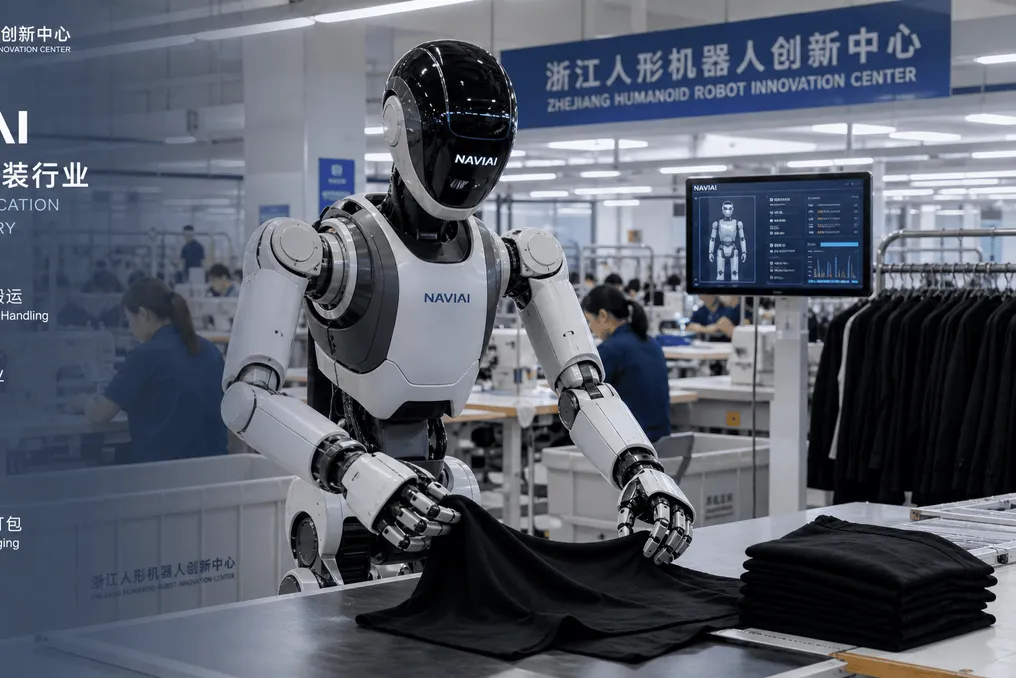
The Zhejiang Humanoid Robotics Innovation Center, established in December 2023 in Ningbo with support from the municipal government and the team of Professor Shun Zhong from Zhejiang University, is at the forefront of commercial humanoid implementation. The NAVIAI line from this center, which utilizes 90% domestic components, is successfully operating in the facilities of SUPCON, GREE, JACK, and FOTILE.
In April 2026, a landmark contract was signed with Jack Technology to supply 2000 units of robots for clothing manufacturing, marking the first batch for global application in the apparel sector. These robots are capable of achieving 98% fabric separation, performing operations in 3 seconds, and ensuring alignment with an error margin of plus-minus 2 mm, approaching 80% of human efficiency.
The NAVIAI product line includes three types of form factors. Stationary robots are designed for clothing manufacturing workstations where movement is not required and feature a lower cost. Wheeled arm robots, such as NAVIAI-WA2, are equipped with an advanced bionic arm with 8 degrees of freedom, providing a re-positioning accuracy of plus-minus 0.02 mm, 6 hours of autonomy, and the ability to overcome obstacles up to 20 degrees. Bipedal robots are used for security patrolling, exhibition escort, and entertainment, as they can climb stairs and navigate obstacles.
The brain of these robots combines an autonomous cognitive system for planning and perception with a real-time control system analogous to the cerebellum. In May 2026, the RAM system was introduced—a three-dimensional spatial model developed jointly with CUHK and Zhejiang University—which supplements large models with accessible 3D knowledge to connect semantic reasoning and precise manipulation.
International expansion accelerated in 2026. The first major deployment occurred at the BEKO refrigerator factory in Turkey, where the European appliance manufacturer chose quality control as the initial scenario. The Zhejiang Center provided the hardware and software and participated in joint on-site engineering work. In March 2026, at the LogiMAT exhibition in Germany, the NAVIAI-WA2 operated continuously for three days without failure during a smart logistics demonstration involving KION Group, a giant in industrial vehicles and supply chain solutions. In July, the center participated in the IPLUSMOBOT event at AUTOMATE 2026, North America's largest robotics exhibition, where the full-sized bipedal NAVIAI-I2 was showcased. It performed precise sorting, autonomous walking, and voice interaction in fluent English with a response delay to audience questions of less than 3 seconds.
CTO Xu Xuecheng explained the company's strategy: first perfecting products within the internal operations of foreign groups, and then mass-producing them in Europe and North America. The company focuses on performing tedious and dangerous tasks rather than replacing jobs that employees fight for. NaviStore retail kiosks offer guide functions, cup dispensing, and ice cream preparation with a 3-second voice delay, 98% recognition, and 99.9% capture success. Xu predicts the emergence of home humanoids in about a decade. Chinese humanoid robotics is transforming from equipment demonstration to business model validation.