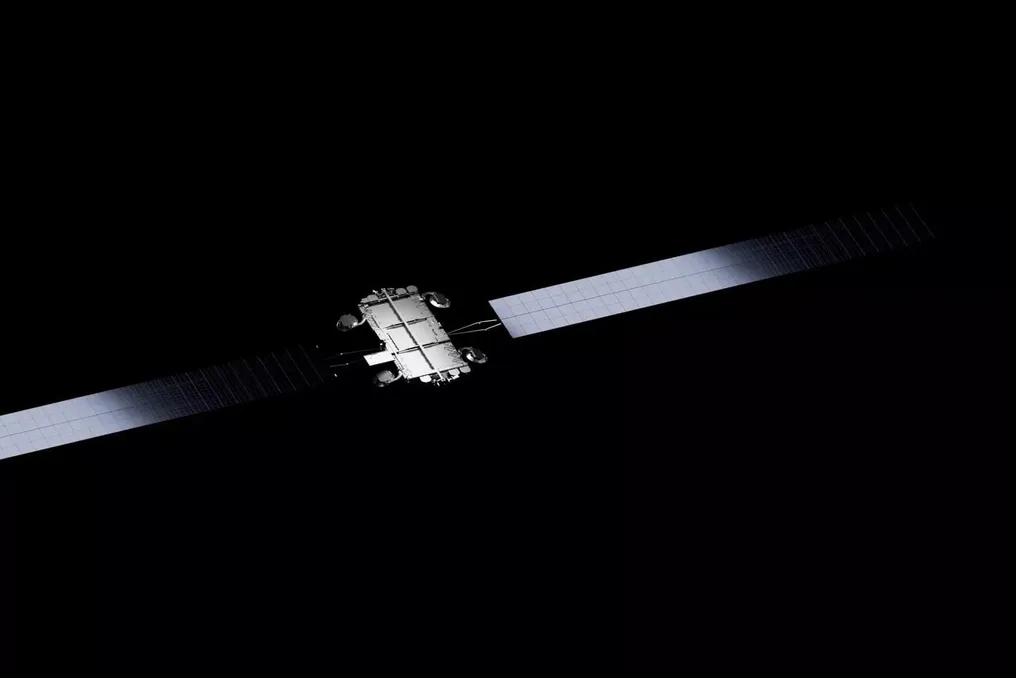
SpaceX released a new video showing the Starship spacecraft in full space flight, captured during the 13th rocket test on July 24. The footage was obtained by one of the new Starlink V3 satellites, which monitored the vehicle's trajectory after being deployed during the mission.
According to the company, six of the launched satellites were equipped with cameras designed to document the performance of the upper stage of Starship's thermal shield. The material also provided detailed information about the craft's flight, including the operation of some of its engines and attitude control systems during the operation.
Details of the craft shown in the video
The 65-second video presents recordings made by four cameras located on a single Starlink V3 satellite. Initially, the Starship is shown in a closer shot. As the separation between the two vehicles increases, the craft becomes visible in its entirety.
The images also show that three of the six Raptor engines remained operational at certain moments of the flight. Furthermore, small jets of white vapor indicate the use of thrusters responsible for precise orientation adjustments of the craft in space.
The satellites remained briefly in orbit
The 13th Starship test flight followed a suborbital trajectory, adhering to the pattern of previous missions in the program. The main distinction of this event was the launch of 20 functional Starlink V3 satellites, reaching space for the first time.
Since the mission did not reach orbit, these satellites returned to Earth approximately twenty minutes after being released. However, SpaceX plans to use future versions in orbital missions. A document submitted to the U.S. Federal Communications Commission (FCC) indicates that the company aims to operate a constellation composed of one hundred thousand Starlink V3 satellites. Currently, the network has almost eleven thousand Starlink satellites, and the new V3s weigh about two tons each (4,400 pounds), making them larger than the V2 models.
Although the mission was successful, the Super Heavy booster encountered setbacks during its return. During the landing burn, only five of the thirteen planned Raptor engines came online, causing the booster to hit the waters of the Gulf of Mexico at a speed higher than projected. The Super Heavy uses 33 Raptor engines during takeoff.
Despite still being in the development phase, Starship is part of SpaceX's future projects. The rocket is scheduled to participate in NASA's Artemis III mission in mid-2027 and Artemis IV, planned for late 2028.